
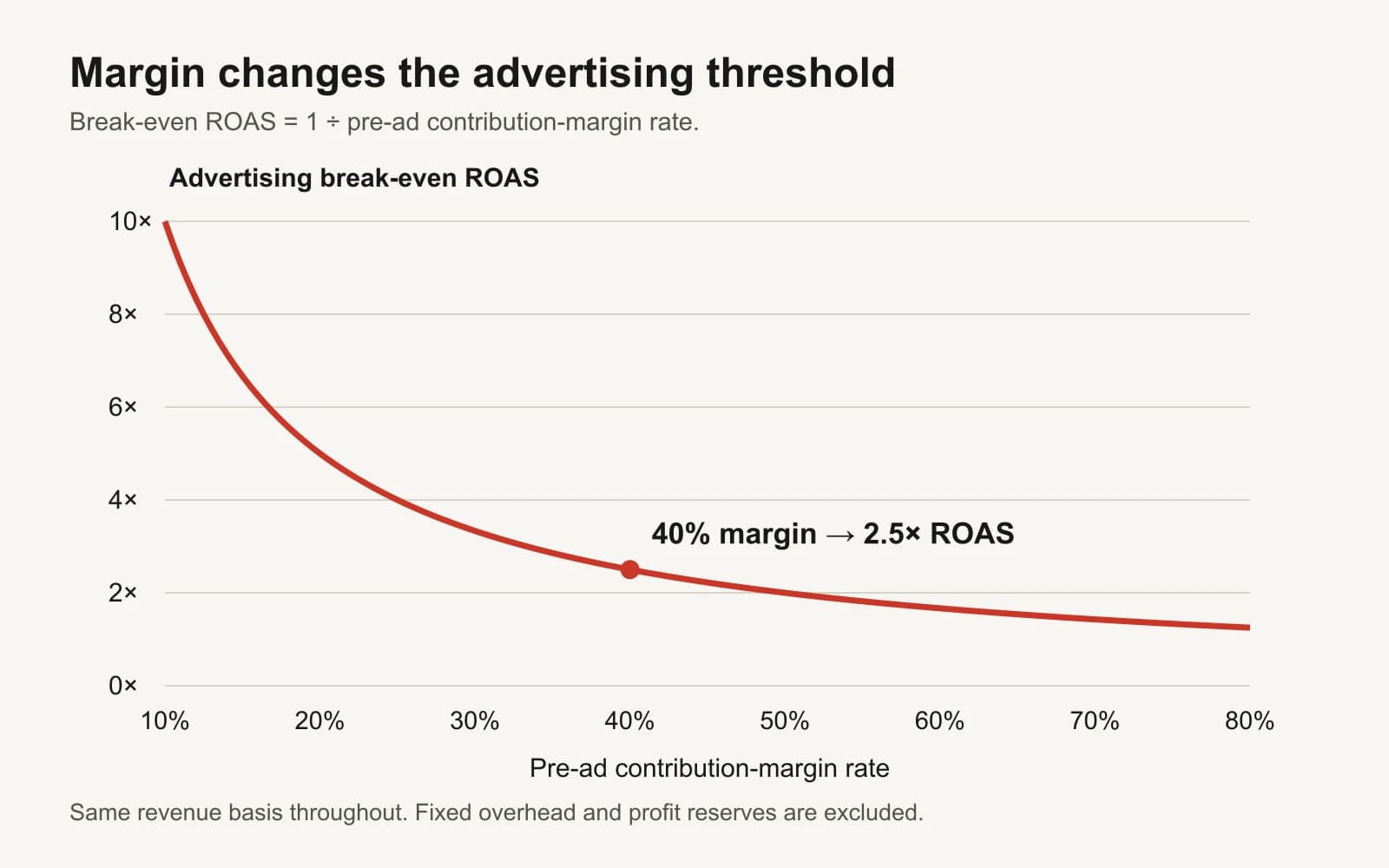
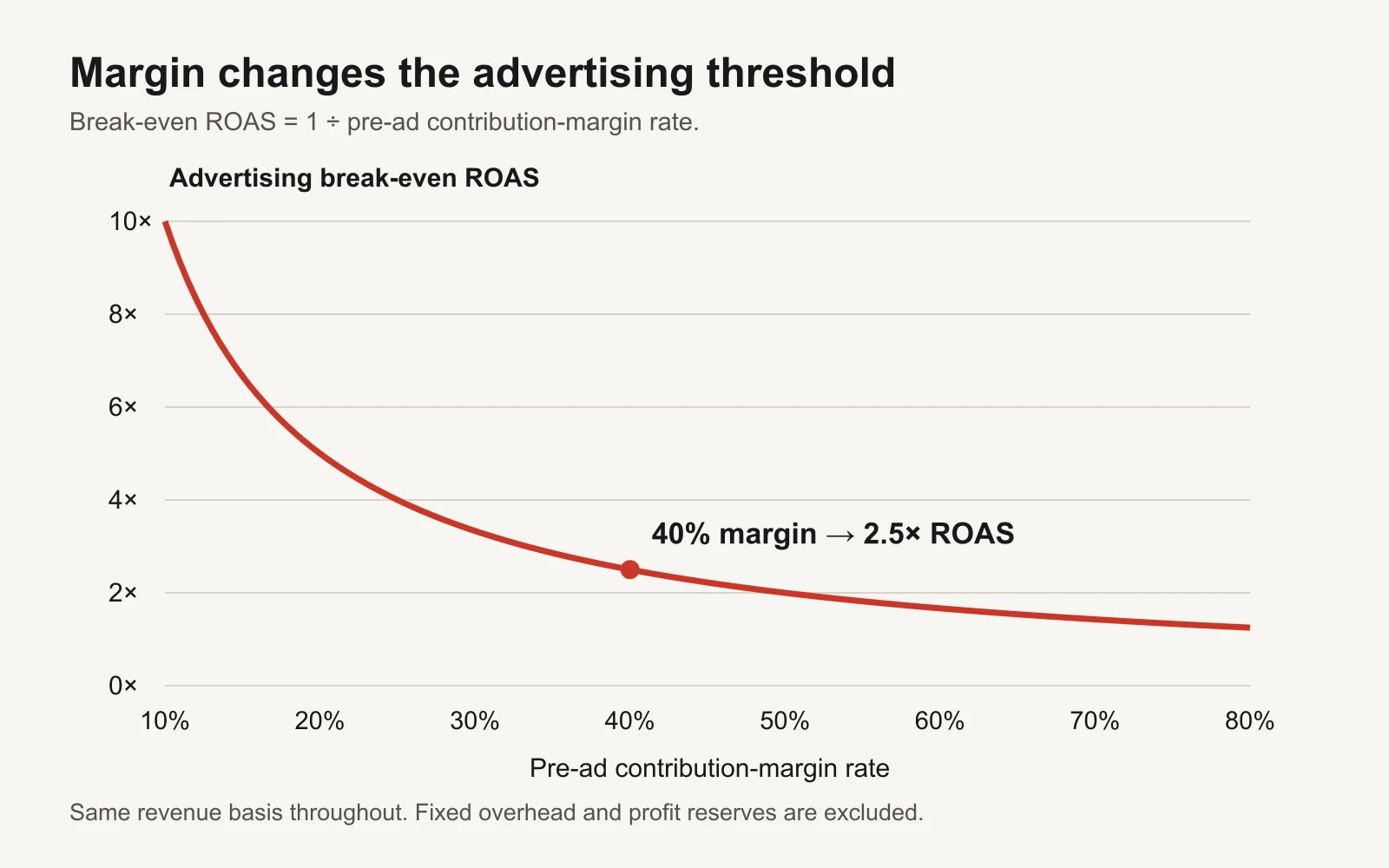
A store targets a 3.0 ROAS because that number sounds healthy. Whether it is healthy depends on what the store keeps from each dollar of revenue before advertising. A high-margin product and a low-margin product can require very different advertising efficiency.
The calculation below is a management-planning model. Use the business's agreed revenue and cost definitions, and have the finance owner confirm what the result covers before turning it into a campaign target.
Use the free break-even ROAS calculator to enter retained revenue, variable costs, and the amount you need to keep. It shows both the pre-overhead threshold and a reserve-adjusted threshold, with a downloadable worksheet.
Define contribution before advertising
Start with the revenue the business expects to retain under the chosen order definition. Subtract the variable costs associated with serving those orders, excluding the advertising cost you are trying to evaluate.
The US Small Business Administration's break-even guide distinguishes sales price, variable costs, and fixed costs. This article applies that basic contribution logic to an advertising threshold rather than to the company's total break-even sales volume.
List product cost, fulfillment, payment fees, shipping subsidy, expected return-related costs, and other relevant variable expenses. Avoid including the same cost twice because it appears in both a product-cost field and a separate operations export.
Use a consistent revenue basis
Decide whether revenue excludes tax, discounts, refunds, and shipping charges. Keep the choice consistent between the contribution calculation and the ROAS numerator.
If the advertising platform reports gross purchase value while your model uses refund-adjusted merchandise revenue, the same numeric ROAS target may not be directly transferable. Build a reconciliation rather than pretending the definitions match.
Use the refund-adjusted reporting guide to keep original purchases and retained revenue visible. Recent return estimates should remain labeled as estimates.
Calculate the margin rate
Pre-ad contribution equals retained revenue minus the included non-ad variable costs. The contribution-margin rate is that contribution divided by the same retained-revenue amount.
For an illustrative order with $100 of retained revenue and $60 of included variable costs, pre-ad contribution is $40 and the contribution-margin rate is 40%.
At $40 of advertising cost per such order, modeled contribution after advertising is zero. The corresponding revenue-to-ad-cost ratio is $100 divided by $40, or 2.5. Equivalently, one divided by 0.40 equals 2.5.
Inspect the full example
| Illustrative order component | Amount |
|---|---|
| Retained revenue under the chosen definition | $100 |
| Product cost | $42 |
| Fulfillment and shipping subsidy | $12 |
| Payment and other included variable costs | $6 |
| Contribution available before ads | $40 |
| Advertising cost at modeled ad break-even | $40 |
| Contribution after ads at that threshold | $0 |
The values are an example, not a benchmark. A different product, shipping policy, return profile, or order mix changes the threshold.
Separate ad break-even from the business target
At the modeled ad break-even point, nothing remains from the included contribution to cover fixed overhead or the business's desired profit. The company may therefore require a stricter operating target.
Suppose the illustrative business wants to retain $15 per order after advertising for overhead and profit under this planning view. Its allowable ad cost becomes $25, and the corresponding revenue-to-ad-cost target becomes 4.0.
That target is a policy choice based on the specified economics. It is not a universal requirement for every business with a similar product category.
Check source-cost coverage
Shopify's profit-report documentation explains that reported product profit depends on recorded costs and describes the cost-per-item field. A platform gross-profit report should not be assumed to include every fulfillment, payment, marketing, or operating cost relevant to your decision.
Reconcile the source report with the model's cost list. Missing cost data is unknown cost, not zero cost. If some variants lack historical cost records, flag their margin estimates rather than treating them as exceptionally profitable.
Handle mixed products carefully
A store-wide average can conceal products with very different contribution. Use a revenue-weighted or order-level calculation that matches the actual mix, rather than averaging product margin percentages without weights.
The product-margin allocation guide helps connect those differences with budget decisions. Also inspect whether the campaign changes the mix as it scales. A target based on last month's high-margin orders may become less suitable if new spend favors lower-margin products.
Do not calculate a meaningful positive break-even ROAS from a zero or negative pre-ad contribution rate. Those economics require a different commercial decision before ordinary ad-cost recovery is possible under the model.
Keep acquisition and attribution limits visible
ROAS can describe platform-attributed revenue, while the business model concerns revenue economically associated with the acquisition decision. Those are related but not identical concepts.
The calculation does not establish that every attributed purchase would disappear without the ad. It also does not automatically distinguish first-time customers from repeat orders. Use the first-order allowable CAC guide when the decision concerns acquiring a new customer.
Keep any repeat-purchase assumptions separate from the first-order threshold. Future contribution can matter, but it should not be invented to justify current spend.
Review the threshold when economics change
Update the model after price changes, promotions, shipping changes, product-cost changes, or a material shift in returns. Save the prior version and effective date so campaign reviews remain understandable.
The useful output is a clear statement: this revenue definition and these costs imply this advertising threshold, with this amount reserved for the business. That gives the buyer a defensible operating target and makes the next budget discussion concrete.