
Your 1-star reviews are your best ads.
Not word for word. But every bad review is a customer telling you, in their own words, the reason they almost didn't buy, or wish they hadn't. The people scrolling past your ads have the same doubts. They just never wrote them down.
Most brands hide those reviews or argue with them. This guide shows how to mine them instead: export your worst reviews, tag the objection in each one, rank the objections, sort out the ones an ad can't fix, and turn the rest into hooks that say the objection out loud before answering it. It is written for business owners, with enough structure for a performance marketer or copywriter to run it on a few thousand reviews.
The workbook takes a paste of your 1, 2 and 3-star reviews, suggests an objection tag for each from editable keywords (you can override any of them), ranks the objections, marks which ones an ad can fix, and writes three hooks for each of your top three, with your product name filled in. It also has a prompt for tagging hundreds of reviews with an AI assistant. The 36 example reviews in the workbook and in this article are a fictional worked example.
Why imperfect reviews sell
The Spiegel Research Center at Northwestern University, working with the reviews platform PowerReviews, studied how reviews affect purchases. Three findings matter here (Spiegel Research Center: How online reviews influence sales):
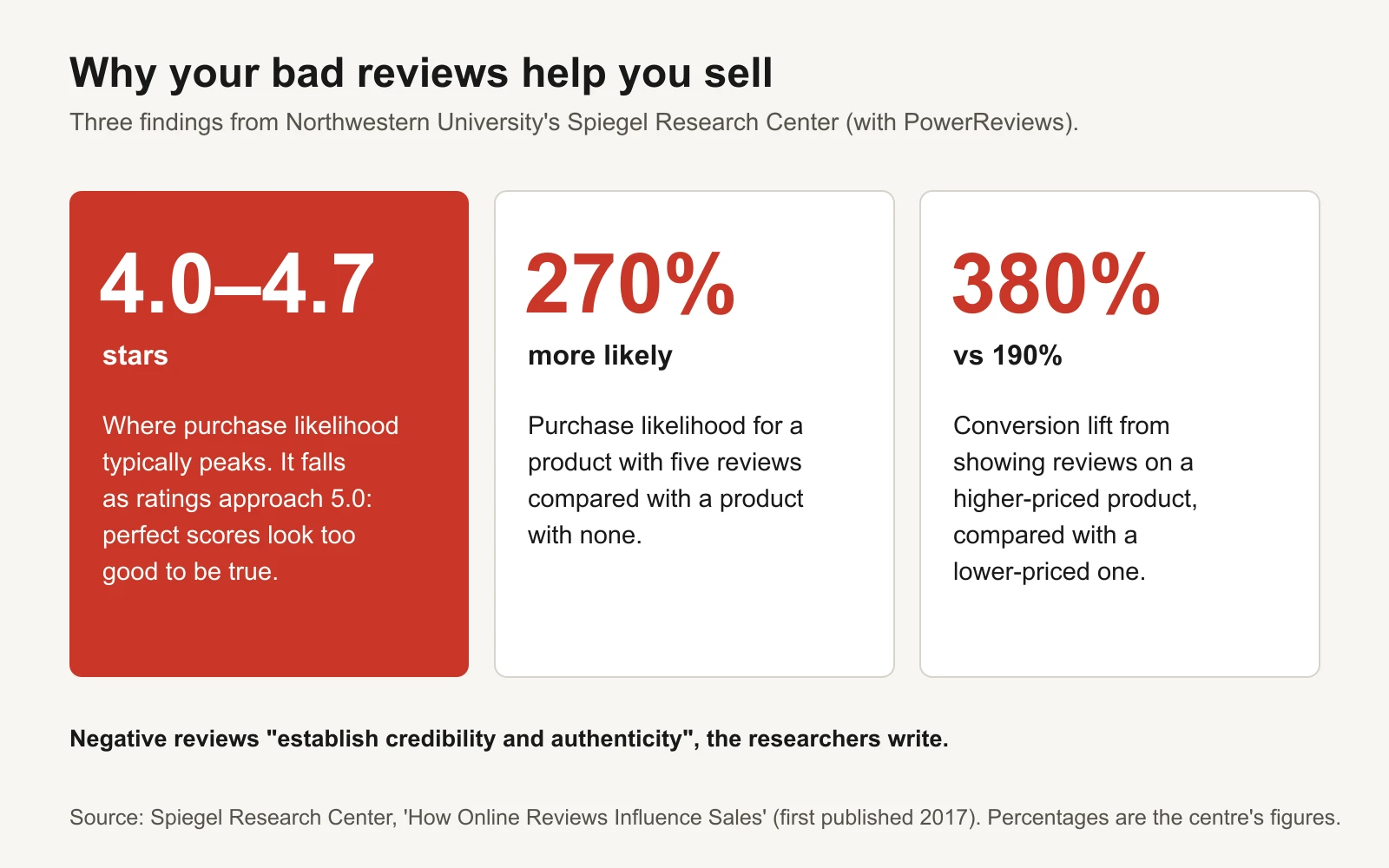
Source: Spiegel Research Center, first published 2017.
- Purchase likelihood typically peaks at ratings between 4.0 and 4.7, then falls as ratings approach 5.0. In the centre's words, five stars is "too good to be true" in the eyes of consumers.
- The researchers write that negative reviews can have a positive impact because they establish credibility and authenticity.
- Showing reviews at all matters a lot: purchase likelihood for a product with five reviews was 270% greater than for a product with none, and displaying reviews lifted conversion 380% for a higher-priced product versus 190% for a lower-priced one.
That research is about review pages, not ads. The idea we take from it is narrower: shoppers trust a brand more when they can see what's wrong with the product, not less. An ad that names the most common complaint and answers it honestly borrows that trust. An ad that pretends there are no complaints doesn't.
Step 1: export the bad reviews
Collect reviews from everywhere customers leave them: your store's review app, marketplaces, your Google Business Profile, app stores, Trustpilot. Most review tools can export a CSV. If one can't, copy and paste.
Keep the 1, 2 and 3-star reviews from the last 6 to 12 months. Older reviews may describe problems you've already fixed. Paste four columns into the Reviews tab: date, star rating, review text, source. The workbook ignores 4 and 5-star rows, so you can paste everything if that's easier.
Leave out customer names, emails and order numbers. You don't need them for this, and you shouldn't paste them into an AI tool.
Step 2: tag the main objection in each review
An objection is the reason someone hesitates or regrets: too expensive, too small, didn't work, arrived late. Each review gets one tag, for its main complaint. "Lovely quality but it's SO hot" is "Too hot", not "Quality".
The workbook suggests a tag from keywords. If a review contains "sweat", "too hot" or "overheat", it suggests "Too hot". You will need to edit the keyword list for your product, and you should read every suggestion: keyword matching is a first draft, not a judgement. Anything it can't match shows Untagged in amber. Type the right tag in the override column and that wins.
Keep the list short: 6 to 10 objections. If a tag has only one review after a few hundred, merge it into another.
Tagging hundreds of reviews with AI
For more than a few hundred reviews, an AI assistant (Claude, ChatGPT or Gemini) will tag faster than keywords and handle phrasing they miss. The workbook's AI prompt tab has this prompt, with your objection list filled in:
You are tagging customer reviews for an ad team. For each review below, pick exactly one
objection from this list: Too hot; Too heavy; Smaller than expected; Didn't help sleep;
Shipping; Price; Cover and washing; Smell on arrival. If none fits, answer "Other: " and a
2 to 4 word name for the new objection. Use the review's main complaint, not a passing
remark. Do not rewrite or summarise the review. Answer with one line per review, in the
same order, containing only the objection, so I can paste the column straight into a
spreadsheet. Reviews (one per line):
Check 20 answers by hand before you trust the rest, and paste the result into the override column.
Step 3: rank the objections
Not every review weighs the same. A 1-star review usually means a return or a lost customer; a 3-star means "fine, but". The workbook scores each objection as:
Score = (1-star mentions × 3) + (2-star mentions × 2) + (3-star mentions × 1)
The weights are in Settings. Set the 3-star weight to 0 if you only care about real anger.
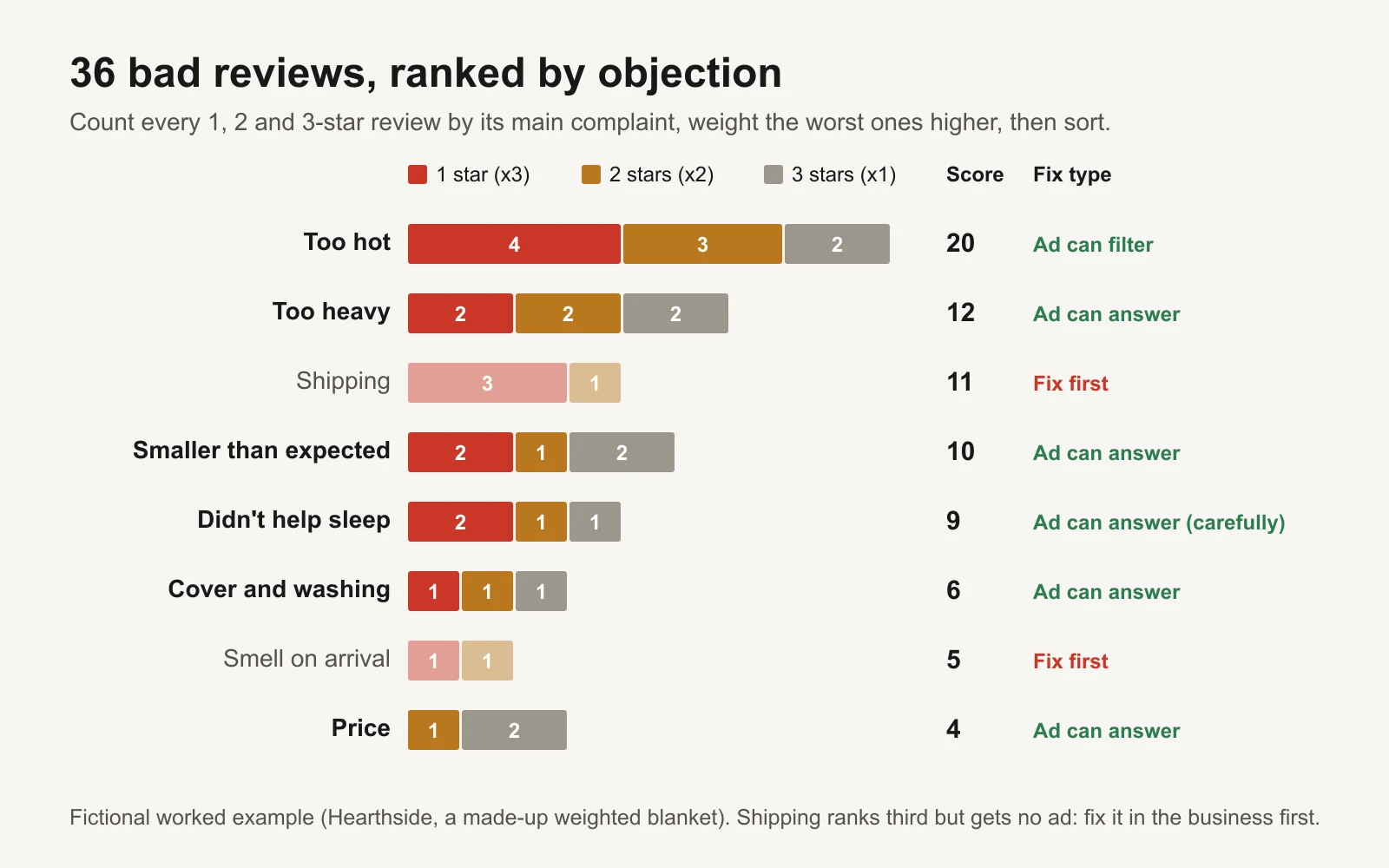
Fictional worked example: Hearthside, a made-up weighted blanket brand.
In the example, one objection stands out: a quarter of all bad reviews say the blanket is too hot. That is the first ad to write. Price, which most owners assume is the main objection, comes last.
Step 4: sort out what an ad can't fix
This is the step most people skip, and it is the one that keeps you honest. Every objection goes in one of three buckets.
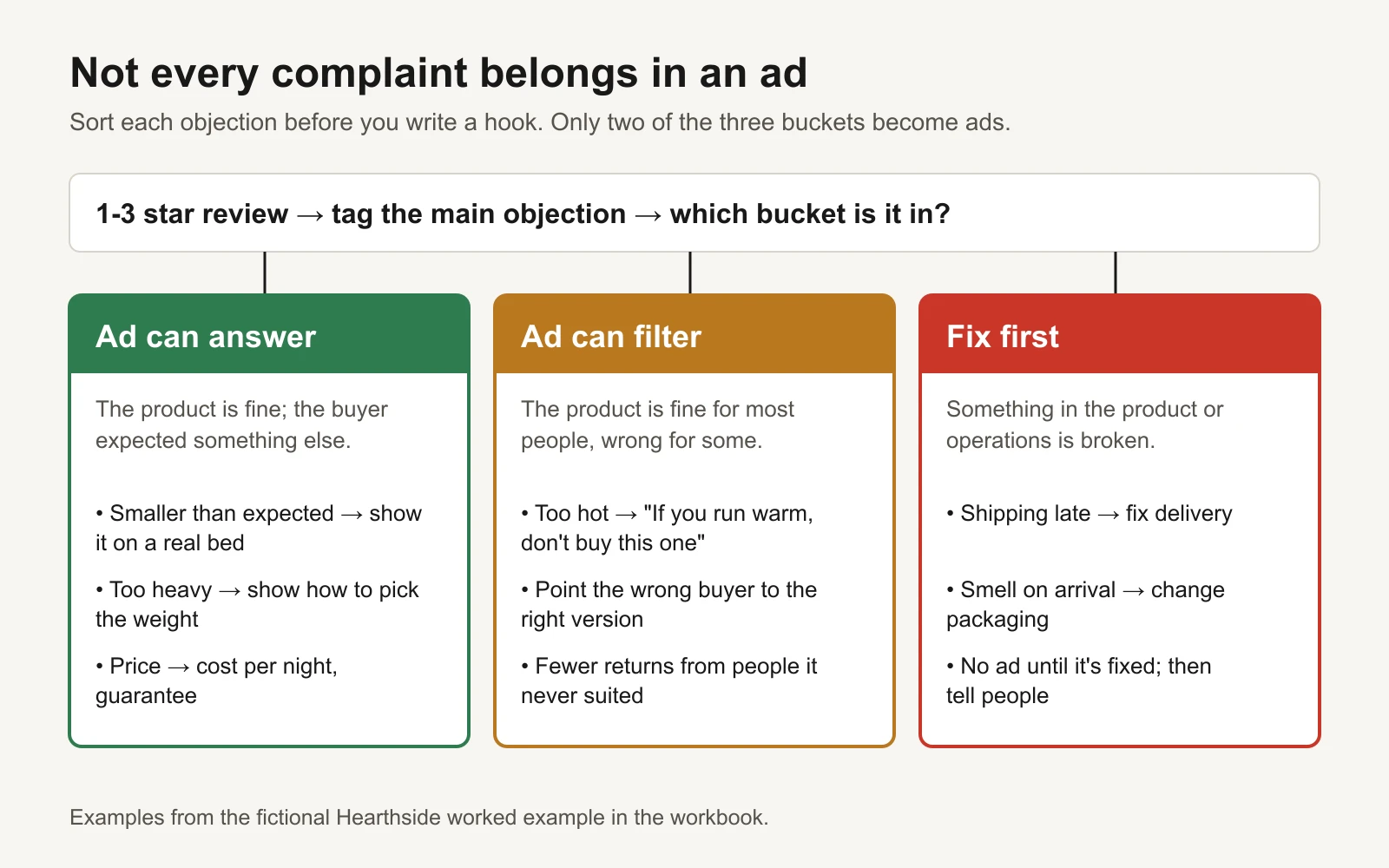
Only two of the three buckets become ads.
- Ad can answer. The product is fine; the buyer expected something different. "Smaller than the photos" is an expectation problem. Show the real size, on a real bed, with a tape measure.
- Ad can filter. The product is right for most people and wrong for some. "Too hot" is a filter: say who it isn't for and, if you have one, point them to the version that suits them. You lose a few sales and a lot of returns.
- Fix first. Something is broken: late shipping, damaged boxes, a smell out of the packaging, rude support. No ad fixes that, and an ad that promises otherwise makes the next review worse. Fix it, then (once it's true) you can say what you changed.
If a big share of your bad reviews land in "fix first", that is the most valuable thing this exercise will tell you, and it isn't an ad.
A word on claims: objections like "didn't help me sleep" or "didn't clear my skin" are where ads get into trouble. Set an honest expectation, never promise a health result you can't prove. Our creative claims review covers what to check.
Step 5: turn objections into hooks
A hook is the first 1 to 3 seconds of a video ad, or the first line of a text or image ad. Hooks built from objections work because they say the thing the viewer is already thinking. Four formats cover most of them:
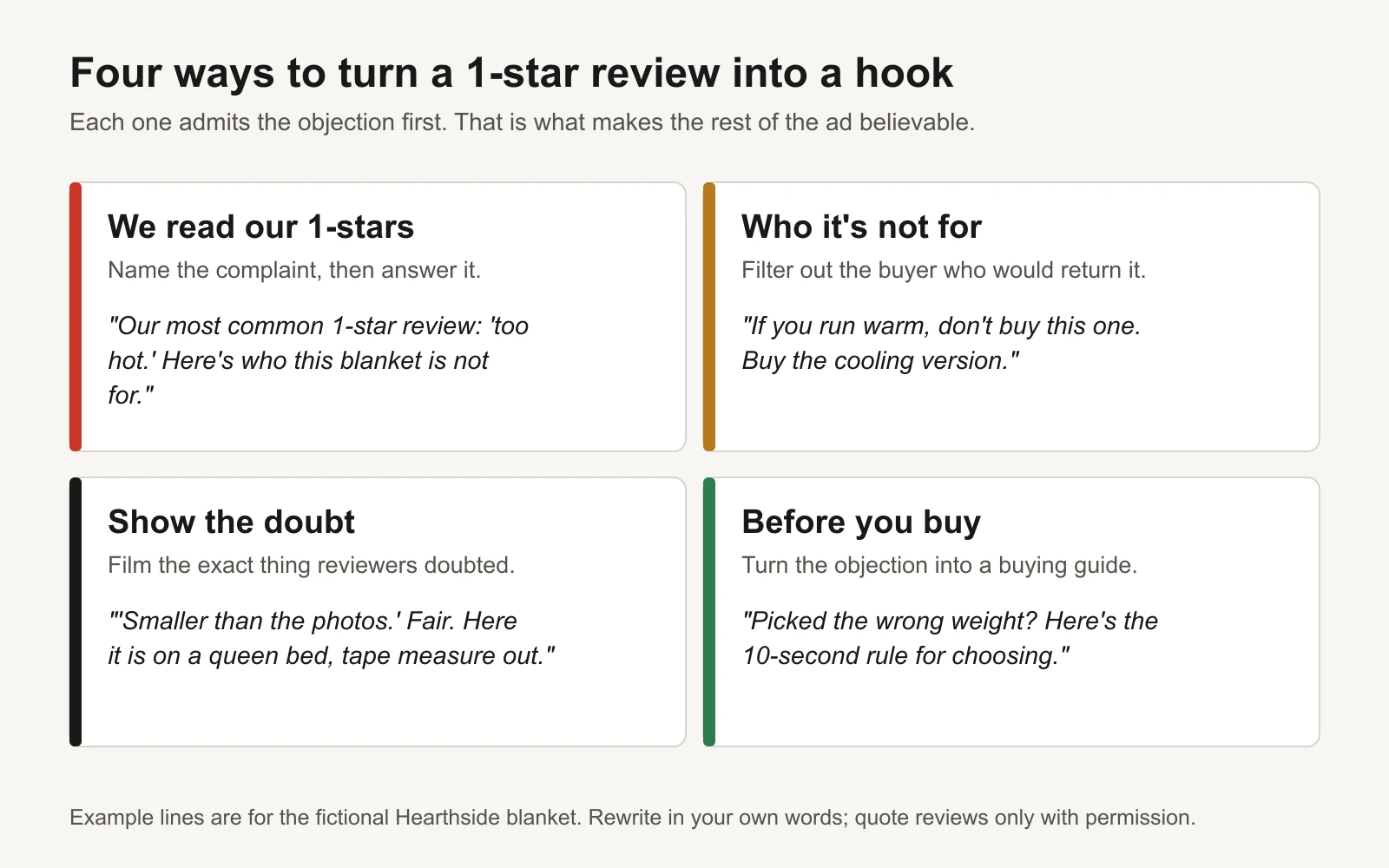
Each one admits the objection first. That is what makes the rest of the ad believable.
For the example brand, the workbook's Top 3 hooks tab gives:
| Ad rank | Objection | Mentions | Hook |
|---|---|---|---|
| 1 | Too hot | 9 | "Our most common 1-star review: 'too hot.' If you run warm, don't buy the Hearthside blanket. Buy this one instead." |
| 1 | Too hot | 9 | "Hot sleeper? Watch this before you order the Hearthside blanket." |
| 2 | Too heavy | 6 | "'I felt trapped under it.' Here's how to pick the right weight so that doesn't happen to you." |
| 2 | Too heavy | 6 | "Picked the wrong weight? Here's the 10-second rule for choosing the Hearthside blanket." |
| 3 | Smaller than expected | 5 | "'Smaller than the photos.' Fair. Here's the Hearthside blanket on a real queen bed, tape measure out." |
| 3 | Smaller than expected | 5 | "The Hearthside blanket is not a bedspread. Here's exactly what it covers." |
Shipping ranked third overall, but it is "fix first", so the ad ranking skips it. The Hook bank tab has three templates for each objection, which you can edit; your product name fills in automatically.
The hook is the start, not the whole ad. The body still has to answer the objection with proof: the real measurements, the cooling version, the 30-night return policy. If you can't answer an objection with proof, you're not ready to name it in an ad. For more hook structures, see the hook bank; for ad formats to put them in, see the 50 ad formats teardown.
Step 6: test the hooks properly
Put each objection hook on the same ad body and change only the first 3 seconds or first line, so any difference comes from the hook. Our hook test design guide shows how to set that up and how much spend each version needs before you judge it.
Two things to watch beyond the usual cost per purchase:
- Returns. A "who it's not for" ad may sell slightly fewer units and get fewer returns. Check your return rate by ad, not just ROAS. The return-rate creative review shows how.
- New reviews. If the objection you answered keeps showing up in new reviews at the same rate, the ad isn't reaching the people who need to hear it, or the answer isn't convincing.
Rules that keep you honest
- Don't change what a customer said. If you quote a review, quote it exactly. US advertising rules say an endorsement may not be presented out of context or reworded so as to distort the endorser's opinion or experience (16 CFR 255.1). Paraphrasing the objection in your own words ("some people find it too hot") is safer.
- Get the right to quote. Quote a review in an ad only if your review platform's terms or the customer's permission allow it. If in doubt, ask the customer or paraphrase.
- Never bury the bad reviews. In the US, the FTC's rule on consumer reviews, in force since 21 October 2024, bans review suppression: using unfounded legal threats, intimidation or false accusations to stop or remove negative reviews, and implying that the reviews you show represent all or most of the reviews you received when you've held back negative ones (FTC: final rule banning fake reviews and testimonials). Ordinary moderation, like removing obscene or abusive reviews, is allowed.
- Make "most common" true. "Our most common 1-star review" is only allowed if your ranking says so. The workbook gives you the count to check.
This is general guidance, not legal advice. If you're unsure about a claim, ask a lawyer who knows advertising in your market.
The worked example: 36 reviews, one afternoon
Hearthside, a fictional weighted-blanket brand selling a $149 blanket, exports 36 reviews of 1 to 3 stars from the last six weeks: 15 one-star, 11 two-star and 10 three-star.
| Rank | Objection | 1★ | 2★ | 3★ | Score | Bucket | First ad |
|---|---|---|---|---|---|---|---|
| 1 | Too hot | 4 | 3 | 2 | 20 | Ad can filter | "If you run warm, don't buy this one" |
| 2 | Too heavy | 2 | 2 | 2 | 12 | Ad can answer | How to pick the weight |
| 3 | Shipping | 3 | 1 | 0 | 11 | Fix first | None until delivery is fixed |
| 4 | Smaller than expected | 2 | 1 | 2 | 10 | Ad can answer | Real bed, tape measure |
| 5 | Didn't help sleep | 2 | 1 | 1 | 9 | Ad can answer (carefully) | Honest expectation, return policy |
| 6 | Cover and washing | 1 | 1 | 1 | 6 | Ad can answer | Cover off, in the machine, back on |
| 7 | Smell on arrival | 1 | 1 | 0 | 5 | Fix first | None until packaging is fixed |
| 8 | Price | 0 | 1 | 2 | 4 | Ad can answer | Cost per night, guarantee |
What the example teaches:
- 9 of 36 bad reviews, a quarter, say the same thing. One objection is worth a whole batch of ads.
- Two of the eight objections are not ad problems. Together they are 6 reviews, 17% of the total. Those go to operations, not to the creative team.
- Price came last. The objection owners worry about most is often not the one customers write about.
Make it a routine
- Once a month, export new 1 to 3-star reviews and paste them in under the old ones.
- Check every Untagged row and any suggestion that looks wrong.
- Send every "fix first" objection to whoever owns it, with the review count.
- Brief one objection hook for each of the top three ad-fixable objections.
- Test them on the same ad body; check returns as well as cost per purchase.
- When a fix-first problem is fixed, write the "here's what we changed" ad.
Or let GaaS write and test the hooks
GaaS is an AI agent that creates, launches and optimises Meta and Google ads from three inputs: your website, a spend limit and a one-line goal. It writes and tests new hooks every week, explains each change in plain words, and asks before anything that changes spend. If you'd rather do the review mining yourself, the workbook does the counting.
Limits of this kit
- The Spiegel findings come from review pages on retail sites, first published in 2017. They suggest why honest ads work; they don't measure ads.
- Keyword tagging is rough. It will mis-tag sarcasm, mixed reviews and complaints phrased in ways the keyword list doesn't cover. Read the suggestions.
- Review volume is not market share. People who write reviews are not a random sample of your buyers, and 1-star reviewers are not a random sample of unhappy ones.
- The score weights (3, 2, 1) are defaults, not a standard. Change them in Settings.
- Nothing here is legal advice.
Sources
- Spiegel Research Center, Northwestern University: How online reviews influence sales (checked 17 November 2026)
- US Code of Federal Regulations: 16 CFR 255.1, General considerations (FTC Endorsement Guides)
- Federal Trade Commission: FTC announces final rule banning fake reviews and testimonials (14 August 2024)
- Federal Register: Trade Regulation Rule on the Use of Consumer Reviews and Testimonials (published 22 August 2024, effective 21 October 2024)