
R.I.P. the $99 UGC video. HeyGen makes a 30-second one for $0.30.
That's real, with a catch you should know before you budget: $0.30 is the price on HeyGen's oldest avatar engine, and the cheap part was never the hard part. The hard parts are making every ad look like the same believable person, writing 30 seconds that sell, and not breaking the consent and disclosure rules that get ads rejected or worse.
We've made more than 60,000 ads. This guide is the recipe we'd hand a small brand starting with AI UGC (user-generated-content-style ads, the selfie-video look): what it really costs, the character sheet, the shot list, the prompts, and four rules to check before anything goes live. It's written for business owners making their own ads, with enough detail for a creative team to adopt.
The workbook has a character sheet with a consent check, a 30-second shot list that times itself, prompts built from both, a cost calculator by engine, and a pre-flight tab that only goes green when consent, the AI label and the claims check are done. The drink brand and creator in this article are a fictional worked example.
What it really costs
HeyGen's API charges pay-as-you-go by the minute, billed by the seconds actually generated (HeyGen: API plans, updated Nov 9, 2026):
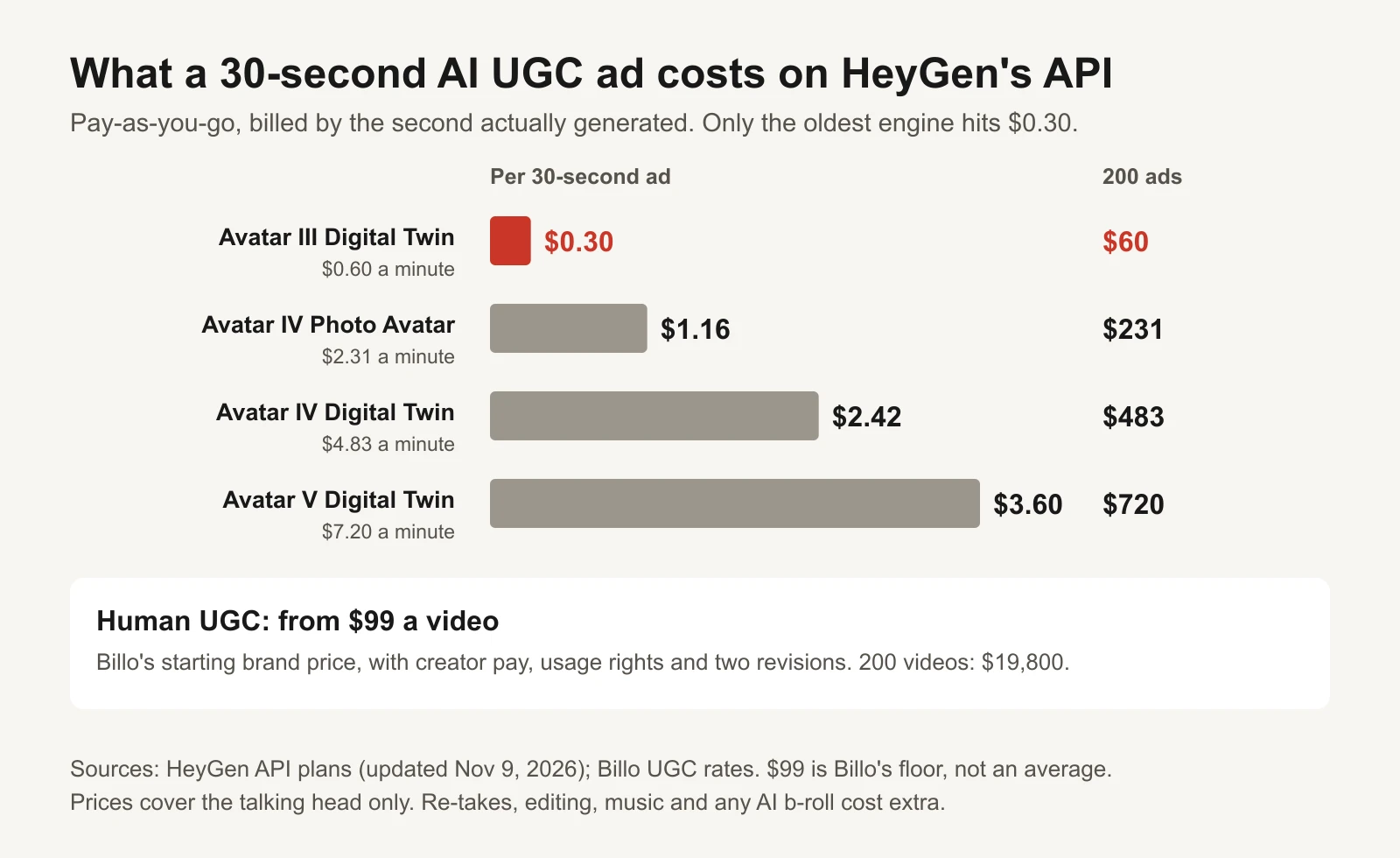
Talking head only. Re-takes, editing, music, captions and any AI b-roll cost extra.
| Engine | Per minute | 30-second ad | 200 ads |
|---|---|---|---|
| Avatar III Digital Twin | $0.60 | $0.30 | $60 |
| Avatar IV Photo Avatar | $2.31 | $1.16 | $231 |
| Avatar IV Digital Twin | $4.83 | $2.42 | $483 |
| Avatar V Digital Twin | $7.20 | $3.60 | $720 |
Avatar III is HeyGen's older, less lifelike engine. If the newer engines look right for your brand and the old one doesn't, budget $2 to $4 an ad. That's still a rounding error next to human UGC: Billo's brand price starts at $99 a video, including creator pay, usage rights and two rounds of revisions, and an Influencer Marketing Hub survey of 600+ marketers found about 80% of UGC creator costs under $500 a piece (Billo: UGC rates). $99 is the floor, not the average.
The price also leaves out the real person behind a Digital Twin. If your twin is a paid creator, their fee for the likeness and the usage rights is a cost too.
One tool note: OpenAI shut down its Sora 2 models and Videos API on Sep 24, 2026, with no one-to-one replacement (OpenAI: Sora 2). If an older recipe tells you to make the b-roll in Sora, that step no longer works. This recipe prices the talking head only.
Step 1: the character sheet
The fastest way to make AI UGC look fake is a different-looking "creator" in every ad. Write one character sheet and build every prompt from it.
| Field | Example (fictional) |
|---|---|
| Creator | Maya, late 20s, natural make-up, oversized cream sweater |
| Real person behind the avatar | A paid creator who signed a contract and recorded HeyGen's consent statement |
| Setting | Home kitchen, morning light, phone propped on the counter |
| Voice | Warm, quick, a little dry; talks like a friend, not a presenter |
| Product | Starter pack of a low-sugar energy drink |
| Claims she may make | Only things true for her: she drinks it most mornings, it replaced her 3pm coffee, she likes the taste |
| Claims she must not make | Health or weight-loss claims, numbers she didn't measure, other customers' results |
| Format | 9:16, captions on, 30 seconds |
The two claims rows matter most. They're what keeps the script inside the rules in Step 4.
Step 2: the 30-second shot list
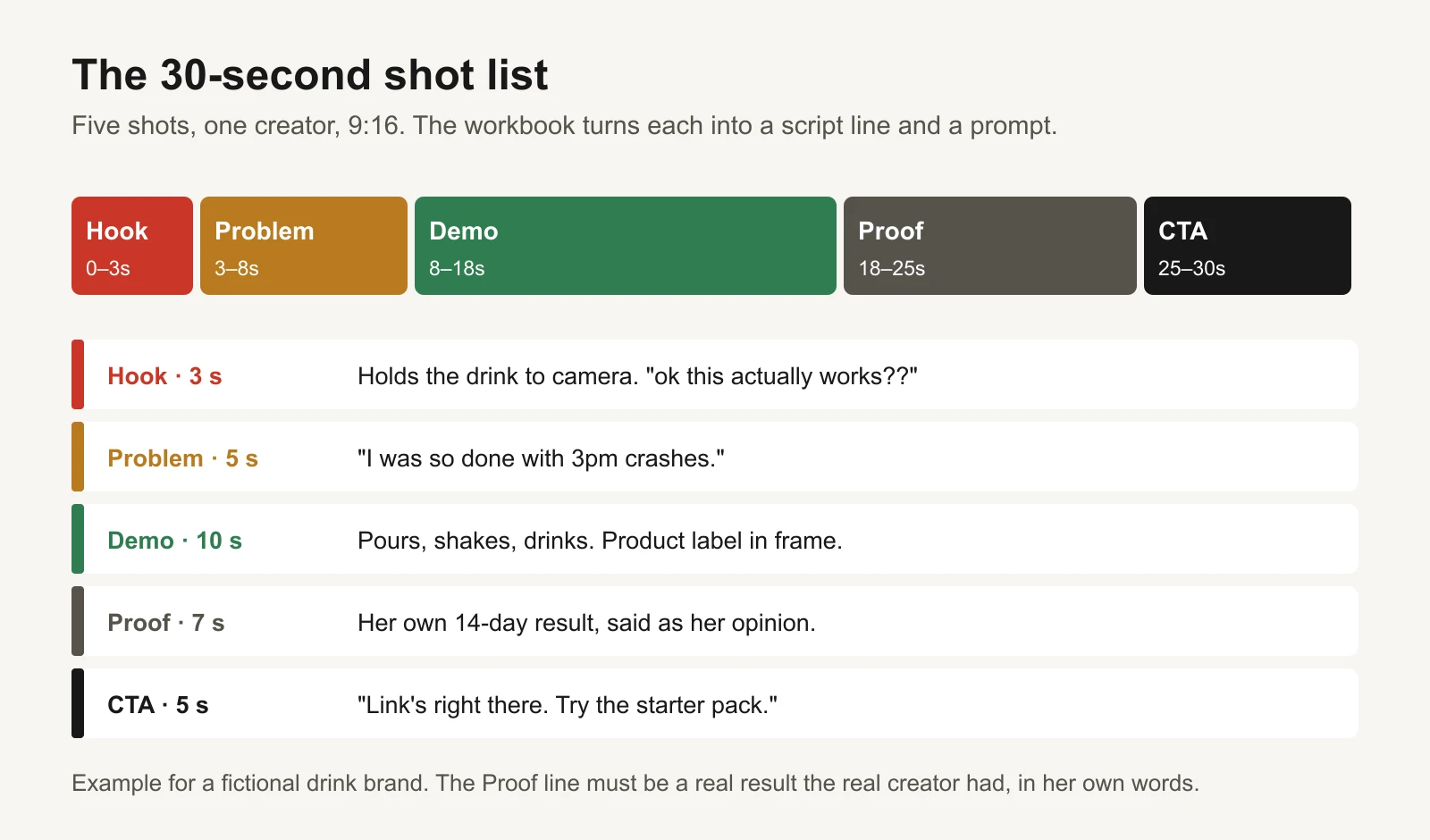
| Shot | Time | What happens |
|---|---|---|
| Hook | 0 to 3 s | Holds the can to camera, close-up: "ok this actually works??" |
| Problem | 3 to 8 s | "I was so done with 3pm crashes." |
| Demo | 8 to 18 s | Pours over ice, shakes, drinks. Product label in frame for 2+ seconds |
| Proof | 18 to 25 s | Her own result in her own words: "Two weeks in, I just don't reach for the second coffee anymore." |
| CTA | 25 to 30 s | Points to the link: "Try the starter pack." |
Spend most of your testing on the first 3 seconds. Keep the body, swap the hook, and you have five ads for five times $0.30. The 30 UGC script templates give you more structures to rotate.
Step 3: the prompts
The workbook's Prompts tab builds one direction prompt per shot from the character sheet and the shot list, so every shot carries the same look, setting and voice. For the hook:
Creator: Maya, late 20s, natural make-up, oversized cream sweater. Setting: home kitchen, morning light, phone propped on the counter. Voice: warm, quick, a little dry; talks like a friend, not a presenter. Shot 1 of 5 (3 seconds, 9:16, captions on): holds the can to camera, close-up, eye contact. Says: "ok this actually works??" On-screen text: ok this actually works??. Product: starter pack of a low-sugar energy drink.
It also joins the five lines into one script to paste into HeyGen, and adds a last check: does every line stay inside the "may" claims?
Step 4: four rules before it goes live
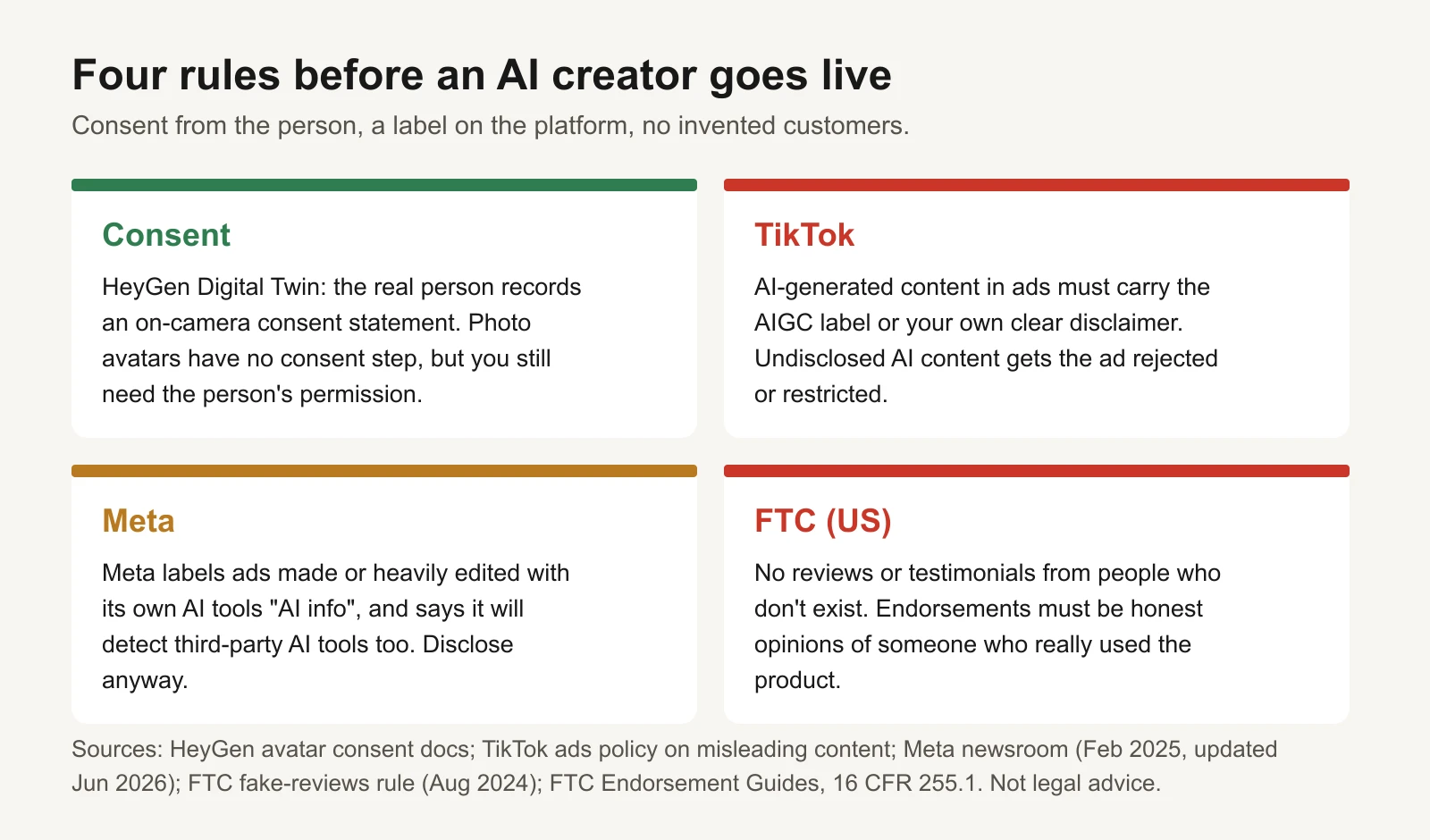
1. Consent from the real person. HeyGen requires the person in a Digital Twin to record an on-camera consent statement, reading HeyGen's text, before the twin can be used (HeyGen: avatar consent, recording your consent video). Photo and prompt-made avatars have no consent step, and HeyGen's docs say plainly that no step is not permission: if a photo avatar is a real person, get their written agreement and keep it.
2. TikTok: label it. AI-generated content in TikTok ads is allowed if you apply TikTok's AIGC label or add your own clear disclaimer. TikTok's policy says that if it finds AI-generated content that hasn't been disclosed, the ad will be rejected or restricted (TikTok ads policy: misleading and false content).
3. Meta: expect a label, disclose anyway. Meta adds an "AI info" label to ads created or significantly edited with its own generative AI tools, and has said it will also identify ads made with third-party AI tools through industry signals (Meta: gen AI transparency in ads, updated June 2026). We couldn't confirm that third-party detection is live, so don't rely on it either way: say it's AI in the ad.
4. No invented customers. The FTC's rule on fake reviews and testimonials, final since August 2024, bans testimonials that misrepresent that they come from someone who doesn't exist, "such as AI-generated fake reviews", and lets the FTC seek civil penalties against knowing violators (FTC: final rule on fake reviews). The FTC's Endorsement Guides also require endorsements to reflect the endorser's honest opinions, and an endorser who says they use a product must really have used it (16 CFR 255.1).
That's why the Proof shot in the recipe is the real creator's own experience, in her own words, and never a made-up customer, a "results may vary" number or a before/after nobody had. A Digital Twin of a real creator who uses the product can share her honest opinion. An invented "Maya, 29" with an invented 14-day result can't.
This is a practical summary, not legal advice. Platform policies change; check them before a campaign, and talk to a lawyer for health, finance or other regulated claims. The AI ad creative claims review has a fuller checklist.
The pre-flight tab
One row per ad: ad name, avatar type, consent on file, platform, AI label or disclaimer on, claims are hers and true, no invented customers or reviews. It goes green only when every column says yes. In the example, the TikTok ad is ready, the Meta ad isn't (no disclaimer yet), and a photo-avatar test is blocked because nobody has written consent on file.
Or let GaaS make them
GaaS is an AI agent that creates, launches and optimises Meta and Google ads from three inputs: your website, a spend limit and a one-line goal. It makes and tests creative continuously, and asks before anything that changes spend. If you'd rather make AI UGC yourself, the workbook holds the whole recipe.
Limits
- Prices are HeyGen's published API pay-as-you-go rates on Nov 9, 2026. Plans, credits and prices change; check before you budget.
- $0.30 is the Avatar III engine only. Newer engines look more lifelike and cost 4 to 12 times more per second.
- Cheap to make isn't the same as good. AI UGC still needs a strong hook and testing, like any ad; most tested ads don't become winners.
- Rules differ by country and platform. This guide covers HeyGen's consent requirement, TikTok's and Meta's ad labelling and US FTC rules only.
Sources
- HeyGen: API plans and pay-as-you-go prices (updated Nov 9, 2026)
- HeyGen: Avatar consent and recording your consent video
- Billo: UGC rates
- OpenAI: Sora 2 model page (shut down Sep 24, 2026)
- TikTok: Ads policy, misleading and false content
- Meta: Gen AI transparency in Meta's ads products
- FTC: Final rule banning fake reviews and testimonials (August 2024)
- FTC Endorsement Guides: 16 CFR 255.1