
Most of Liquid I.V.'s Meta ads come and go fast. On 17 November 2026 it had 103 live in the US, and the median one was 11 days old. Flavours, cold and flu season, the holidays, creators: new ads, then gone.
Five ads have stayed. They started between 23 September and 8 October and were still running 40 to 55 days later. None of them is about a flavour or about hydration. All five sell the subscription: "Subscribe and save 30%", "Put a ring on it", "VIP treatment".
That's the pattern worth copying. Rotate the ads that sell the product; keep a few ads that sell the reorder switched on. This teardown shows the data, explains why the subscription lane lasts, and gives you a sheet to check whether a subscription discount pays at your own margin before you build that lane.
How we read the library, and what it can't tell you
We opened Liquid I.V.'s Page in the Meta Ad Library on 17 November 2026, signed in, with active ads, the United States and all media selected, and scrolled to the end. The header said "~150 results", which counts versions; 103 distinct ad cards loaded. For each we logged the start date, format, advertiser line and opening text.
The limits:
- Live ads only. Outside the EU, the library shows only running ads (Meta Transparency Center: Ad Library tools). We don't know what ran before.
- No results. No spend, sales or subscriber numbers are shown. "Longest-running" means Liquid I.V. keeps paying for it.
- "Rotate every two weeks" is our reading of the age spread, not a stated Liquid I.V. policy.
Liquid I.V.'s homepage, checked the same day, offers free shipping on orders over $40 and links to a subscriptions page (liquid-iv.com). The 30% figure comes from the ads, not the homepage.
Finding 1: almost everything is under two weeks old
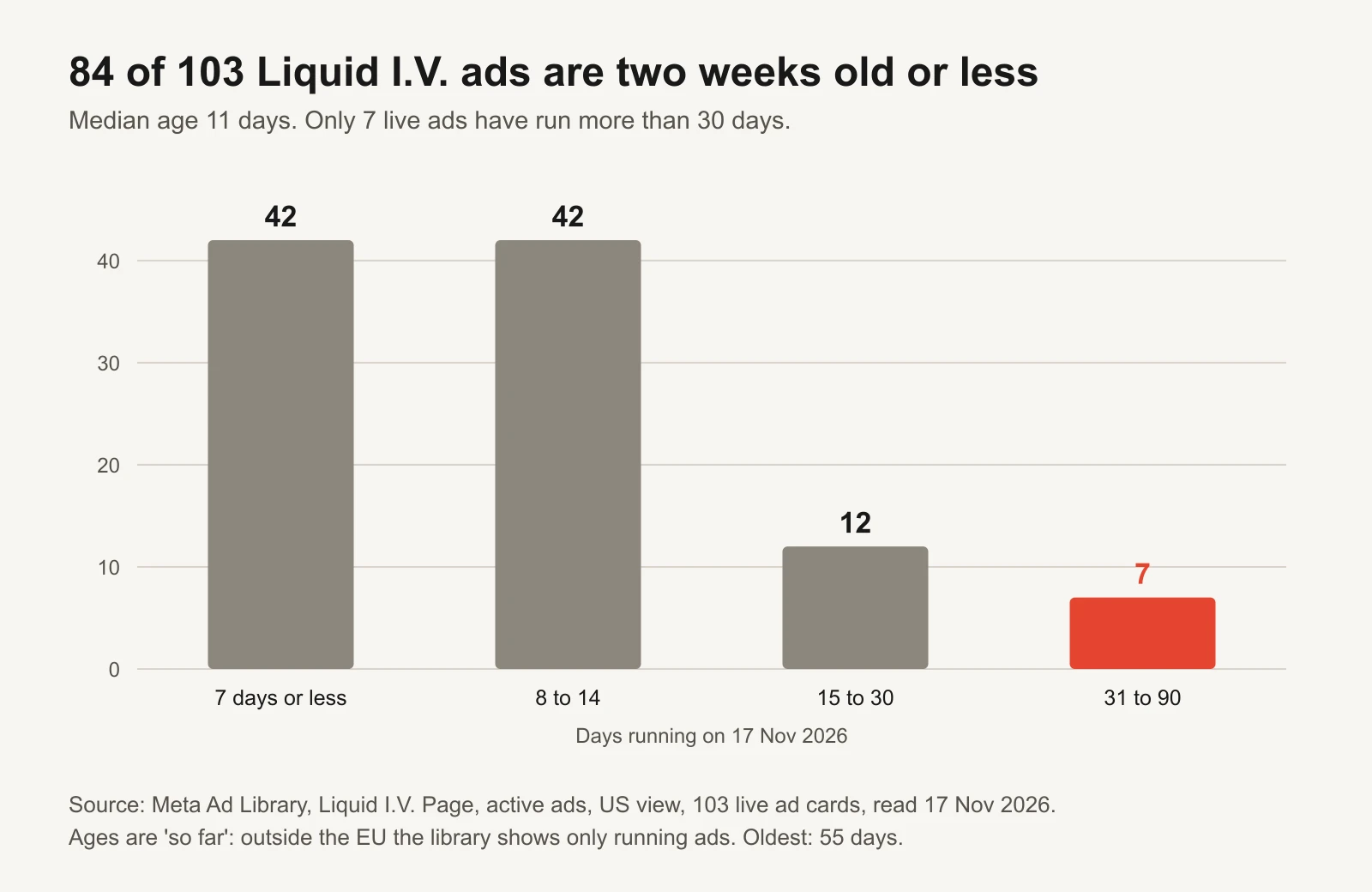
84 of 103 are 14 days old or less. Only 7 have run more than 30 days.
The batches are big: 33 ads started on 12 November and 24 on 6 November. 91 of the 103 are video, and 23 run as partnerships with creators (BB The Scientist, Life of Reyhauna, Edward Digges, kelsarogers and others). Liquid I.V.'s own Page runs the other 80.
Finding 2: the survivors all sell the subscription
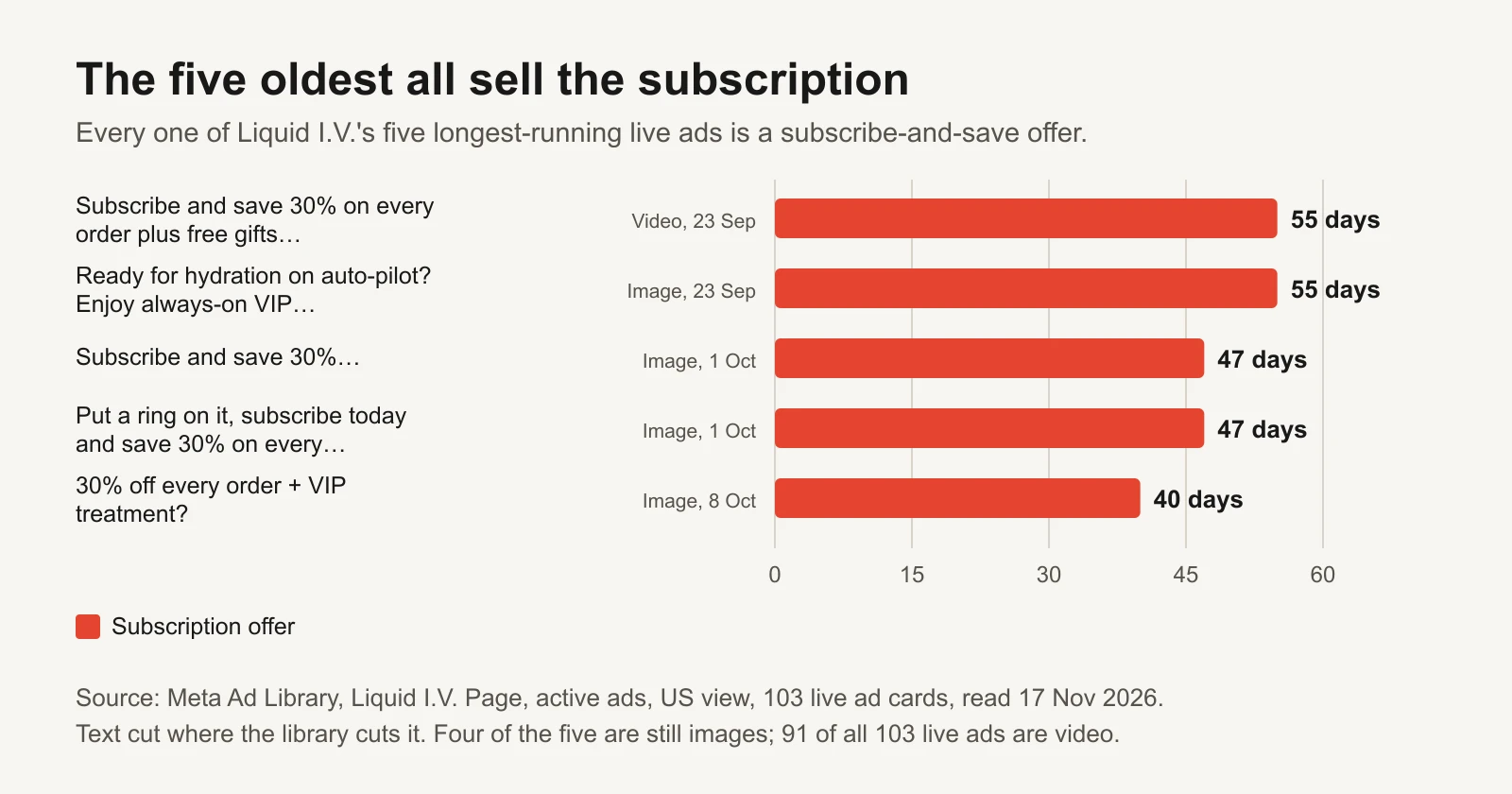
Four of the five are still images, in an account where 91 of 103 ads are video.
| Started | Days running (to 17 Nov) | Format | Opening line | Library link |
|---|---|---|---|---|
| 23 Sep | 55 | Video | "Subscribe and save 30% on every order plus free gifts…" | Ad |
| 23 Sep | 55 | Image | "Ready for hydration on auto-pilot? Enjoy always-on VIP…" | Ad |
| 1 Oct | 47 | Image | "Subscribe and save 30%…" | Ad |
| 1 Oct | 47 | Image | "Put a ring on it, subscribe today and save 30% on every…" | Ad |
| 8 Oct | 40 | Image | "30% off every order + VIP treatment?" | Ad |
The 31-to-90-day group has 7 ads; these are the five oldest. We didn't log the other two, so we only claim the five.
Finding 3: the rotating lane
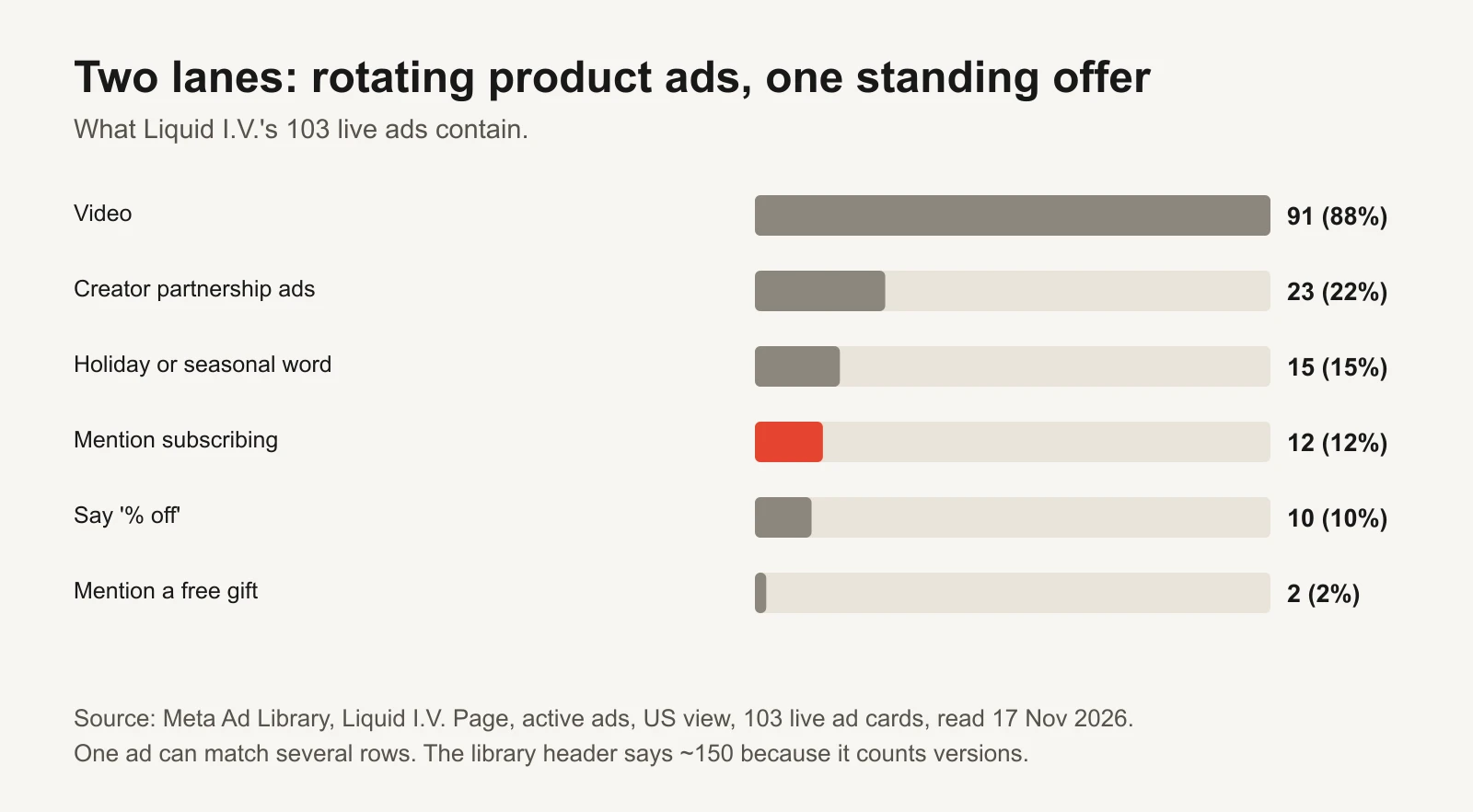
One ad can match several rows.
| Most-repeated opening line | Ads |
|---|---|
| "Fuel your thirst for more. Liquid I.V.® Sugar-Free help[s]…" | 5 |
| "Stay ready for cold & flu season…" | 4 |
| "Stay hydrated this holiday season…" | 4 |
| "Your favorite flavors, delivered on repeat 📦💧 Subscri[be]…" | 4 |
| "Stock up & save 💧 Buy 3 pouches, get 1 FREE!" | 4 |
No single line dominates; the top one runs on 5 ads. The rotating lane is many small themes (a sugar-free range, cold and flu season, the holidays, a multi-buy offer) each with a few ads, mostly video, many with creators.
Why the subscription ads last
We can't see Liquid I.V.'s numbers, so this is reasoning.
The offer doesn't expire. A holiday ad dies on 1 January. "Save 30% on every order" is as true in March as in November, so there's no reason to turn it off.
It's aimed at people who already know the product. Someone who has bought a pouch from a shop has done the hard part. An ad that says "get it delivered, cheaper, every time" turns a one-off buyer into a repeat one. That audience refreshes itself as new people try the product through the rotating lane.
The offer is the creative. "Subscribe and save 30%" doesn't need a creator or a new flavour shot. A still image with a clear number does the job, which is why four of the five survivors are stills.
A reason to belong, not just a discount. "VIP treatment" and "Put a ring on it" make subscribing sound like joining something, not like being locked in.
The template: advertise the reorder
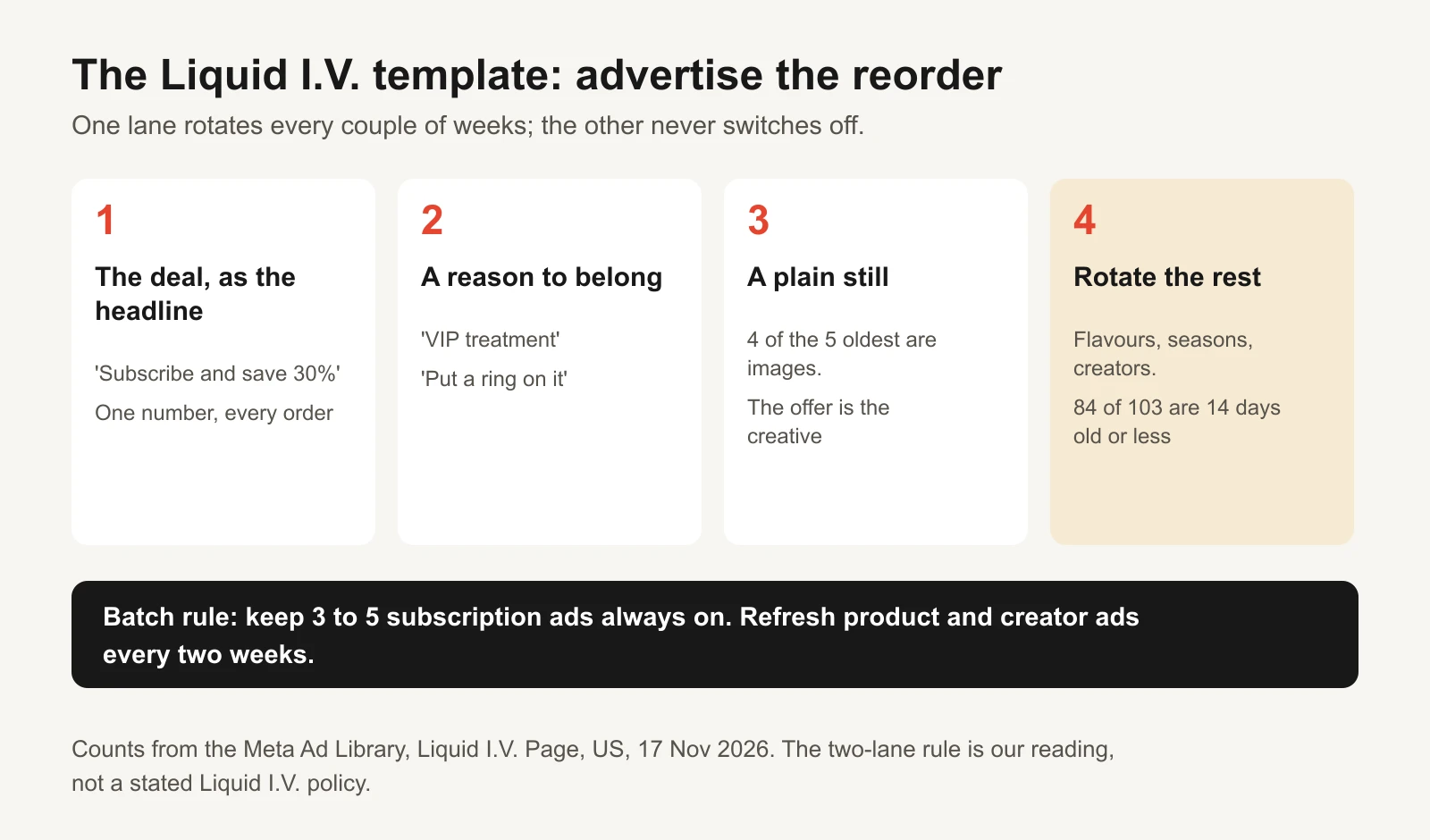
The two-lane rule is our reading, not a stated Liquid I.V. policy.
- The deal, as the headline. One number, on every order, said first.
- A reason to belong. A name for subscribers, a perk, a line with some personality.
- A plain still. The offer is the creative; you don't need a video for it.
- Rotate the rest. Product, flavour, season and creator ads in batches every couple of weeks.
Show the renewal terms and how to cancel as clearly as the discount. A subscription people feel trapped in turns into chargebacks and complaints.
This fits anything people use up and buy again: drinks, supplements, coffee, pet food, skincare, razors. It doesn't fit products people buy once.
Check the maths before you build the lane
A 30% subscription discount comes straight out of your margin. It pays only if subscribers order enough more often than one-time buyers. The workbook's Subscription maths tab checks it:
- Type your price per order, gross margin and the discount.
- Type how many orders a one-time buyer and a subscriber place in 12 months, from your own data if you have it.
- The sheet compares 12-month gross profit per customer and says whether subscribers are worth advertising to.
In the fictional example, a $25 order at a 65% margin earns $16.25. A one-time buyer orders 1.6 times a year: $26.00 of gross profit. With 30% off, a subscriber pays $17.50 and each order earns $8.75; at 5 orders a year that's $43.75, 1.7 times the one-time buyer. The subscriber needs about 3 orders a year just to break even with a one-time buyer. Below that, the discount costs more than it earns. The 1.5x line the sheet uses to say "advertise it" is our starting point, not a Liquid I.V. figure. For what you can afford to pay to win that customer, see allowable CAC for the first order.
Read any competitor the same way
The Ad log is prefilled with Liquid I.V.'s five oldest live ads, with links. Add a competitor below:
- Open their Page in the Meta Ad Library with active ads, your country and all media, and scroll to the end.
- Log each ad's library ID, start date, format, face, angle, offer and first line.
- The Summary tab counts by age and format and gives the share older than 30 days. Because the prefilled rows are the oldest ads, the reading for Liquid I.V. there says "keeps winners"; the full count (7 of 103 past 30 days) is on the snapshot tab. Log a whole brand to get a true reading.
Then sort by days running and read the top five. When a fast-rotating brand keeps a few ads for months, those ads show you what it really relies on. The Ad Library competitor playbook goes further.
Tools and repos that help
| Tool or repo | What it is for | Who should use it |
|---|---|---|
| Meta Ad Library | Every live ad for a Page, with start dates, formats and versions | Everyone; this teardown is built on it |
| Meta Transparency Center: Ad Library tools | What the library keeps and for how long | Anyone reading "days running" |
| facebookresearch/Ad-Library-API-Script-Repository | Meta's Python examples for the Ad Library API; ordinary product ads only if they reached the EU | Developers |
| anthropics/skills | Public agent skills, including an xlsx skill for spreadsheets like this one | Anyone who wants an assistant to fill in the log |
Or let GaaS run it
GaaS is an AI agent that creates, launches and optimizes Meta and Google ads from three inputs: your website, a spend limit and a one-line goal. It can run both lanes: rotate product and creator ads in batches, keep your best subscription ads on, and judge each on cost per purchase, with nothing spending until you approve it. See how GaaS works. Either way, the subscription maths below is yours to keep.