
Grüns sells daily packs of gummies with greens, vitamins and fiber in them. Gummies are a format most people associate with children, and Grüns sells them to adults, on a subscription. So how do they sell it?
We expected to find a few evergreen ads that had been running for months, the kind of winners most teardowns are built on. That is not what the library showed. On 16 November 2026, Grüns had 192 Meta ads live. Only 3 had been running for more than two weeks, and none of those 3 sell Grüns gummies.
The real lesson is the opposite of "find their one winning ad". Grüns treats ads as a batch product: dozens of new ones every few days, each built from a small set of parts, and almost none kept past two weeks. This teardown shows what we found, the parts they use, and a template and tracker to run the same system on your own account.
How we read the library, and what it can't tell you
We opened the Grüns Page in the Meta Ad Library on 16 November 2026, signed in, with all countries and all ad types selected, and scrolled to the end. 192 ad cards loaded; the library itself said "~200 results". The US-only view showed 156. We logged each card's "Started running on" date, format, advertiser line, first line of text and offer.
Three limits matter before any conclusion:
- Live ads only. Outside the EU, Meta's library shows ads that are running now. Meta keeps ads about social issues, elections or politics for seven years, and ads that delivered in the EU for a year after their last impression, but ordinary US product ads disappear when they stop (Meta Transparency Center: Ad Library tools). So "older than two weeks" means "still running after two weeks", not "the longest any Grüns ad has ever run".
- No results. The library shows no spend, sales or ROAS for these ads. It can rank by impressions (high to low), but for these ads it showed no impression numbers. We can see what Grüns keeps paying to run; we can't see what works.
- A snapshot. One day's view. Grüns may run evergreen ads in other periods. We are describing November 2026, the run-up to Black Friday, which may be busier than usual.
Product facts below come from gruns.co, checked on 17 November 2026.
Finding 1: almost everything is less than two weeks old
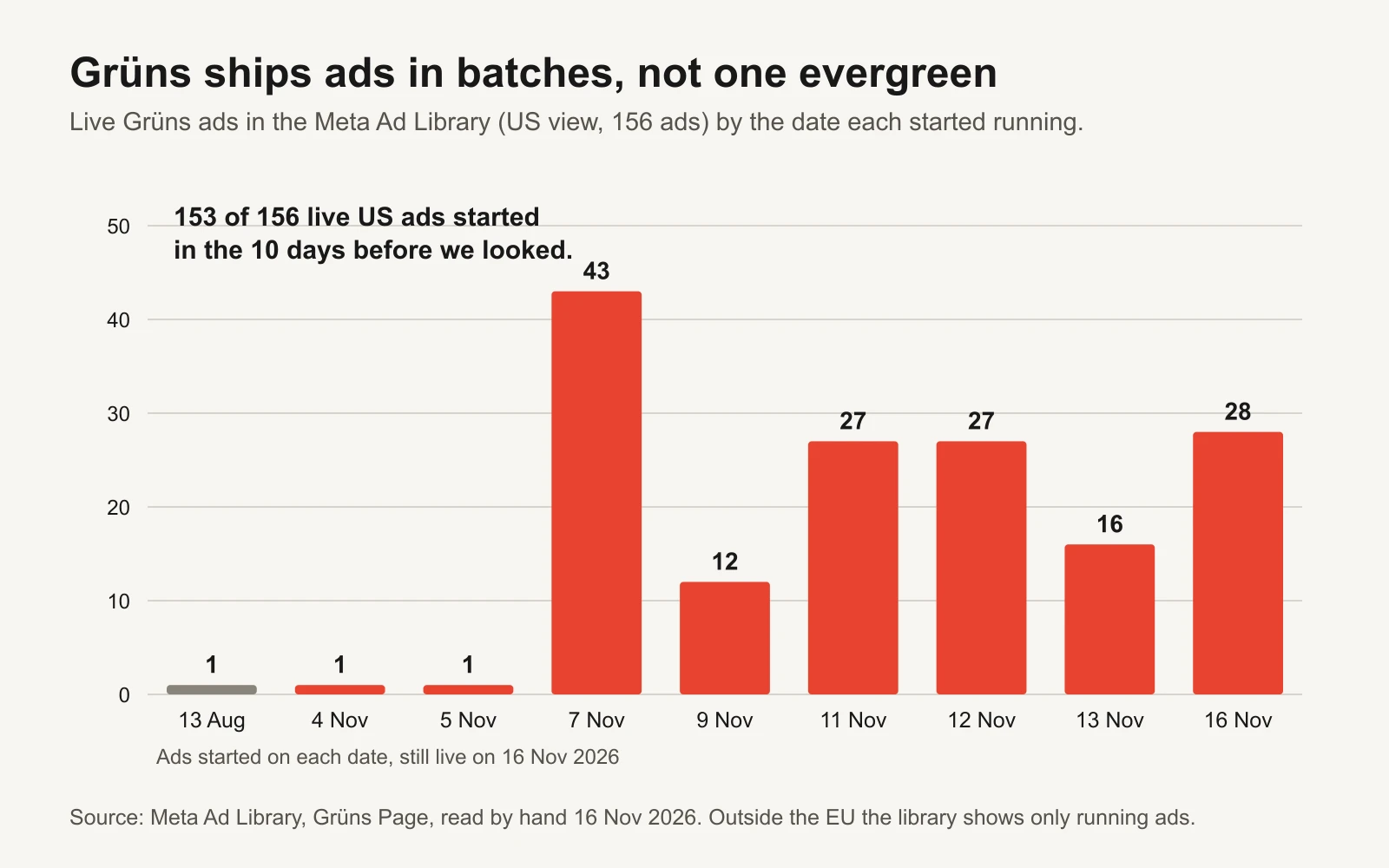
Batches, not evergreens: 43 new ads started on one day, then 27, 27, 16 and 28 on later days.
Of the 156 live US ads, 153 started between 7 and 16 November. Across all countries, 189 of 192 started in November.
The three ads that had lasted were all "Grüns with Nütrops" partnership ads for Nütrops, a mushroom-gummy sister brand. The oldest ad selling Grüns itself was a Julianne Hough creator video that started on 4 November: 12 days old.
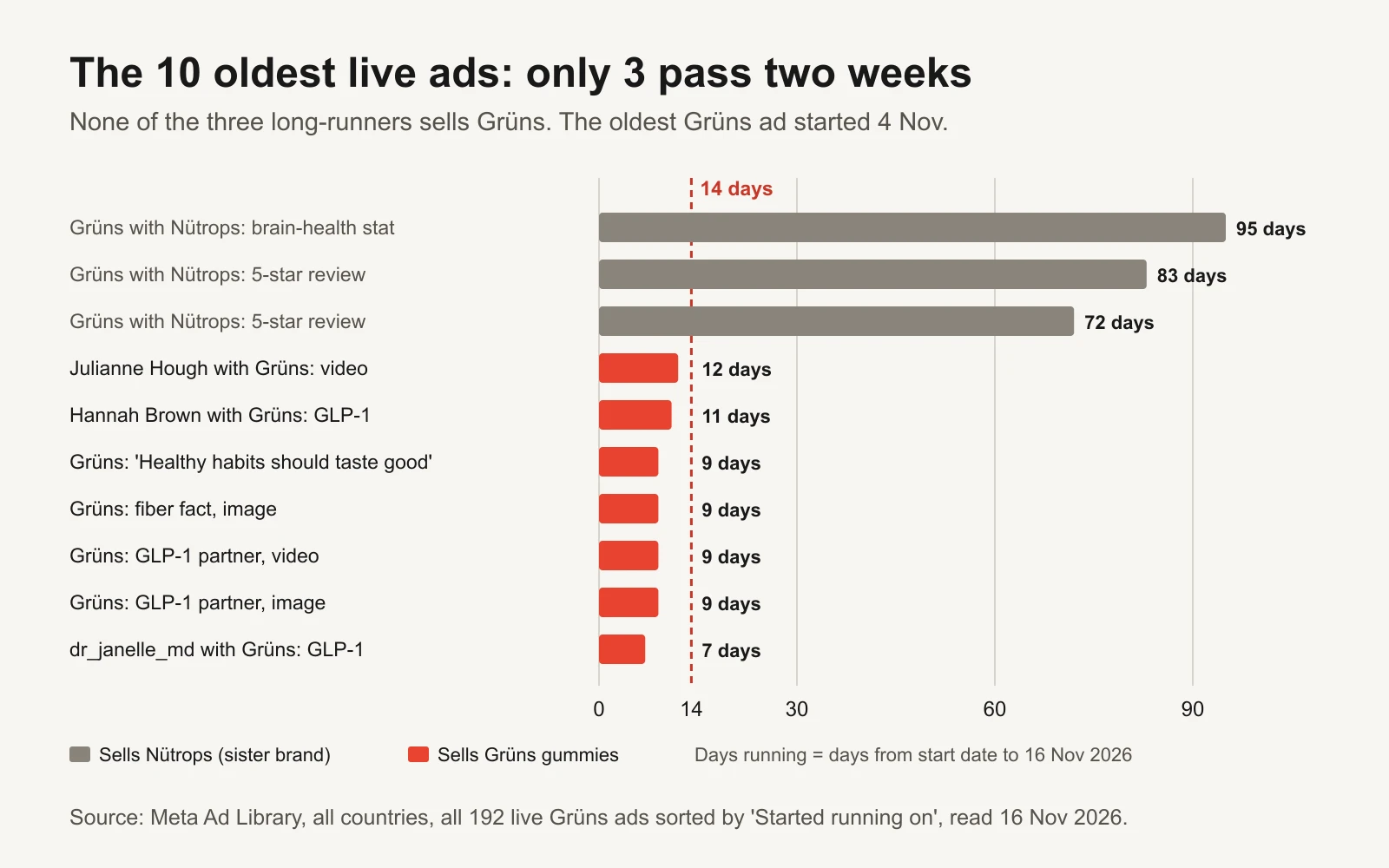
Only the three Nütrops ads pass two weeks.
| Started | Days running (to 16 Nov) | Advertiser line | Format | First line | Library link |
|---|---|---|---|---|---|
| 13 Aug | 95 | Grüns with Nütrops | Image | "Did you know 82% of Americans are affected by brain health" | Ad |
| 25 Aug | 83 | Grüns with Nütrops | Image | Five stars, then a customer review signed "Rachel A." | Ad |
| 5 Sep | 72 | Grüns with Nütrops | Image | The same five-star review | Ad |
| 4 Nov | 12 | Julianne Hough with Grüns | Video, 0:24 | "Glam one minute, live TV the next." | Ad |
| 5 Nov | 11 | Hannah Brown with Grüns | Image | "Hannah B.'s daily…" | Ad |
| 7 Nov | 9 | Grüns | Video, 1:01 | "Healthy habits should taste good." | Ad |
| 7 Nov | 9 | Grüns | Video, 0:53 | "…your perfect nutrition partner, especially on a GLP-1." | Ad |
| 9 Nov | 7 | dr_janelle_md with Grüns | Video, 1:10 | The same GLP-1 line, from a doctor creator | Ad |
Notice what the survivors have in common: they are image ads that open with a statistic or a five-star review. Everything else, including big-name creator videos, is new.
Finding 2: a small set of parts, repeated across 192 ads
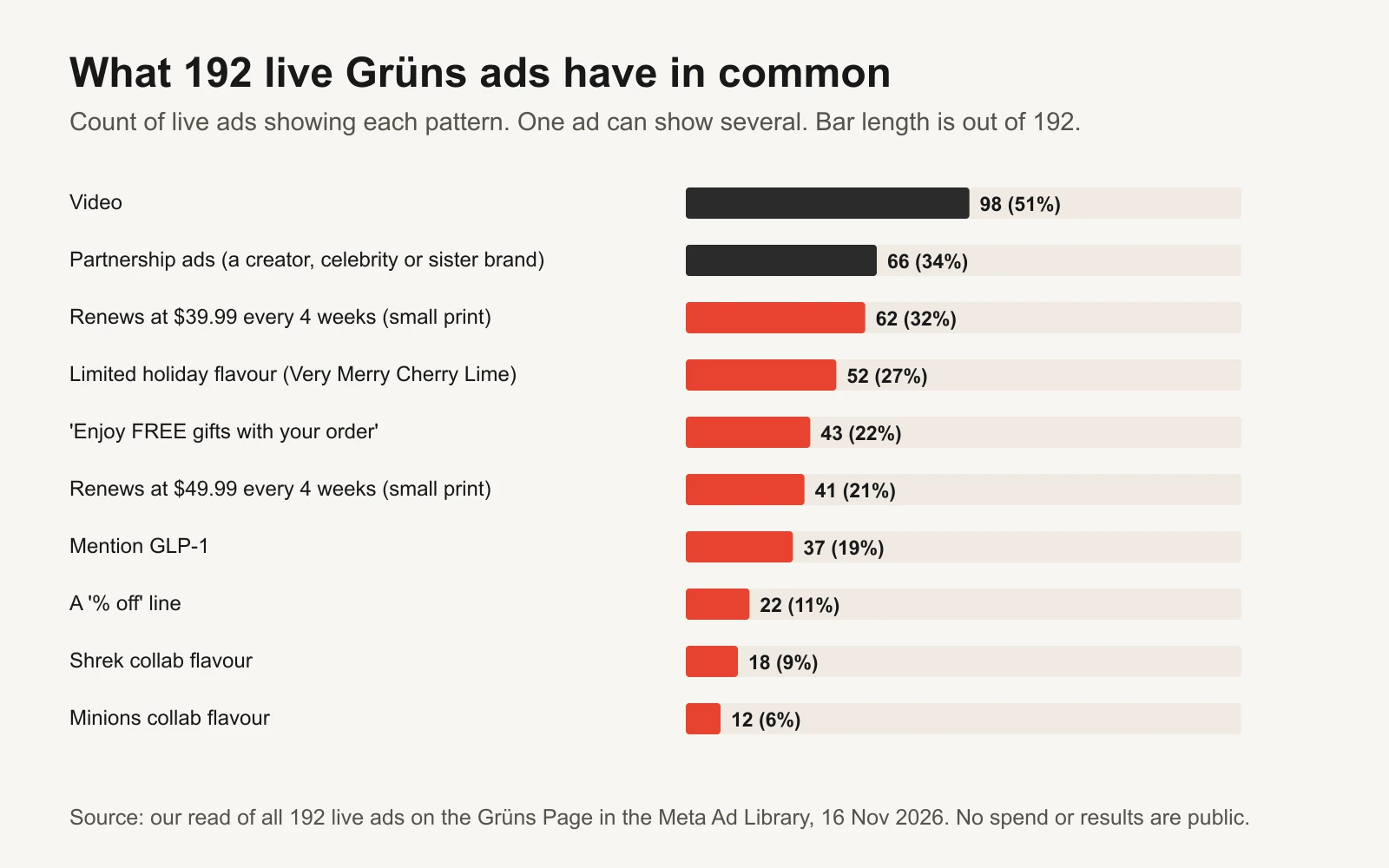
One ad can show several patterns, so the bars add up to more than 192.
The 192 ads are not 192 ideas. They are a handful of parts, combined:
| Part | How often | Examples from the live ads |
|---|---|---|
| Format | 98 video, 94 image or carousel | An even split; neither format "won" |
| A face they don't own | 66 partnership ads; 52 with a creator or celebrity | Hannah Brown alone runs 24; Julianne Hough, Krista Horton, Taylor Ann Green, Kat Stickler, a doctor creator |
| A limited drop | 52 holiday flavour, 18 Shrek, 12 Minions | "Clean greens meet mean green." opens 47 ads; "Bello. Also Bello." opens 10 |
| A specific adult problem | 37 mention GLP-1 (30 of them video) | "…your perfect nutrition partner, especially on a GLP-1."; gut health and fiber; changing hormones |
| A proof number | Across most product ads | "21 vitamins and minerals, plus prebiotics in one tasty bite" opens 23 ads |
| The offer | 43 free gifts; 22 with a "% off" line | "up to 55% OFF with FREE gifts"; "Save 61% OFF + FREE shipping" |
| The renewal in the small print | 62 at $39.99, 41 at $49.99 every 4 weeks | "Offer valid for new subscribers only. Subscription renews at $39.99 every 4 weeks." |
The most-repeated opening lines tell the same story: "Clean greens meet mean green." 47 times, "Hannah B.'s daily…" 24 times, the 21-vitamins line 23 times, "A Healthy Gut is Not Far Far Away" (the Shrek collab) 11 times. Grüns does not write a new idea for every ad. It writes a few good lines and ships many versions of each.
How they sell gummies to adults: six moves
1. Ship batches, not evergreens. 43 ads in one day, then batches of 12 to 28 every day or two. A batch is cheap to make when every ad is built from the same parts. And a batch answers a question one ad can't: which line, face or format the algorithm picks up this week.
2. Give adults a new reason to buy every few weeks. A gummy is a kids' format. The limited holiday flavour and the Shrek and Minions collab flavours turn it into a drop and a gift. A drop has a deadline built in; "limited edition" works as urgency without a discount.
3. Name a specific adult problem. Not "wellness" but GLP-1 users, gut health and fiber, changing hormones. 37 ads mention GLP-1, including a version for men and a doctor creator. A buyer who sees their own situation named does not need to be persuaded the product is "for them".
4. Borrow faces. 52 ads run as partnerships with creators and celebrities, so the ad appears with that person's name on it. Hannah Brown, a former Bachelorette lead, runs 24 of them. A familiar face does the trust work a new brand can't.
5. Lead with a discounted subscription, and state the renewal. The offer is a first-order discount (up to 55% to 61% off in some ads), free gifts and free shipping, with the renewal price in the small print: $39.99 or $49.99 every four weeks. The homepage leads with "Save 25% + free shipping on your first order" and an autoship price starting at $49.99 for 28 packs (gruns.co). If you copy this offer shape, copy the clear renewal disclosure too.
6. Keep the statics that prove something. The only ads that lasted months are plain image ads that open with a statistic or a named customer review. When you find a proof-led static that keeps working, leave it alone.
The template: one ad in four lines
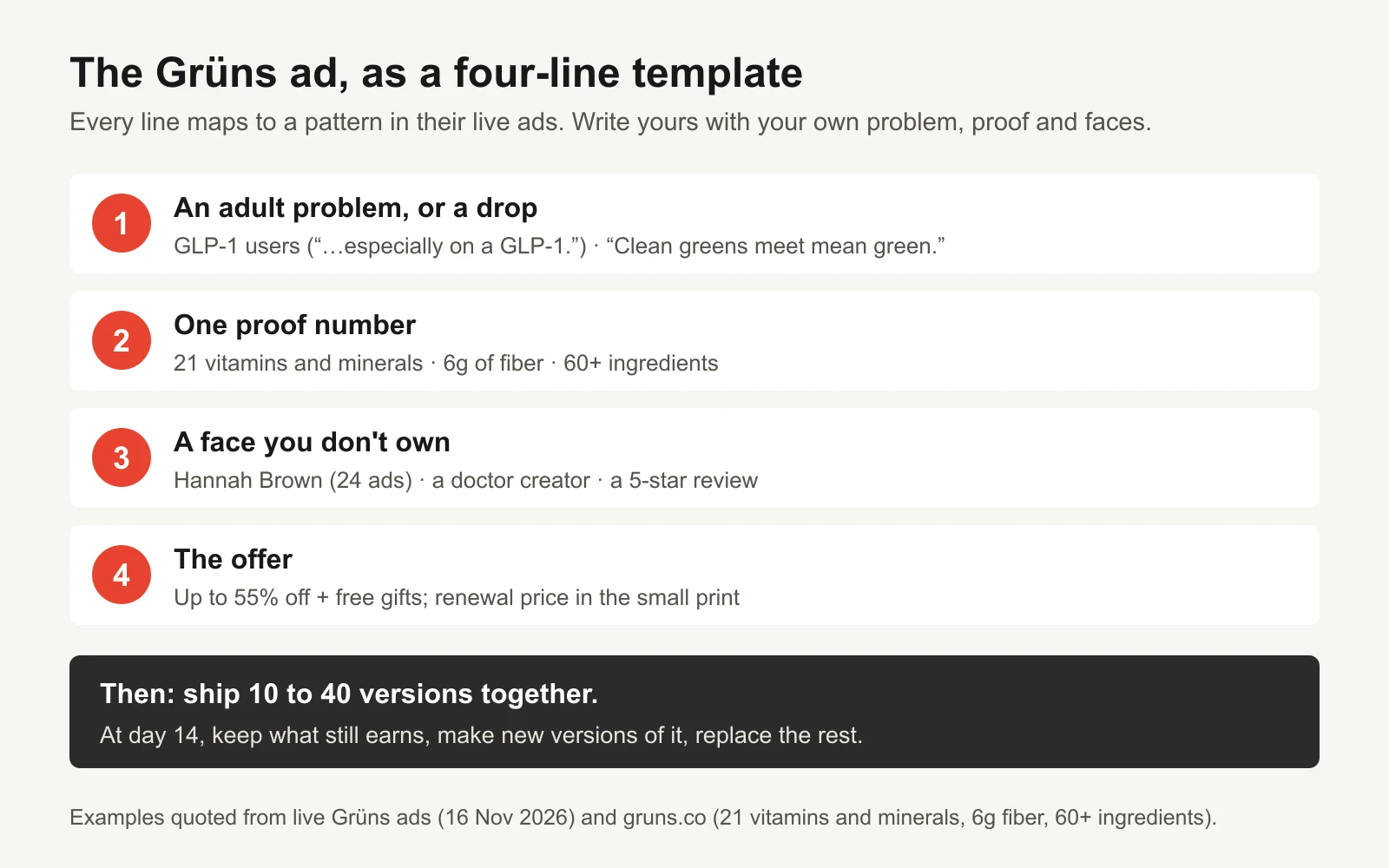
The proof numbers (21 vitamins and minerals, 6g of fiber, 60+ ingredients) are on gruns.co; the rest is from the live ads.
Write each ad as four lines, then make versions by swapping one line at a time:
- An adult problem, or a drop. Name the situation ("on a GLP-1", "afternoon slump", "travelling all month") or the limited thing ("the winter flavour is back").
- One proof number. A count, a dose, an amount, a result you can substantiate. One number, not five.
- A face. A creator, a doctor or expert, a customer review with a first name, or the founder. Use people who agreed to it, with the right partnership disclosure.
- The offer. What the first order gets, and what happens after it, in plain words.
With 5 problems or drops, 3 faces and 2 formats you have 30 variants. That is a batch.
Two cautions. Health claims need evidence; in the US, supplement structure and function claims carry the FDA disclaimer, as Grüns's own site does. And copy the system, never the ads: use your own problems, proof, faces and words. The Ad Library competitor playbook covers how to turn what you see into briefs that are yours.
Run your own batch, and judge it at day 14
The workbook's Batch planner works the same way Grüns appears to:
- Plan the batch. Type how many hooks, faces and formats you have. It multiplies them (5 x 3 x 2 = 30 in the example) and, with your target CPA (cost per acquisition) and a minimum spend per variant, works out the test budget. In the example, 30 variants at a $40 target CPA and 1.5 times that as the minimum spend to judge each one need $1,800, about $129 a day for 14 days.
- Launch them together, in the same campaign, so they compete for the same budget.
- At day 14, type spend and purchases for each variant. The sheet marks each one: keep and make versions (spent enough, CPA at or under target), kill (spent enough, no purchases or CPA over target), or too early (not enough spend yet, flagged separately if its early CPA looks good).
In the fictional example's first 12 variants, 4 are keepers, 3 are kills and 5 are too early to judge. Make new versions of the 4 keepers for the next batch, replace the 3, and let the 5 spend a little longer.
Fourteen days is a choice, not a rule. It matches what we saw at Grüns, it covers every day of the week twice, and it is short enough to keep the batches coming. If your budget is small, use fewer variants rather than a shorter window; each one needs enough spend to say anything. The kill, hold, scale rulebook has more on judging ads with small numbers, and creative fatigue vs saturation explains why even keepers need fresh versions.
Read any competitor the same way
The workbook's Ad log is prefilled with the 16 Grüns ads we looked at most closely, each with a link. Clear them or add your own competitor below:
- Open their Page in the Meta Ad Library with all countries and all ads selected, and scroll to the end.
- For each live ad, log the library ID, the start date, format, face, angle, offer and first line. Set the check date at the top.
- The Summary tab counts ads by age, format and face, and gives the share older than 14 days. Under 20% means the brand replaces ads fast, so study its batches and the parts they reuse. Over half means it keeps winners for a long time, so study its long-runners.
Check again a week later. A brand's batch rhythm only shows up across two or three checks.
Tools and repos that help
| Tool or repo | What it is for | Who should use it |
|---|---|---|
| Meta Ad Library | See every live ad for a Page, with start dates, formats and versions | Everyone; this teardown is built on it |
| Meta Transparency Center: Ad Library tools | What the library keeps, for how long, and the research tools around it | Anyone drawing conclusions from "days running" |
| facebookresearch/Ad-Library-API-Script-Repository | Meta's own Python examples for the Ad Library API. The API returns ordinary product ads only if they reached the EU, so for a US-only brand the website is the way | Developers tracking EU ads in a spreadsheet |
| anthropics/skills | Public agent skills, including an xlsx skill that lets Claude read and edit spreadsheets like this tracker | Anyone who wants an assistant to fill in the log or write variants from the template |
Or let GaaS run it
GaaS is an AI agent that creates, launches and optimizes Meta and Google ads from three inputs: your website, a spend limit and a one-line goal. It writes ads in batches from parts like these, tests them, keeps what earns and replaces the rest, and nothing spends without your approval. If you would rather review batches than build them, see how GaaS works. Either way, the tracker below is yours to keep.