
The "rule of 7" is usually traced to an 1885 book. At the seventh view, the reader says "Oh brother!"
Your ad didn't stop working. Your audience ran out of people who hadn't seen it. On Meta that happens on a schedule you can work out in advance, because it depends on three things you already know: how many people you're showing ads to, how much you spend a day, and what each thousand impressions costs. This guide shows the maths, gives you a free calculator for it, and explains why the number 7 is a convention, not a rule.
The workbook has a Planner tab (audience, budget, CPM and target frequency in; the day you hit it, a day-by-day table and two charts out), a Calibrate tab that finds your real audience size and days left for every live ad set, and a checklist for when frequency climbs. Example numbers in this article and the workbook are a fictional worked example unless a source is linked.
What frequency is on Meta
Frequency = impressions ÷ reach. Reach is the number of accounts that saw your ad at least once; frequency is the average number of times each of them saw it in the date range (Jon Loomer's Meta Ads glossary). Meta now counts "Accounts Center accounts" rather than people, but it's the same idea.
Two things follow:
- It's an average. A frequency of 4 can mean everyone saw the ad four times, or that a few people saw it twenty times while most saw it once or twice. Meta's delivery is skewed toward the people most likely to act, so the second is closer to reality.
- You can't cap it on a sales campaign. Under the auction buying type, a frequency cap is only available when the ad set optimises for Reach; conversion and sales optimisation have none (Jon Loomer: Meta needs frequency capping, last updated March 2025). Meta changes these settings often, so check your own Ads Manager. If it's still true for you, frequency on a sales campaign is controlled only by budget and audience size.
The worked example: $500 a day on 80,000 people
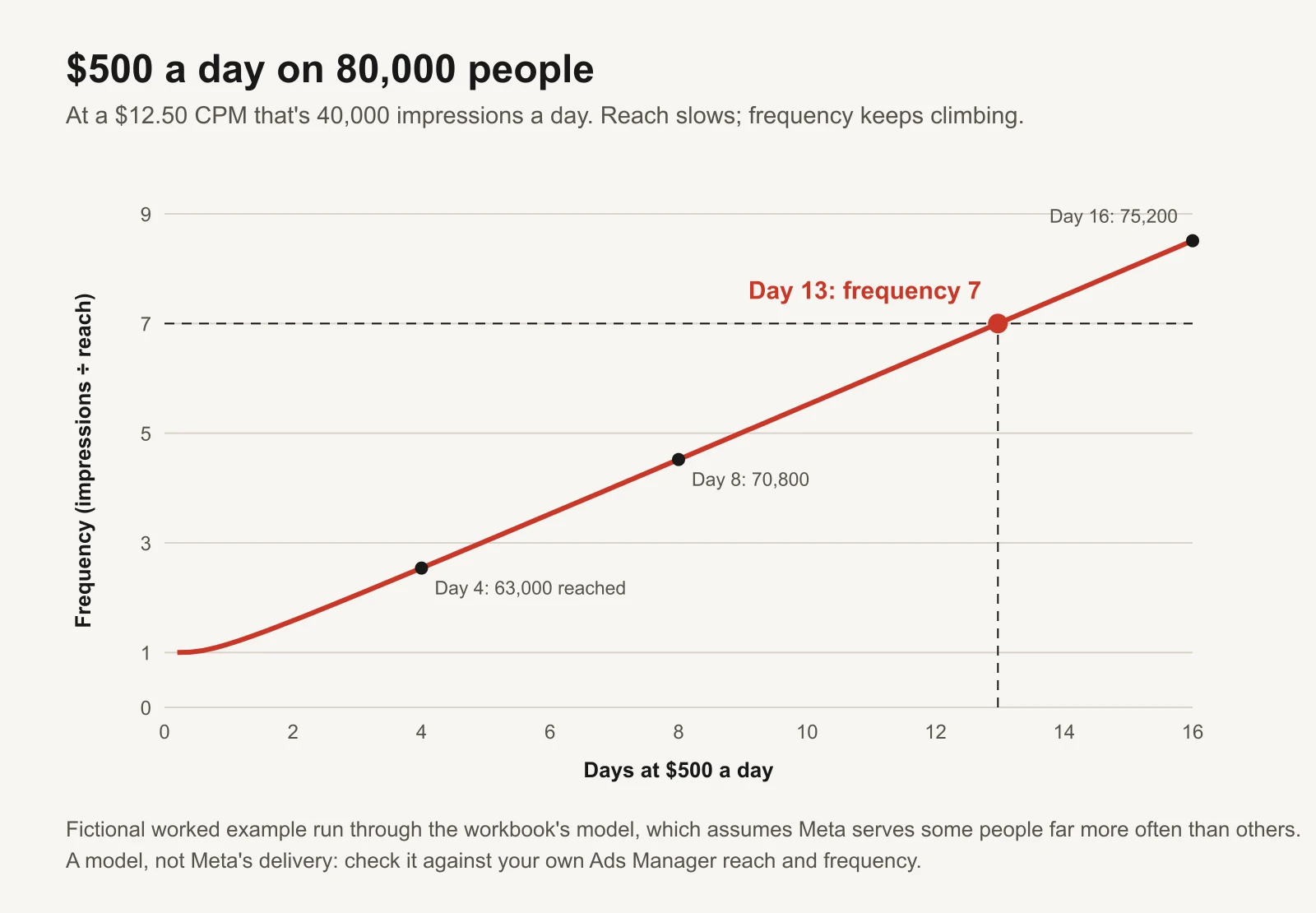
Fictional worked example run through the workbook's model.
A fictional brand spends $500 a day on an audience of 80,000 people at a $12.50 CPM. That buys 40,000 impressions a day: half the audience's worth of impressions, every day.
| Day | Impressions so far | People reached | Frequency |
|---|---|---|---|
| 1 | 40,000 | 34,600 | 1.16 |
| 4 | 160,000 | 63,000 | 2.54 |
| 8 | 320,000 | 70,800 | 4.52 |
| 13 | 520,000 | 74,200 | 7.01 |
| 16 | 640,000 | 75,200 | 8.51 |
Reach grows fast and then flattens: by day 8 most of the people Meta will reach have been reached. Impressions keep coming at 40,000 a day, so frequency keeps climbing. The average person in this audience has seen the ad 7 times on day 13, after $6,500 of spend.
How the calculator works
If Meta showed ads to everyone equally, frequency would simply be total impressions ÷ audience. It doesn't: some people are served far more often than others. The calculator uses a simple model of that skew. With m = impressions so far ÷ audience size:
People reached = audience × m × (1 − e^(−1/m))
Frequency = 1 ÷ (1 − e^(−1/m))
Turn that around and you get the day any target frequency arrives:
Day the target is reached = (−1 ÷ ln(1 − 1/target)) × audience ÷ impressions a day
For a target of 7, the first part is 6.49, so the day is 6.49 × 80,000 ÷ 40,000 = 13.0.
It's a planning model, not Meta's delivery system, so the next section checks it against your own numbers.
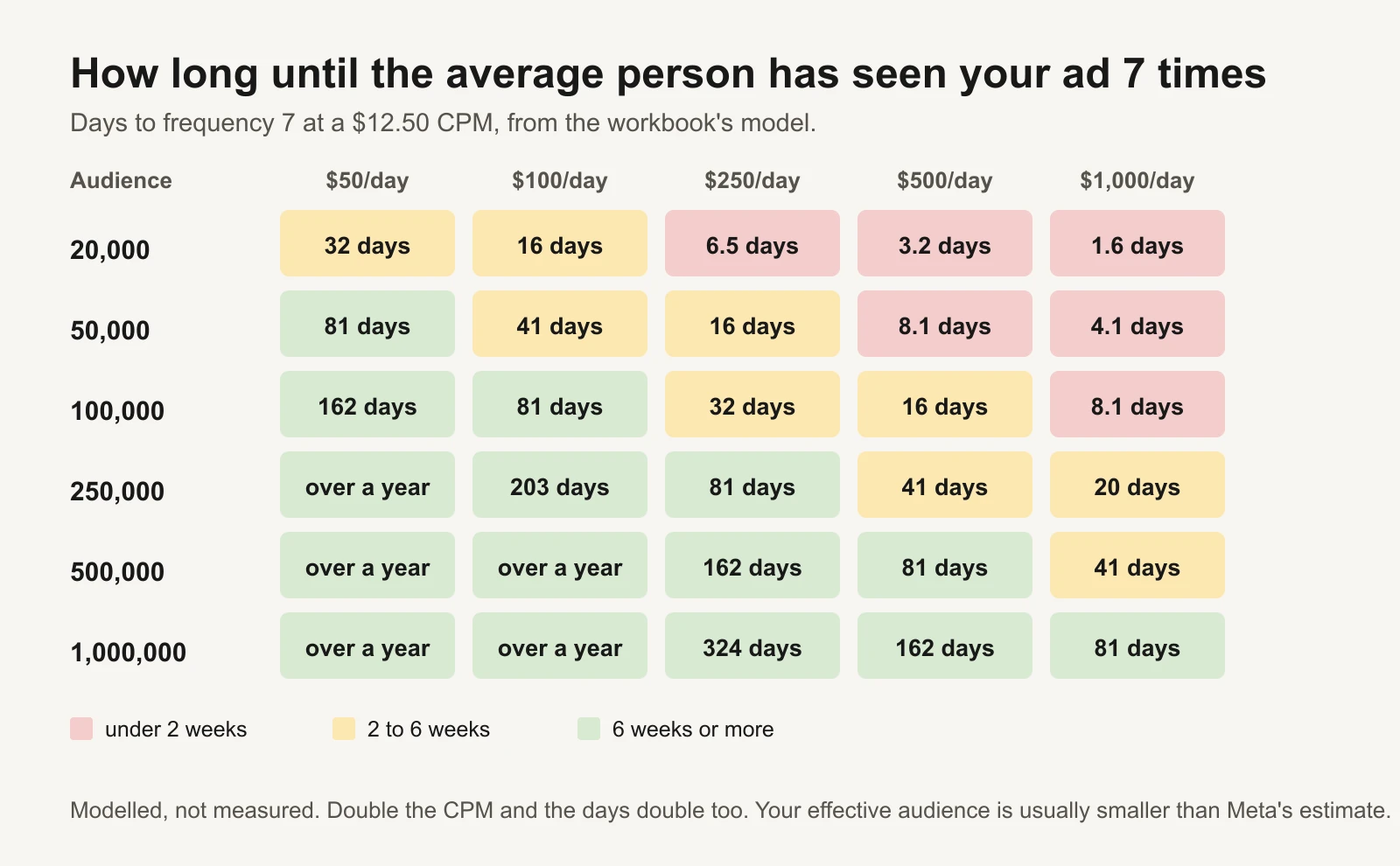
Modelled at a $12.50 CPM. Double the CPM and every number doubles.
The grid makes the trade-off plain. A small audience with a big budget hits 7 in days; a large audience with a small budget takes months. Retargeting audiences live in the top-right corner. That is normal there, as long as cost per result holds.
Calibrate: find your real audience size
The weak input is audience size. Meta's estimated audience size in the ad set is an estimate of who matches your settings, not of who Meta will actually deliver to at your budget and bid. Your effective audience is usually smaller.
You can work it out from what already happened. Take any date range of 7 days or more, starting when the ad set started, and note impressions and reach. Then:
Exposures per person = −1 ÷ ln(1 − 1 ÷ frequency)
Effective audience = impressions ÷ exposures per person
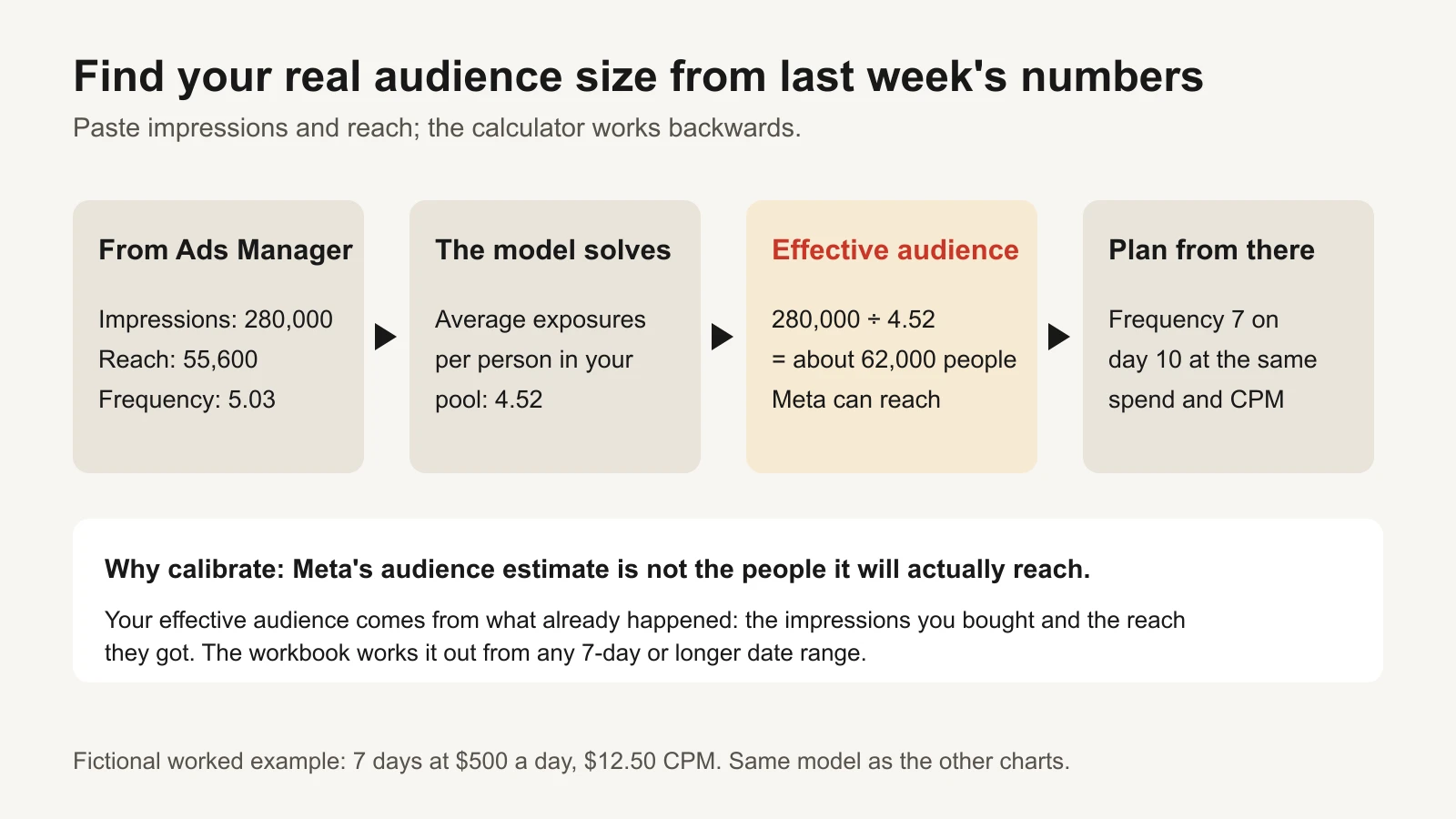
Fictional worked example: 7 days at $500 a day.
Worked example (fictional): a broad prospecting ad set ran 7 days at $500 a day: 280,000 impressions, 55,600 reach, frequency 5.03. The calculator finds an effective audience of about 62,000 people, and at 40,000 impressions a day a frequency of 7 on day 10: three days from now. That's the row the Calibrate tab colours amber.
Do this for every live ad set. The Calibrate tab takes one row each (days, impressions, reach, spend) and gives frequency, CPM, effective audience, days to your target and a status: OK, under a week left, or past target.
Where "the rule of 7" comes from
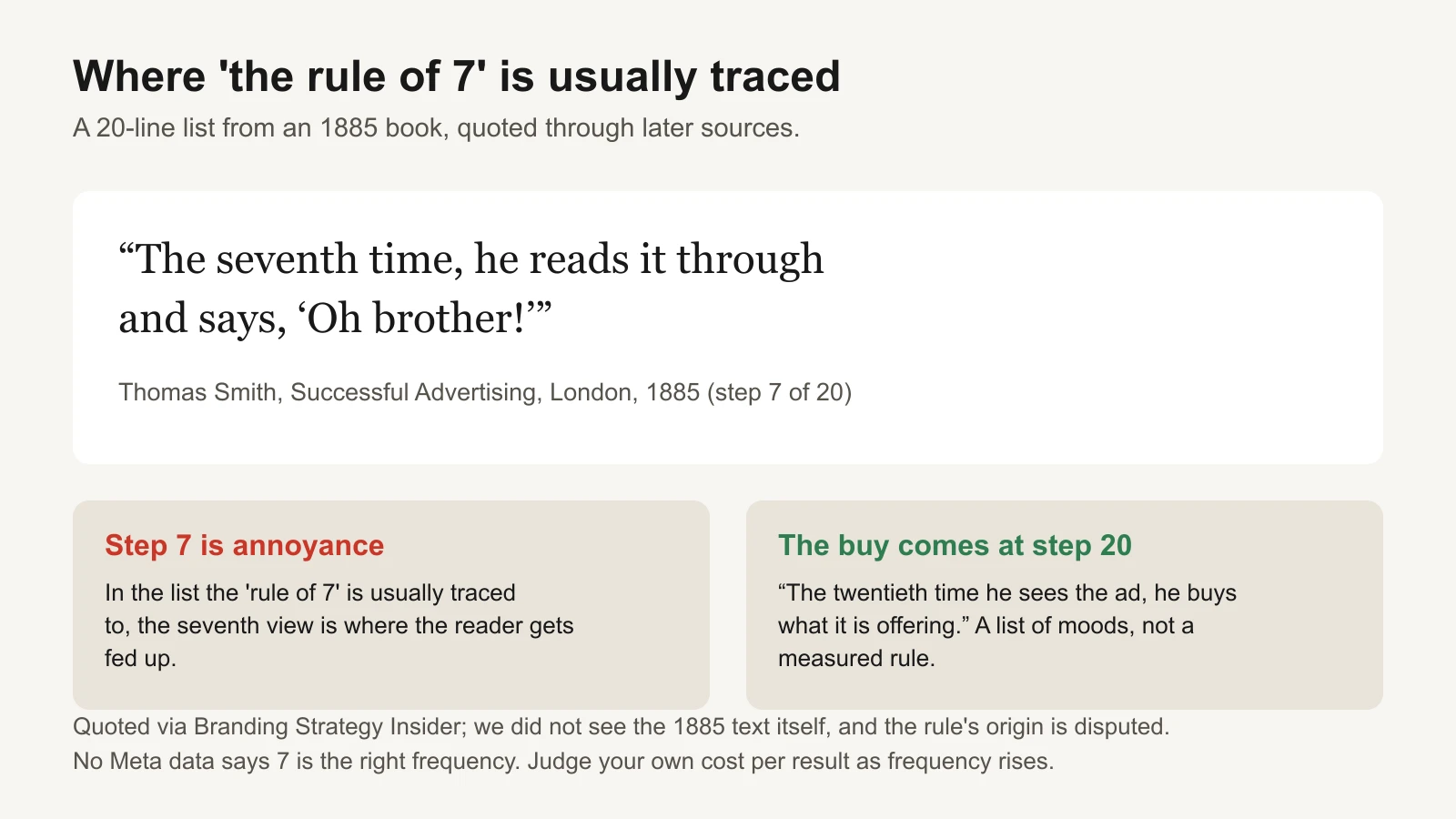
Quoted via Branding Strategy Insider. The rule's origin is disputed.
The idea that people need to see an ad seven times is usually traced to Thomas Smith's Successful Advertising, published in London in 1885. Smith gives a 20-step list of how a reader reacts to seeing the same ad again and again. In it, step 7 isn't the sale. It's the moment the reader "reads it through and says, 'Oh brother!'" The purchase only comes at step 20 (Branding Strategy Insider: advertising frequency theory circa 1885). We quote it through that secondary source; we haven't seen the 1885 text, and several marketing writers say the rule's real origin is unclear.
Either way, it's a list of moods from 141 years ago, not a measured rule, and Meta doesn't recommend any frequency. We use 7 as the calculator's default because it's the number people ask about. Change it on the Planner tab to whatever your own data says.
When frequency climbs: what to do
High frequency is a reason to look, not a verdict. Check in this order:
- Is cost per result rising as frequency rises? If not, leave it. Plenty of retargeting ad sets sell well at a frequency of 8.
- Is reach still growing week on week? If it has flattened, the audience is used up. New creative won't fix that; a bigger audience will (broader targeting, more countries, a wider lookalike). See the fatigue vs saturation guide.
- Is it one ad or all of them? One ad's cost rising while others hold is creative fatigue: refresh that ad (creative fatigue refresh system). All of them rising together is the audience or the offer.
- Is CPM rising too? Higher CPM buys fewer impressions and slows frequency, but raises cost per result for other reasons (CPM spike investigation).
Our earlier guide, Is high Meta ad frequency really creative fatigue?, covers the diagnosis in depth. This one gives you the date it's coming.
Or let GaaS watch it
GaaS is an AI agent that creates, launches and optimises Meta ads from three inputs: your website, a spend limit and a one-line goal. It watches reach, frequency and cost per result for every ad set, lines up new creative or a wider audience before an audience runs out, and asks before anything that changes spend. If you'd rather do it yourself, the calculator does the same maths.
Limits of this calculator
- The reach model assumes a particular kind of skew in who Meta serves. Real delivery depends on bids, placements, competition and your creative. Calibrate against your own numbers and re-check weekly.
- CPM changes daily and through the year; a CPM rise slows frequency, a fall speeds it up.
- Reach in Ads Manager is estimated and de-duplicated across the date range you pick; always use a range that starts when the ad set started.
- The target of 7 is a convention. The 1885 list is quoted through a secondary source.
- The frequency-cap rule comes from Jon Loomer's guide (updated March 2025), not a Meta page we could load; check Ads Manager.
- Example numbers are fictional.
Sources
- Jon Loomer: Meta Ads glossary (frequency = impressions ÷ reach; reach counts Accounts Center accounts; checked 17 November 2026)
- Jon Loomer: Meta needs frequency capping (published 18 May 2022, updated 1 March 2025)
- Branding Strategy Insider: Advertising frequency theory circa 1885 (Thomas Smith, Successful Advertising, 1885)