
Your Meta interest targeting is a suggestion now. And Meta says ignoring it is cheaper.
If you set up your ad sets a few years ago, they probably target a stack of interests: Yoga, Pilates, Lululemon, Whole Foods. Today, on most sales and lead campaigns, Meta treats that stack as a hint about who to show ads to first, not a fence. With Advantage+ audience switched on, it says so openly. And Meta publishes numbers saying advertisers pay less per sale when they let it look beyond the interests.
That doesn't mean you should flip every ad set to broad tonight. An interest ad set that's been working for months is worth protecting, and one setting change can quietly remove targeting you relied on. This guide is the playbook for switching safely: what Meta reports, what it still respects, the exclusions trap, and how to run and read a fair test.
The workbook has an Ad set audit tab (one row per ad set, with the next step for each), a Switch checklist, a Test reader that gives a verdict on a side-by-side test, and reference tabs with Meta's numbers and the hard rules. Example numbers in this article and the workbook are a fictional worked example unless a source is linked. If you're deciding whether to move whole campaigns to Advantage+ sales campaigns, that's a different setting; this guide is about the audience inside any ad set.
What Meta reports
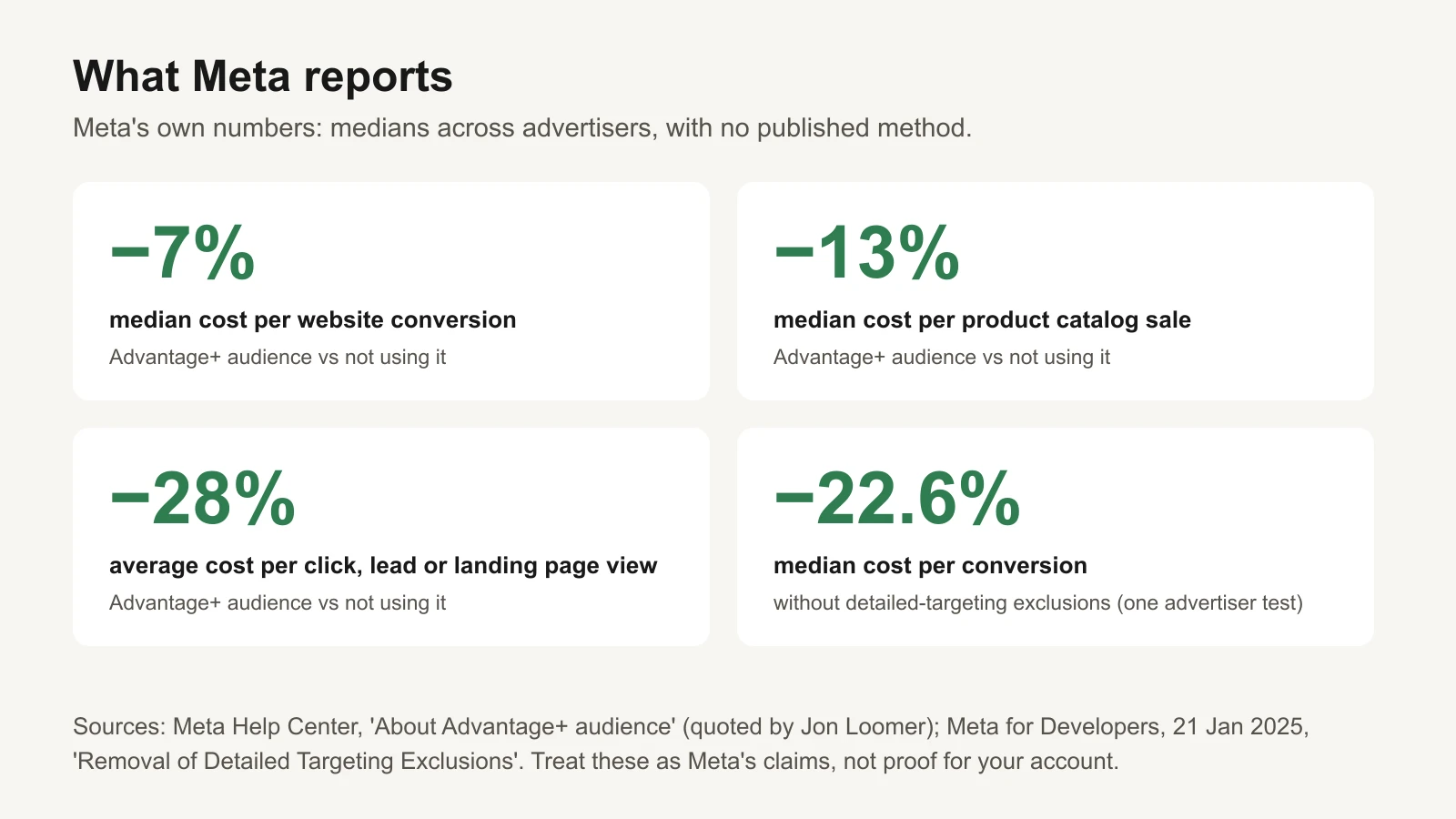
Meta's numbers, with no published method.
Meta's help page on Advantage+ audience, as quoted by Jon Loomer's best-practices guide, reports that compared with not using it, Advantage+ audience gave:
- 7% lower median cost per website conversion
- 13% lower median cost per product catalog sale
- 28% lower average cost per click, lead or landing page view
The same guide mentions a separate 33% lower cost per result from an experiment Meta ran between March and June 2023. And when Meta removed detailed-targeting exclusions in January 2025, its developer blog said an advertiser test showed "the median Cost per Conversion was 22.6% lower when not using Detailed Targeting Exclusions" (Meta for Developers, 21 January 2025).
Read those for what they are: Meta's own figures, medians across many advertisers, with no published method, from the company that sells the ads. Medians also hide accounts where broad did worse. They're a reason to test broad on your account, not proof it will win there. The fair conclusion is "Meta reports", never "proven".
What Meta still treats as hard rules
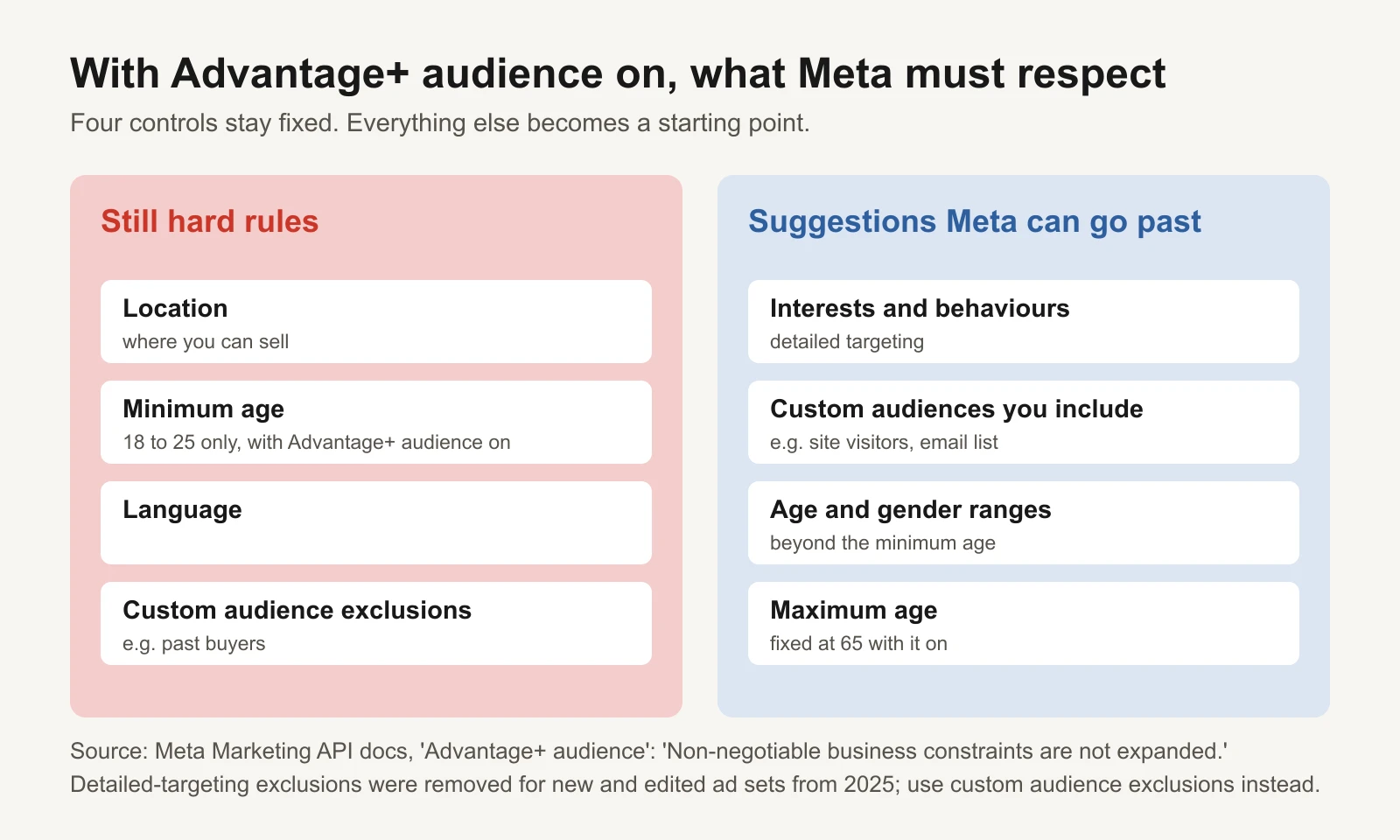
Source: Meta Marketing API docs, "Advantage+ audience".
Broad doesn't mean "anyone, anywhere". Meta's Marketing API documentation says "non-negotiable business constraints are not expanded", and lists them: location, minimum age, language and custom audience exclusions (Meta: Advantage+ audience). Two age details matter:
- With Advantage+ audience on, the minimum age can only be set between 18 and 25. If you need 30+, that ad set can't use it.
- The maximum age is fixed at 65.
Everything else, interests, behaviours, custom audiences you include and age ranges above the minimum, becomes a starting point.
And on most performance goals, it already is. Jon Loomer reported in February 2026, from Ads Manager, that for goals such as maximising conversions, conversion value, landing page views, link clicks and leads, detailed targeting "will only be used as suggestions" even when Advantage+ audience is off (Jon Loomer: detailed targeting is a suggestion). Meta made no announcement we could find. In practice: if your sales ad set targets interests, Meta may already be going past them. Switching to Advantage+ audience mostly makes that explicit and gives Meta fewer limits.
The exclusions trap
This is the one that costs money. Meta removed detailed-targeting exclusions (for example "exclude people interested in Competitor X") in 2025. Old ad sets that had them kept them, but (Meta for Developers):
- Editing an existing ad set removes its detailed-targeting exclusions.
- Duplicating an ad set removes them from the copy.
- Adding new ones gives an error, unless they're covered by an account-level audience control.
So if a long-running ad set still excludes, say, people interested in discount shopping, any edit (including switching on Advantage+ audience) quietly removes that exclusion. Before you touch it, decide which exclusions mattered and rebuild them as custom audience exclusions (recent purchasers, email list, staff), which are still hard rules.
The switch, in four questions
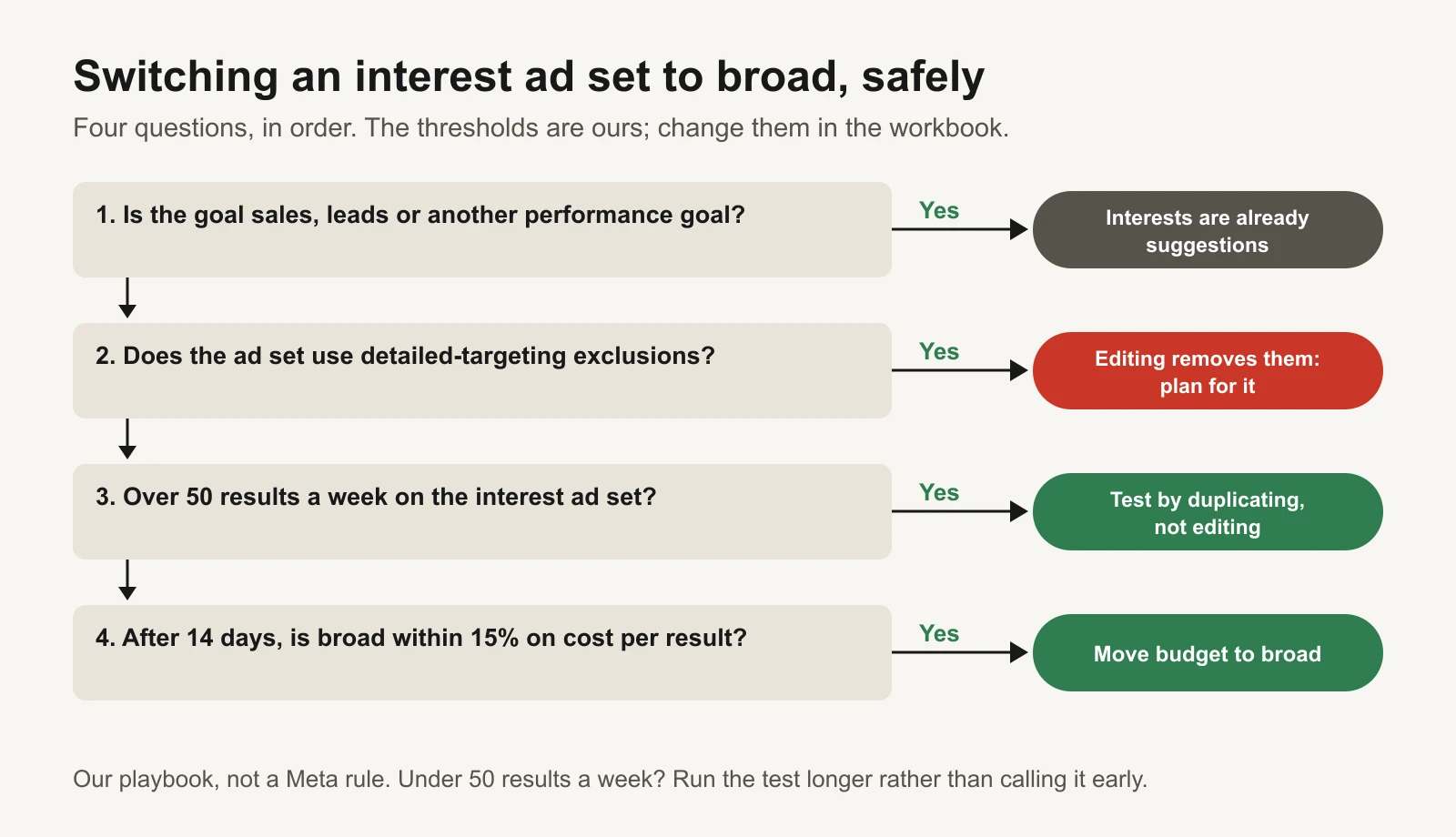
Our playbook, not a Meta rule. Thresholds are on the workbook's Settings tab.
- Is it a performance goal? For sales, leads and similar goals, your interests are probably already suggestions. For reach and awareness, this playbook doesn't apply.
- Does it have old detailed-targeting exclusions? If yes, rebuild the important ones as custom audience exclusions first.
- Does it get enough results to test? Our bar is 50 results a week. Below that, a 14-day test is unlikely to give a clear answer; run it longer or combine small ad sets first (see test sample size and budget).
- Test by duplicating, not editing. Editing a live winner is a significant edit that can restart its learning phase (Meta: significant edits). A copy keeps the original running as your control.
How to run the test
- Duplicate the interest ad set. In the copy, turn Advantage+ audience on and keep your interests as audience suggestions.
- Keep everything else the same: the ads, the budget, the optimisation goal, the attribution setting, the location and age rules.
- Run both for at least 14 days. Don't edit either.
- If you want a proper statistical answer, use Meta's own A/B test (Experiments) with the same two ad sets.
The worked example: a 14-day test
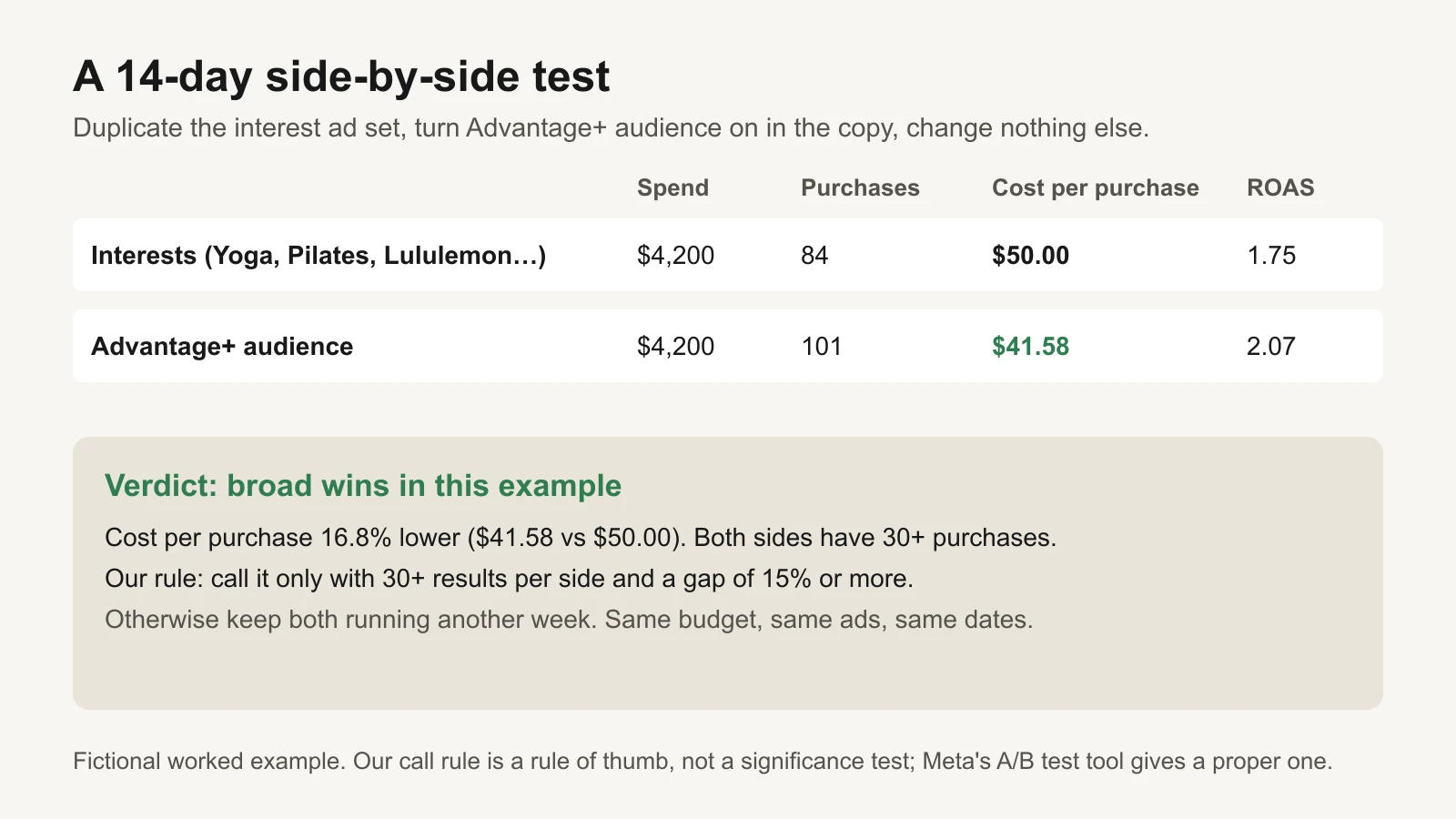
Fictional worked example. Our call rule is a rule of thumb, not a significance test.
A fictional activewear brand duplicates its best interest ad set and runs both for 14 days at $300 a day each.
| Side | Spend | Purchases | Cost per purchase | ROAS |
|---|---|---|---|---|
| A: interests | $4,200 | 84 | $50.00 | 1.75 |
| B: Advantage+ audience | $4,200 | 101 | $41.58 | 2.07 |
The Test reader's rule: call it only when both sides have 30+ results and the gap in cost per result is 15% or more. Here broad is 16.8% cheaper with 84 and 101 purchases, so the verdict is "Broad wins: move budget to B in steps". With a 9% gap, it would say "Too close to call"; with 22 purchases on one side, "Keep running".
Then move budget over a week, not overnight, and turn the interest ad set off once broad holds at the higher budget.
When interests still make sense
- Your business has a real limit Meta can't know. A minimum age above 25, a licence that only covers certain places, a product for one profession. Use the hard rules (location, age, language, exclusions) for those, and test whether interests add anything on top.
- Small budgets with little conversion data. Meta needs signal to find buyers. Under about 50 results a week, interests can steady delivery while the pixel learns. Test again as you grow.
- Reach and awareness goals, where you choose exactly who to reach.
- When your test says so. If interests win by 15% or more with enough results, keep them and retest broad next quarter.
Or let GaaS run the test
GaaS is an AI agent that creates, launches and optimises Meta ads from three inputs: your website, a spend limit and a one-line goal. It audits each ad set's targeting, sets up broad-versus-interest tests without editing your winners, reads them, and asks before moving budget. If you'd rather do it yourself, the sheet does the reading.
Limits of this playbook
- Meta's cost figures are its own, with no published method; your account may differ either way.
- The "suggestion even when off" behaviour comes from Jon Loomer's February 2026 report of Ads Manager, not a Meta announcement. Check your own ad set's audience section.
- The 50-results-a-week bar, the 30-result minimum and the 15% gap are our rules of thumb, not a significance test.
- Results are platform-reported and depend on the attribution setting; use the same one on both sides.
- Example numbers are fictional.
Sources
- Jon Loomer: Advantage+ audience best practices guide (quotes Meta's 7%, 13%, 28% and 33% figures; checked 17 November 2026)
- Meta for Developers: Removal of detailed targeting exclusions (21 January 2025)
- Meta for Developers: Marketing API, Advantage+ audience
- Jon Loomer: Detailed targeting is a suggestion (11 February 2026)
- Meta Business Help Center: Significant edits and learning phase