
There are three common ways to get ads made and run: pay an agency, hire someone, or use an AI tool. Each comes with a price that's easy to see (the fee, the salary, the subscription) and costs that are easy to miss: extra creative, software, onboarding, and hours of your own time.
This guide shows how to add all of it up fairly, with one formula applied to every option. You can run your own numbers in the free agency vs in-house vs AI cost calculator. The workbook adds first-year cost, a sensitivity table across spend levels, a loaded-salary helper and a log for comparing real quotes.
A note on numbers. Every price below is an illustrative input, not a market rate. We don't publish "typical agency fees" because quotes vary widely and we can't verify a fair average. The in-house salary example uses U.S. government data, and we link it. Replace every input with real quotes.
The short answer, in one table
Our example business spends $20,000 a month on ads and needs 20 new ads a month. The owner values an hour of their time at $75.
| Cost line | Agency | In-house hire | AI tool |
|---|---|---|---|
| Fee or salary | $2,500 (10% of spend, $2,500 minimum) | $9,375 ($112,500 a year ÷ 12) | $0 |
| Tools or subscription | $0 | $400 | $500 |
| Creative not covered by the fee | $3,000 (20 × $150) | $3,000 (20 × $150) | $500 (20 × $25) |
| Your time | $450 (6 hours) | $750 (10 hours) | $1,500 (20 hours) |
| Total monthly cost | $5,950 | $13,525 | $2,500 |
| Cost per 100 ads | $29,750 | $67,625 | $12,500 |
| Cost as a share of ad spend | 29.8% | 67.6% | 12.5% |
| Days to first live ads (owner's estimate) | 14 | 60 | 3 |
Ad spend itself is left out of every total. You pay Meta or Google the same $20,000 whichever option runs the account, so it only matters for fees charged as a percentage of spend.
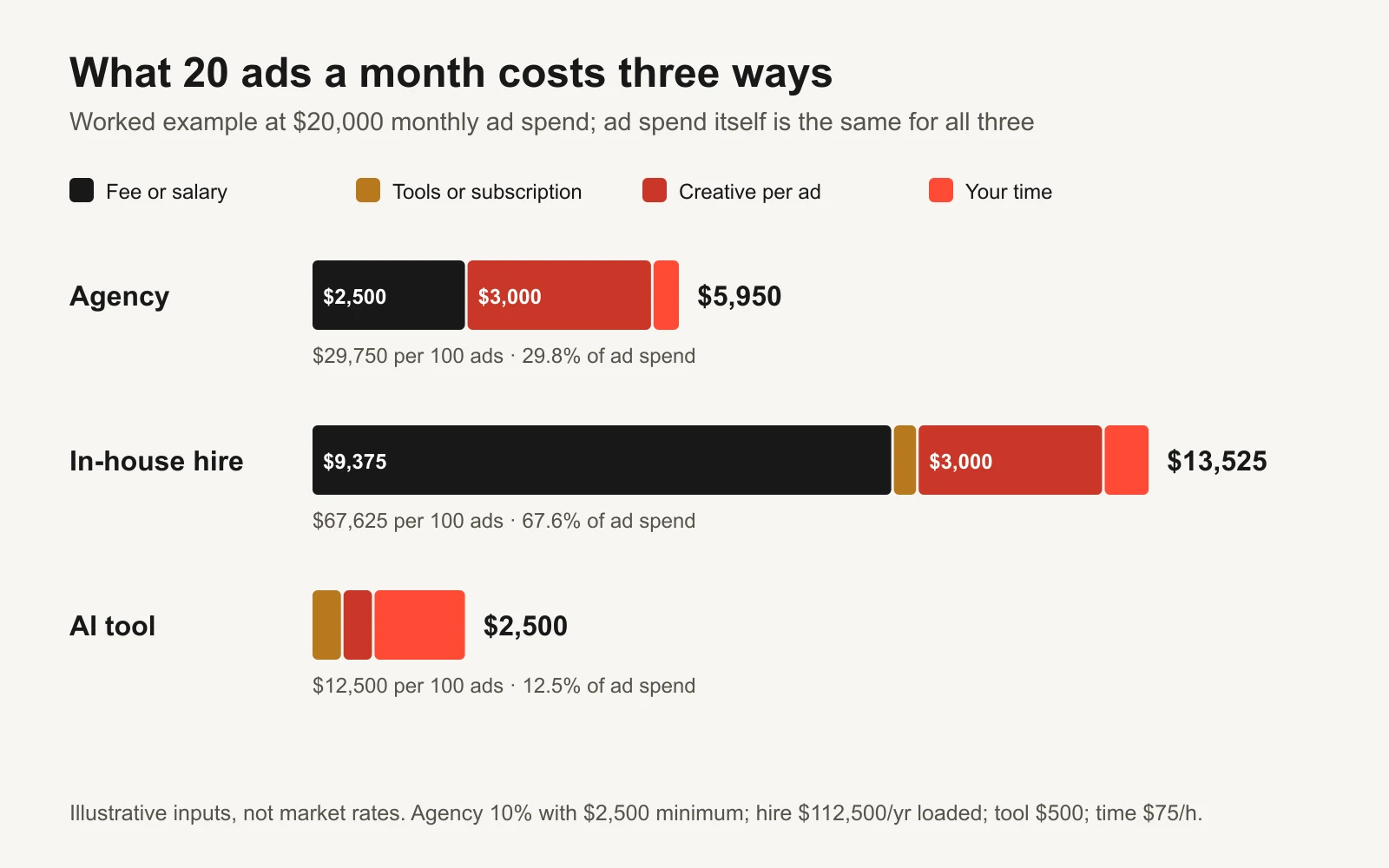
Illustrative inputs. Notice how much of the AI tool's cost is the owner's own time.
Two things in this example are worth noticing before you trust any total:
- The AI tool is cheapest partly because the owner does more of the work. We gave it 20 owner-hours a month against 6 for the agency. If your hours are worth more, or you have fewer to give, the gap narrows.
- The hire costs the most at this spend level, but the hire's cost doesn't grow with spend. That changes the picture as you scale (see below).
What goes into each option
Agency
Agencies price in a few common ways. Ask for the model in writing, because the same headline number can mean very different bills.
| Fee model | How the monthly fee is calculated | What to watch |
|---|---|---|
| Percentage of spend | Fee % × monthly ad spend | The fee rises every time you scale, even if the work doesn't |
| Flat retainer | A fixed amount each month | Check what's included: how many ads, how many campaigns, reporting |
| Minimum fee | The fee never drops below a floor | At low spend, the minimum is what you actually pay |
| Hybrid | Retainer + a percentage, often with a minimum | Our calculator uses: the higher of the minimum, or retainer + % of spend |
| Performance-based | Tied to sales or leads | Agree in advance which conversions count and how they're measured |
Then add anything outside the fee: extra creative, video shoots, user-generated content (UGC) from creators, landing pages, tracking setup, and onboarding fees. Our guide to defining an agency AI service has a scope checklist that makes these visible.
In-house hire
A salary is not the whole cost of an employee. Employers also pay for benefits such as health insurance, retirement contributions and paid leave, plus legally required costs such as payroll taxes.
Two U.S. government figures make a reasonable starting estimate:
| Figure | Value | Source |
|---|---|---|
| Median annual wage for market research analysts, May 2025 | $78,760 | BLS Occupational Outlook Handbook |
| Benefits as a share of private-industry employer compensation, June 2026 | 30.0% | BLS Employer Costs for Employee Compensation |
If benefits are 30% of total compensation, wages are the other 70%. So a fully loaded cost is roughly salary ÷ 0.70: $78,760 ÷ 0.70 ≈ $112,514, which our example rounds to $112,500.
That's an occupation-wide U.S. median, not a quote for a paid-ads specialist in your city. Senior media buyers, creative strategists and people in high-cost areas can cost much more. Use a real salary from your own market. If the person will also run email or social, enter only the share of their cost that belongs to paid ads.
Then add the tools they'll need (design, video editing, reporting) and any creative they won't make themselves.
AI tool
AI ad tools price in different ways too: a flat subscription, tiers by ad spend, a percentage of spend, or credits used per ad generated. Convert the quote to a monthly cost at your spend level, and add any per-ad usage cost.
The cost most people miss here is their own time. An AI tool still needs someone to set the goal, connect the accounts, review what it proposes and approve changes. Be honest about those hours. GaaS is one example of an AI option: an agent that builds and runs Meta and Google ads from a website URL, a spend limit and a one-line goal, and asks for approval before it spends.
Your own time
Every option takes some of your hours: calls and approvals with an agency, managing a hire, reviewing an AI tool's work. Those hours have a cost even when no invoice arrives. Put a number on an hour of your time (what you'd otherwise earn, or what you'd pay someone to cover for you) and enter a realistic number of hours for each option.
How the answer changes with your ad spend
This is where the comparison gets interesting. A percentage fee grows with your budget. A salary and a flat subscription don't.
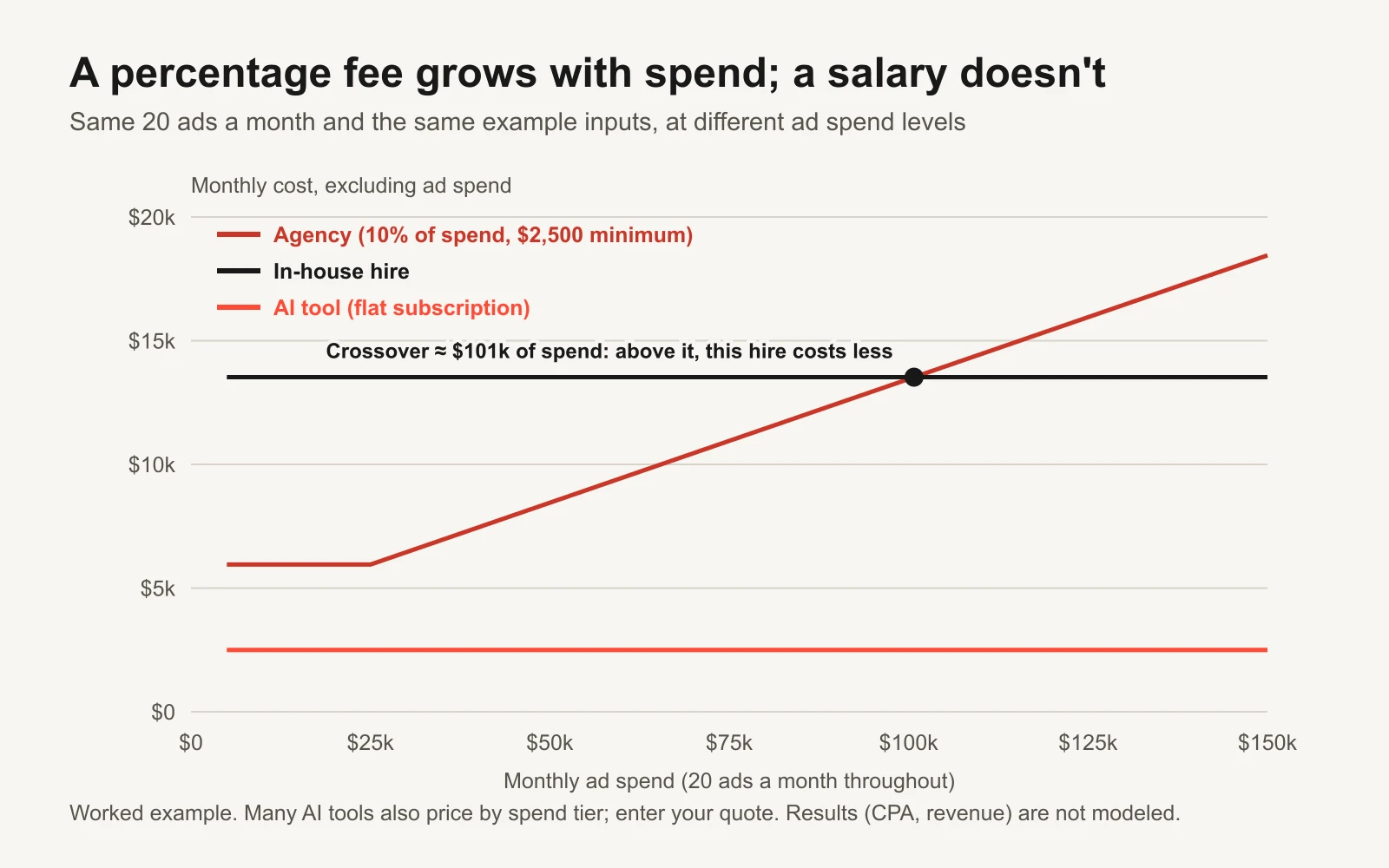
Same example inputs at different spend levels. Many AI tools also price by spend tier, so a flat line is an assumption to check against your quote.
| Monthly ad spend | Agency | In-house hire | AI tool | Lowest in this example |
|---|---|---|---|---|
| $5,000 | $5,950 | $13,525 | $2,500 | AI tool |
| $20,000 | $5,950 | $13,525 | $2,500 | AI tool |
| $50,000 | $8,450 | $13,525 | $2,500 | AI tool |
| $100,000 | $13,450 | $13,525 | $2,500 | AI tool |
| $150,000 | $18,450 | $13,525 | $2,500 | AI tool |
Between the agency and the hire, the crossover in this example sits where 10% of spend plus $3,450 of creative and owner time equals $13,525. That's about $101,000 a month. Below it, the agency costs less than the hire; above it, the hire costs less. With a different fee percentage or salary, the crossover moves, which is exactly why the workbook has a sensitivity tab.
Cost per 100 ads: why volume matters
Fixed costs (a salary, a minimum fee, a subscription) get cheaper per ad as you make more ads. Per-ad costs don't.
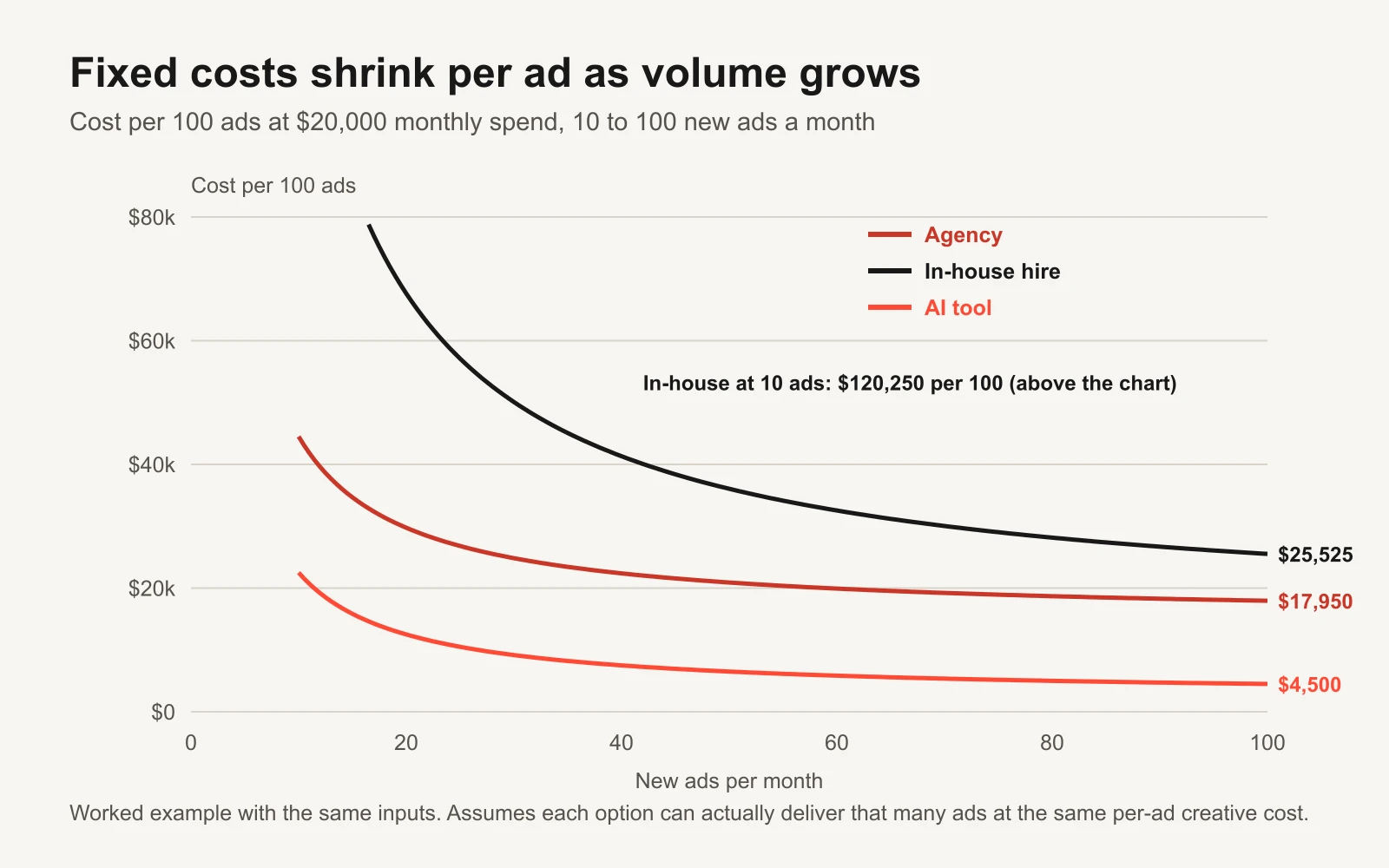
Assumes each option can actually deliver that volume at the same per-ad creative cost. Check that with every provider.
That last caveat is important. One person can't make 100 good ads a month without help, and many agency retainers include a fixed number of ads. "Cost per 100 ads" is a useful yardstick only if each option can really deliver the volume. Ask.
How many ads do you need? It depends on your testing budget. Our creative testing budget calculator works out how many new ads your budget can actually test each month. There's no point paying for 100 ads a month if your budget can only judge 13.
Time to first live ads
The calculator asks for your own estimate of how many days each option takes to get ads live. It repeats your number next to the cost; it doesn't predict it.
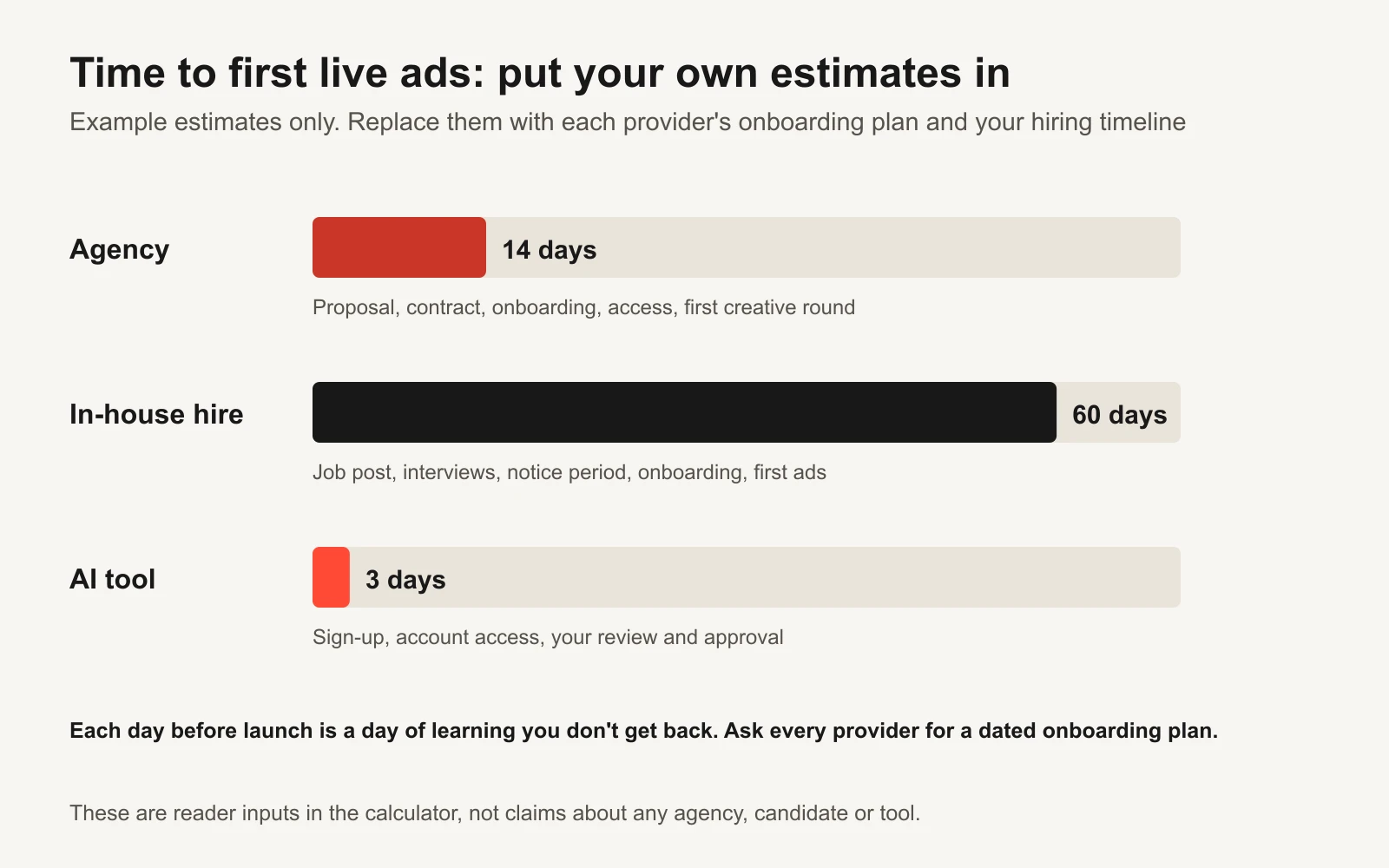
Example estimates only. These are reader inputs, not claims about any agency, candidate or tool.
Ask each provider for a dated onboarding plan: when you get access requests, when you see the first ads, when they go live. For a hire, count job posting, interviews, notice period and ramp-up. Whatever the option, the business still needs working accounts, payment and tracking before anything spends. Our 72-hour launch checklist covers that groundwork.
What the calculator can't price
Cost is half the decision. Here's a fair look at what each option tends to be good at and where it tends to struggle. Individual agencies, people and tools vary a lot.
| Agency | In-house hire | AI tool | |
|---|---|---|---|
| Tends to be strong at | Experience across many accounts, a team of specialists, fast start without hiring | Deep knowledge of your business, full-time focus, learning stays with you | Speed, volume of ads, low fixed cost, works at any hour |
| Watch out for | Fees that grow with spend, junior staff on your account, scope limits, contract terms | Cost and time to hire, one person's skills and availability, needs tools and creative help | Your review time, output quality varies, needs clear goals and limits, check who controls spend |
| Who owns the learning | Shared; make sure reports and test logs come with you if you leave | You | You, if the tool works in your own ad account |
| Best fit when | You want experienced hands now and your fee model makes sense at your spend | Ads are core to the business and spend is high enough to justify a full role | You want to move fast at low cost and can spend a few hours a week reviewing |
Two things matter whichever you choose:
- Own your ad account, pixel and data. If a provider runs your ads in an account they own, your history can leave with them. Our ad account handover checklist and the fire-your-agency kit cover how to keep control.
- Pilot before you commit. Run a time-boxed trial with a clear success measure. Our AI ad platform pilot scorecard shows how to set one up, and the total cost worksheet adds the one-time and correction costs this calculator leaves out.
Questions to ask before you sign
- What exactly is the fee model? Percentage, retainer, minimum, or a mix?
- How many new ads a month are included, and what does each extra one cost?
- Who owns the ad account, the pixel, the creative files and the reports?
- What's the minimum term and the notice period?
- What's the dated plan to first live ads?
- Who will actually work on the account, and how many accounts do they handle?
- How do approvals work? Can anything spend or change without your yes?
- For a hire: what's the fully loaded cost, and who covers holidays and sick days?
- For an AI tool: how is it priced at your spend level, and what limits can you set on spend?
- How will you measure success in the first 30, 60 and 90 days?
The workbook's quote log has a column for each of these, so you can compare answers side by side.
Tools and repos that help
Whichever option you pick, these public projects (checked on 16 November 2026) can lower the cost or make the work more transparent.
| Tool or repo | What it does | Who it's for |
|---|---|---|
| googleads/google-ads-mcp | A Model Context Protocol (MCP) server for the Google Ads API. AI agents can query accounts; write actions need a propose-then-confirm step with an audit record. | Owners or in-house hires using Claude or other agents on Google Ads |
| pipeboard-co/meta-ads-mcp | A third-party MCP server (not made by Meta) for reading and managing Meta ads from AI assistants | Agent users on Meta; review its permissions first |
| meta/facebook-python-business-sdk | Meta's official Python SDK for the Marketing API. Pull spend and results into your own reports. | In-house hires who want reporting without a paid dashboard |
| googleads/google-ads-python | Google's official Python client for the Google Ads API | The same, for Google Ads |
| anthropics/skills | Anthropic's public Agent Skills, including an xlsx skill for building and editing spreadsheets | Anyone who wants an agent to fill in or extend this workbook |
| facebookexperimental/Robyn | Meta Marketing Science's open-source marketing mix modelling (MMM) package | Larger advertisers judging whether spend is working at all, whoever runs it |
How to use the workbook
| Tab | What it does |
|---|---|
| Start here | Plain-English instructions and key terms |
| Comparison | Shared inputs, then three columns with the same nine inputs each. One formula for every column: total monthly cost, cost per 100 ads, share of ad spend, first-year cost with setup, days to live and a rank. The cheapest is highlighted. |
| Sensitivity | Monthly cost at nine spend levels and cost per 100 ads at seven ad volumes, with the lowest option named in each row |
| Loaded salary | Turns a base salary into a fully loaded cost from your benefits share, with the BLS sources |
| Quote log | One row per real quote: fee model, term, notice, ads included, account ownership and days to live |
Yellow cells with blue text are yours. Grey cells are formulas. Example values are illustrative.
Limits of this comparison
- It compares cost and your speed estimate, not results. It doesn't predict which option gets better ads, lower cost per acquisition or more revenue.
- Example inputs aren't market rates. Only the BLS figures come from a published source, and they're U.S.-wide medians.
- It assumes the same output. If scopes differ, add the missing work as a cost or note it in the quote log.
- Prices change. Re-enter quotes whenever a provider changes its pricing or your spend moves into a new tier.
Sources checked 16 November 2026.