
Athletic Brewing makes non-alcoholic beer, and it sells in stores as well as online. That makes selling online harder: why order a six-pack to your door when a store near you may have one?
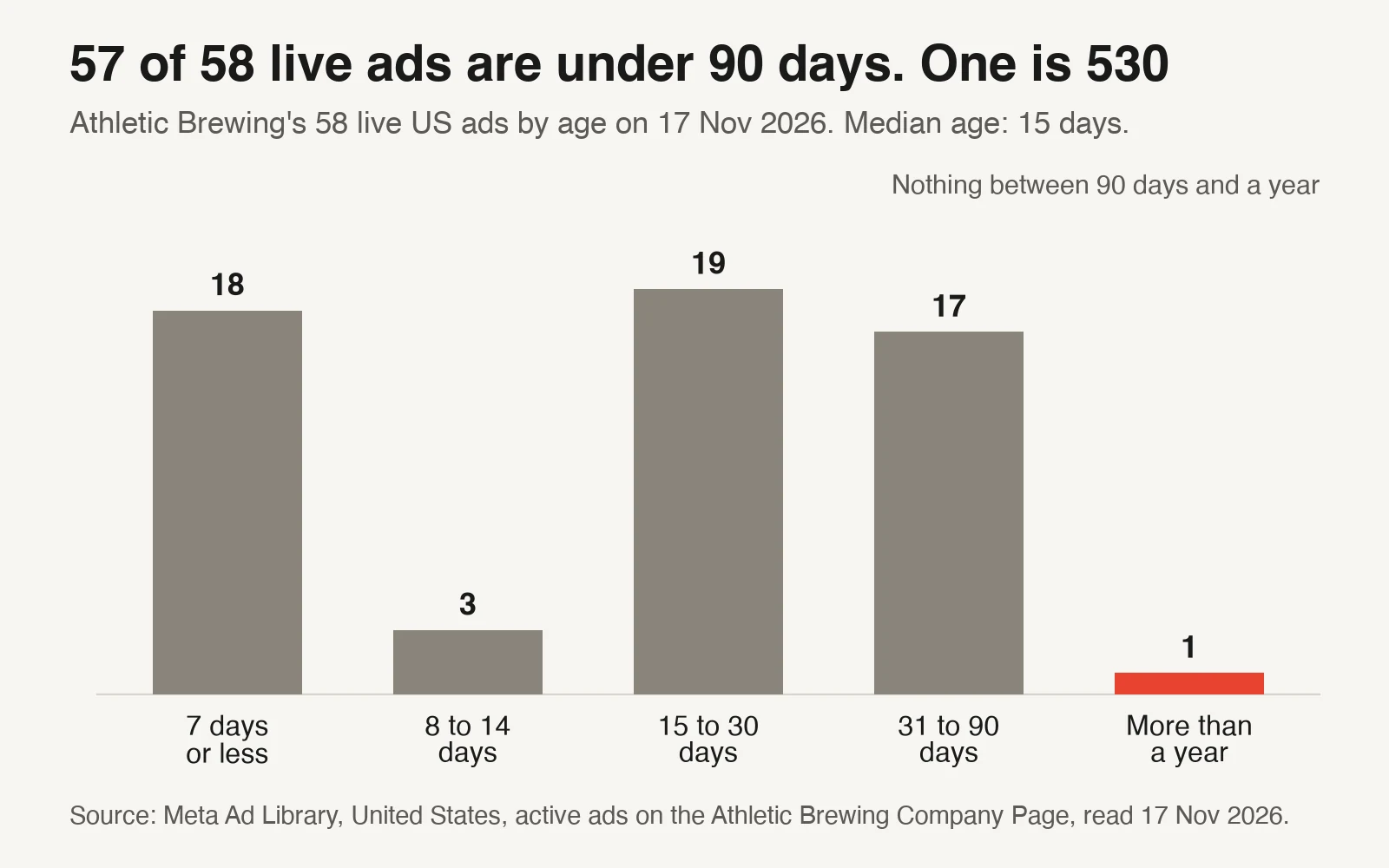
Its oldest live Meta ad answers that question. On 17 November 2026 it had been running for 530 days, since 5 June 2025, and it doesn't sell one beer. It sells what you can't buy in a store: "Online only limited-edition brews and best-selling classics…". Every other live Athletic ad is under 90 days old.
This teardown covers all 58 live ads: the one that lasted, the seasonal ads around it, the NFL quarterbacks, and a Black Friday offer with no "% off". With a template and an offer calculator to run the same play.
How we read the library, and what it can't tell you
We opened the Athletic Brewing Company Page in the Meta Ad Library on 17 November 2026, signed in, with active ads, all ad types and the United States selected, and scrolled to the end. 58 distinct ad cards loaded; the header said "~66 results", which counts versions. For each card we logged the start date, format, advertiser line and first line.
Three limits matter before any conclusion:
- Live ads only. Outside the EU, Meta's library shows ordinary product ads only while they run (Meta Transparency Center: Ad Library tools). "530 days" means still running after 530 days.
- No results. The library shows no spend or sales. An ad Athletic keeps paying to run for a year and a half is a strong signal, but not proof of performance.
- A small account. 58 ads is a focused read. One ad carries the main finding, so treat it as one well-documented example, not a full strategy map.
Product and offer facts below come from athleticbrewing.com, checked on 17 November 2026.
Finding 1: everything is recent except one ad
57 of 58 under 90 days. Then a gap, then one ad at 530.
The median live ad is 15 days old and 9 in 10 are 64 days old or less. 25 are video. Then there is nothing between 90 days and a year, and one ad at 530 days. That gap is the story: every seasonal and promotional ad gets replaced, and one evergreen ad doesn't.
Finding 2: the ads that last sell access
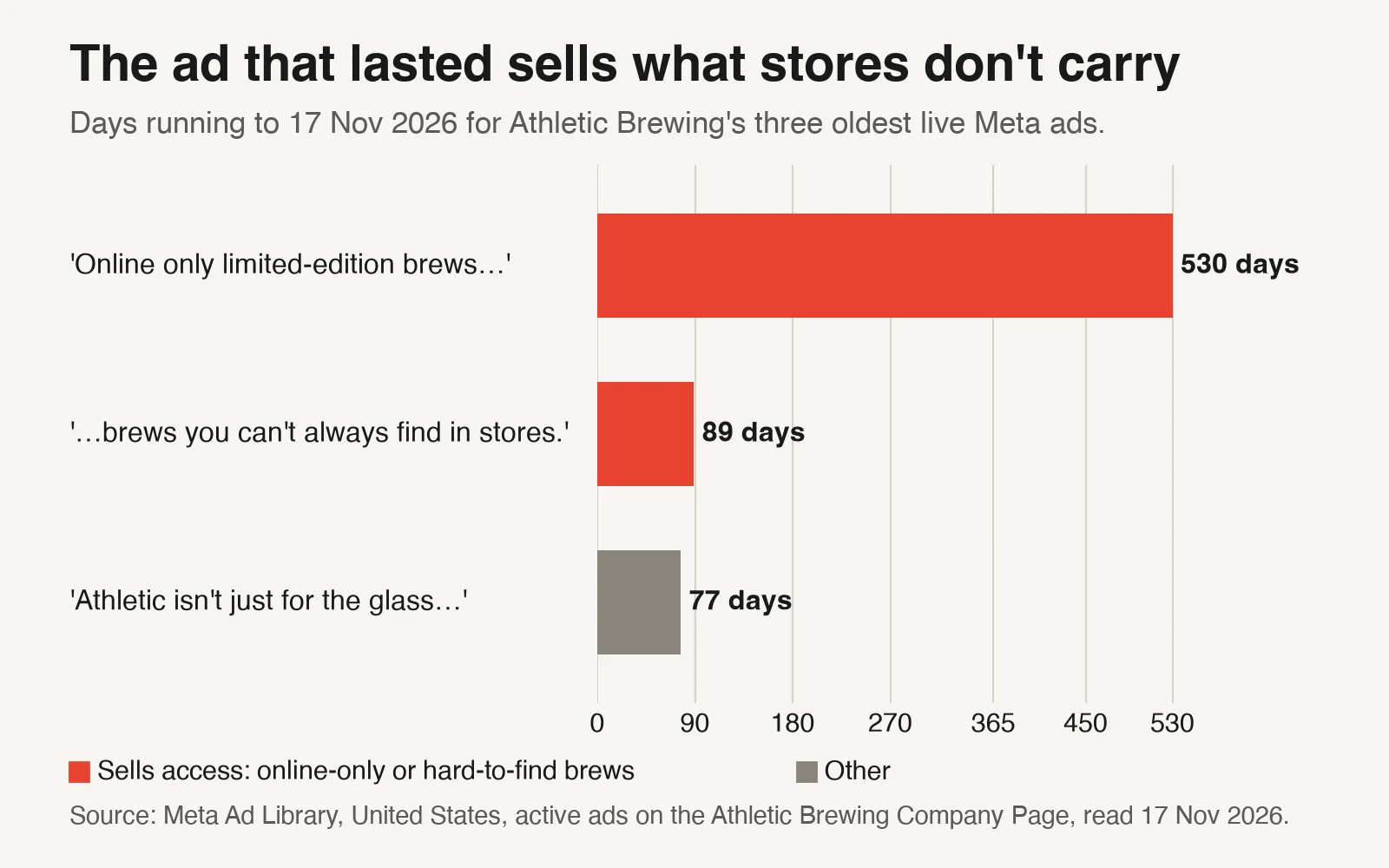
The two oldest both sell the range you can't get on the shelf.
| Started | Days running (to 17 Nov 2026) | Format | First line | Library link |
|---|---|---|---|---|
| 5 Jun 2025 | 530 | Image | "Online only limited-edition brews and best-selling clas[sics]…" | Ad |
| 20 Aug 2026 | 89 | Image | "Try the Athletic brews you can't always find in stores." | Ad |
| 1 Sep 2026 | 77 | Video | "Athletic isn't just for the glass. Add it to the recipe" | Ad |
The two oldest ads say the same thing in different words: our website has beer your store doesn't. The site backs it up. Many products carry an "Online Only" label, and the FAQ talks about brews "you can't get anywhere else".
This is the cleanest answer we have seen to "why buy from the brand online?". Not a discount (the store can match it), not free shipping (the store has no shipping), but access: a range that only exists on the website. An ad built on that reason doesn't expire with a season or a sale, which may be why it is still running after 530 days.
Finding 3: holiday ads, quarterbacks, and a sale with no "% off"
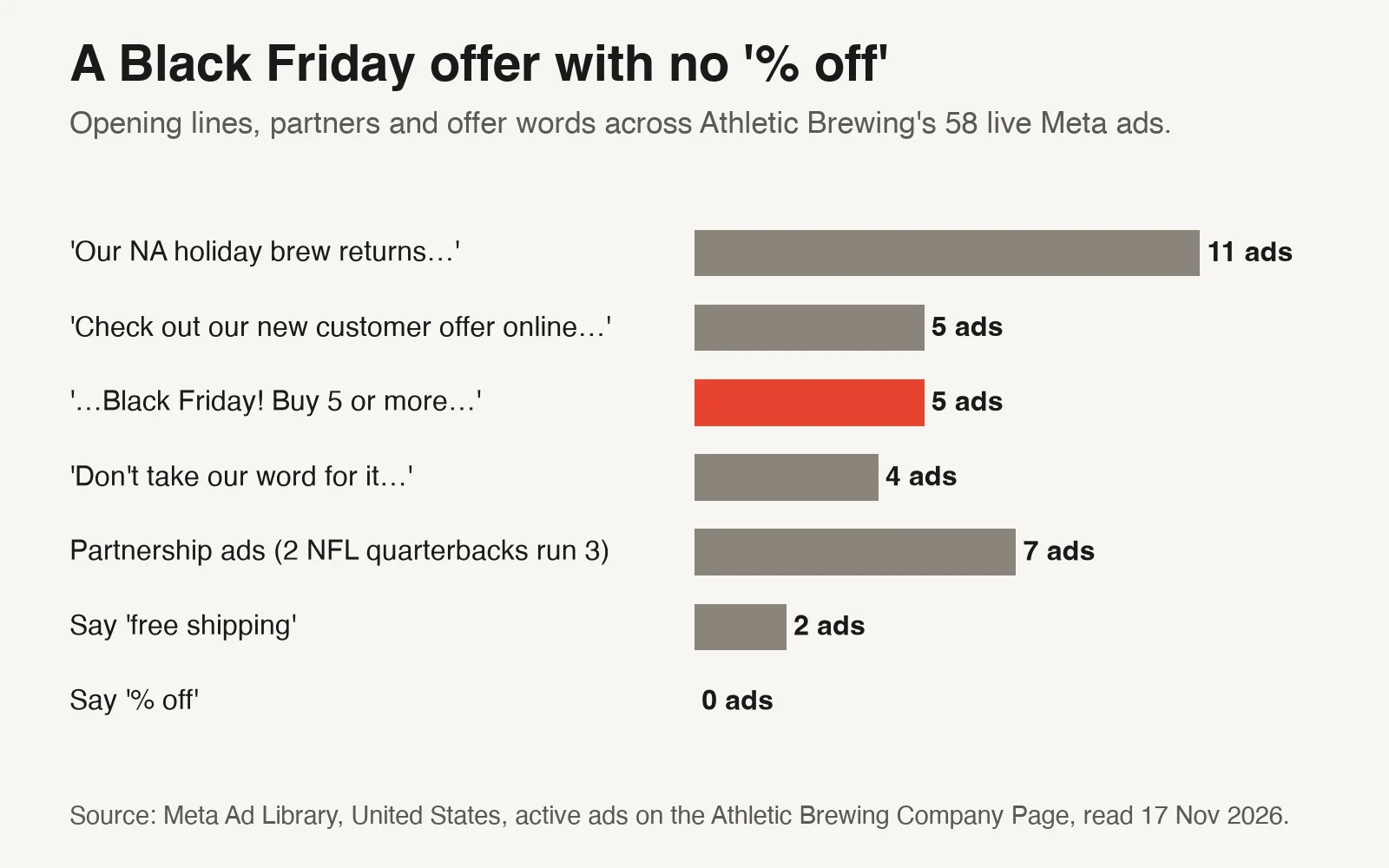
The Black Friday offer is a multi-buy. No ad says '% off'.
Around the evergreen ad, the account changes with the season:
| Opening line | Ads |
|---|---|
| "Our NA holiday brew returns with notes of mulled apple…" | 11 |
| "Check out our new customer offer online…" | 5 |
| "A little something extra for Black Friday! Buy 5 or mor[e]…" | 5 |
| "Don't take our word for it. Let your taste buds decide." | 4 |
Three things stand out.
A seasonal drop. The holiday brew "returns" opens 11 ads, the account's most repeated line. A returning limited beer is a reason to buy now without cutting the price.
Faces with reach. 7 ads are partnership ads that run under someone else's name. Two are NFL quarterbacks: Drake Maye runs 2 and Dak Prescott 1. For a non-alcoholic beer, an athlete's name says "this fits a training life" faster than any claim.
A sale with no percentage. 16 ads mention the holidays or Black Friday, but none says "% off" and only 2 mention free shipping. The Black Friday offer is a multi-buy: "Buy 5 or more". On the site it reads as a limited-edition free glass when you buy five or more 6-packs or 4-packs, mixed and matched. A multi-buy raises the order size, and a branded glass costs far less than a percentage off five packs.
How Athletic Brewing sells online against the shelf: four moves
1. Give people a reason the store can't match. Online-only and limited brews. If your product is in retail, your ads need something only your site has: a range, a bundle, early access, a size.
2. Keep that ad running. It doesn't depend on a season, so there is no reason to switch it off. Rotate everything else around it.
3. Layer seasonal drops on top. The holiday brew returns every year, with its own batch of ads.
4. Sell the sale with a multi-buy and a gift, not a percentage. "Buy 5 or more" plus a free glass. The promotional discount economics post and how to build a winning offer in 30 minutes go deeper on offer design.
The template
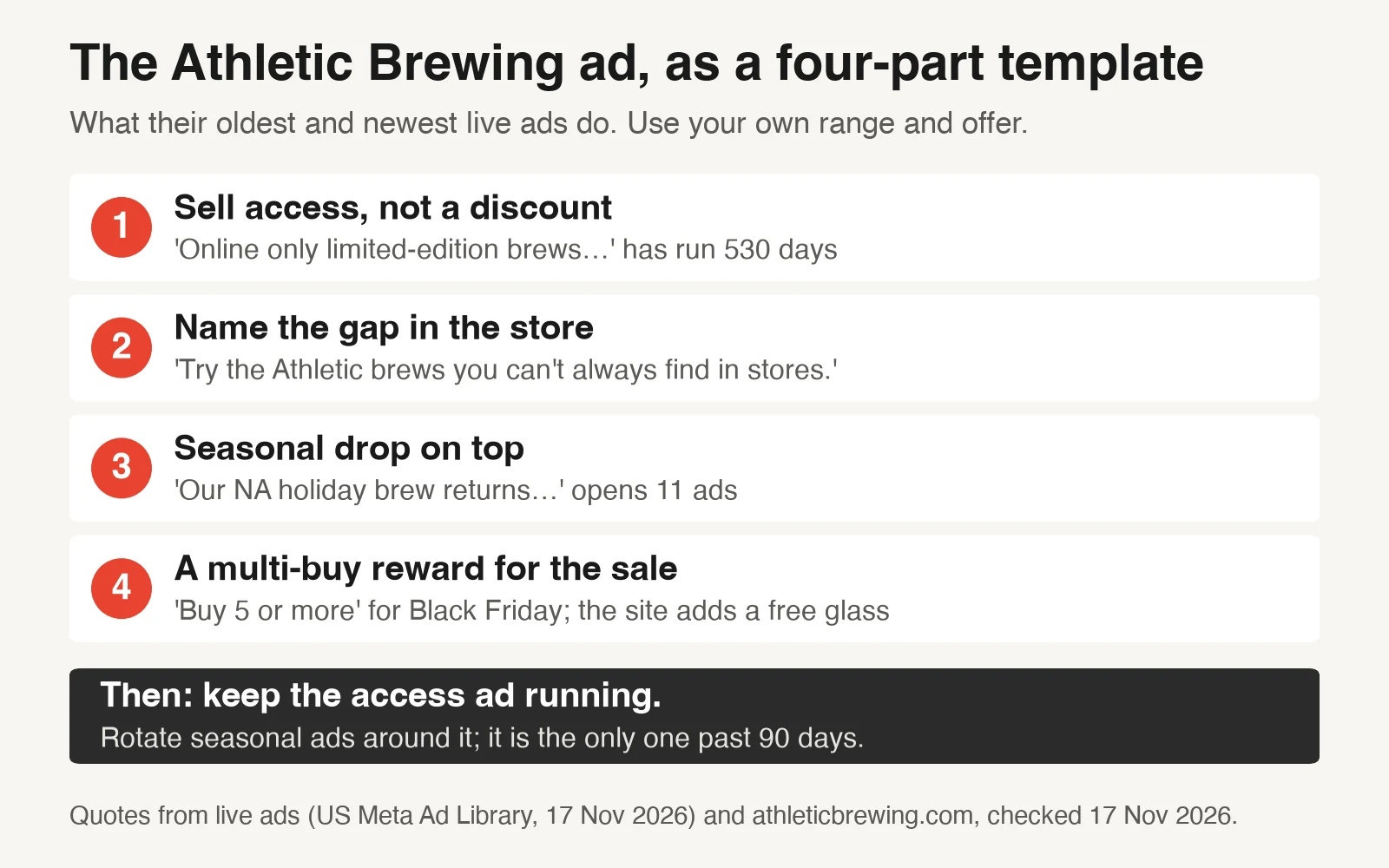
The workbook's "Copy the system" tab has the template with Athletic's examples next to an empty column for yours:
- The access line. What can people get only from you? "Online only limited-edition brews…"
- The gap. Name what the shelf is missing. "…you can't always find in stores."
- The drop. A seasonal or limited item that returns. "Our NA holiday brew returns…"
- The reward. For the sale, a threshold and a gift instead of a percentage. "Buy 5 or more" and a free glass.
Copy the system, not the ads. And if you use athletes or other creators, get their agreement and run it as a proper partnership ad.
Compare the offers in the sheet
The workbook's "Offer compare" tab puts a percentage discount and a multi-buy gift side by side. Type your price per unit, your cost per unit (product plus packing), the discount you would otherwise run, the multi-buy threshold and the cost of the gift. It works out revenue, cost and profit per order for each offer, and how many discounted orders you would need to match the profit of one multi-buy order.
In the fictional example, a pack sells for $14 and costs $6. A customer buying 5 packs at 25% off pays $52.50 and leaves $22.50 of profit. The same customer buying 5 packs with a free $4 glass pays $70.00 and leaves $36.00. At these numbers the discount needs 1.6 orders to earn what one multi-buy order earns. Your numbers will differ; the sheet shows the gap for yours.
Read any competitor the same way
The "Ad log" tab is prefilled with Athletic's three oldest live ads. Add your own competitor below: open their Page in the Meta Ad Library with active ads and your country, scroll to the end, and log each card's library ID, start date, format, angle (access, seasonal, offer, proof) and first line. The "Summary" tab shows the oldest ad, the share older than 30 days and the count by angle. If a competitor's oldest ad sells access, that is the reason they think customers buy from their site; write yours down too. The Ad Library competitor playbook covers the rest of the method.
Tools and repos that help
| Tool or repo | What it is for | Who should use it |
|---|---|---|
| Meta Ad Library | Every live ad for a Page, with start dates and advertiser lines | Everyone; this teardown is built on it |
| Meta Transparency Center: Ad Library tools | What the library keeps, for how long | Anyone drawing conclusions from "days running" |
| facebookresearch/Ad-Library-API-Script-Repository | Meta's Python examples for the Ad Library API (EU-delivered ads only for ordinary product ads) | Developers tracking ads in a spreadsheet |
| anthropics/skills | Public agent skills, including an xlsx skill that lets Claude fill in the offer sheet and the log | Anyone who wants an assistant to keep the tracker up to date |
Or let GaaS run it
GaaS is an AI agent that creates, launches and optimizes Meta ads from three inputs: your website, a spend limit and a one-line goal. It finds the reason to buy from your site, keeps that ad running, adds seasonal ads and offers around it, and nothing spends without your approval. See how GaaS works. Either way, the calculator below is yours to keep.