
You paid the most expensive ad prices of the year to get your Black Friday customers. Many of them came for the discount, bought once and will never think of you again unless you give them a reason.
That is the quiet cost of Black Friday. The sale itself can look great on the day. Whether it was worth it depends on what those new customers do next, and most stores leave that to chance.
This guide is a 30-day plan to get the second order. It is six messages, a few retargeting audiences, one calculation to tell you whether it pays, and a tracker to check whether your Black Friday buyers come back as often as your normal ones. It is written for a business owner with an email or SMS tool and a Meta ad account, with enough detail for a retention or performance marketer to load it as it is.
The free workbook holds the flow with send dates for Black Friday and Cyber Monday buyers, the retargeting audiences, an economics calculator and a cohort tracker with a chart. All numbers in this article are a fictional worked example unless a source is linked.
Why Black Friday buyers need their own plan
The best-sourced numbers we found are old, so read them as direction, not as a forecast.
- Retention Science, 2015 holiday data. In an analysis of nearly 6 million orders from more than 3 million consumers, first-time Black Friday buyers were 19% less likely to make a repeat purchase and made 20% fewer purchases over time than other customers. Cyber Monday first-timers were 26% less likely to buy again, with 23% fewer purchases. One twist: customers whose first purchase came over that weekend spent 12% more than other customers through the year. The figures were published by Retention Science's own CEO in Entrepreneur on 4 December 2015.
- Optimove, Black Friday 2021 data. One month after Black Friday, 8% of new customers had bought again, against 15% of existing customers. Six months after, it was 16% against 33% (Optimove, 11 October 2022). Optimove compared new with existing customers, not with new customers from other months, and it is vendor research with no sample size published.
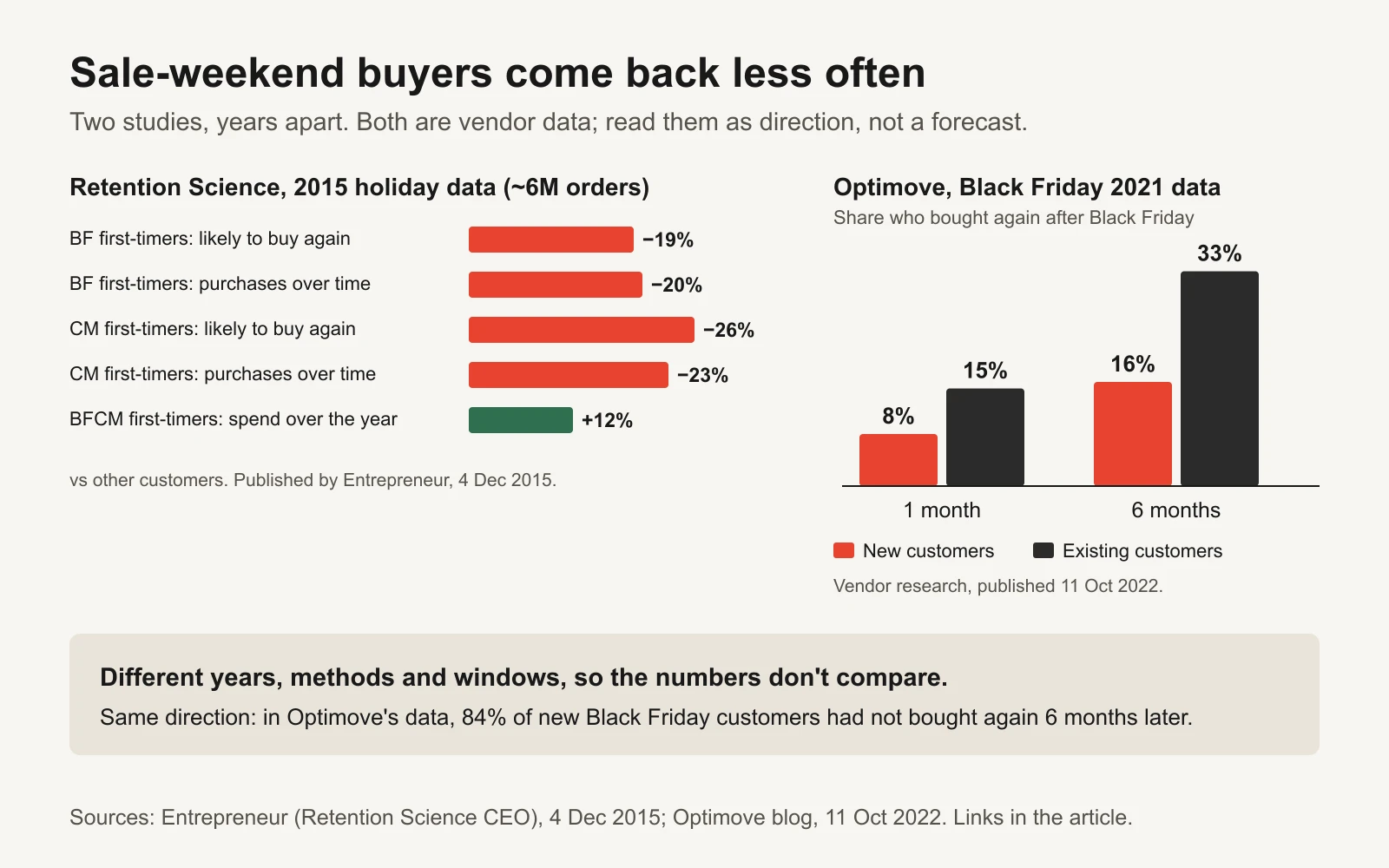
Different years and methods, so don't compare the numbers with each other. Both point the same way.
The reason is not mysterious. A sale brings in people who were waiting for a price. They have no habit with you yet, the product may be a gift for someone else, and in December your next email lands among dozens of others. None of that is fixed by a bigger discount. It is fixed by giving the right person the right reason in the weeks after the first order.
The good news in the 2015 data is the 12%. Sale buyers are not worse customers; they are customers who haven't been given a second reason yet.
The flow: six messages in 30 days
The trigger is a customer's first-ever order placed between Black Friday and Cyber Monday. The exit is a second order. Everything below is counted in days after that first order.
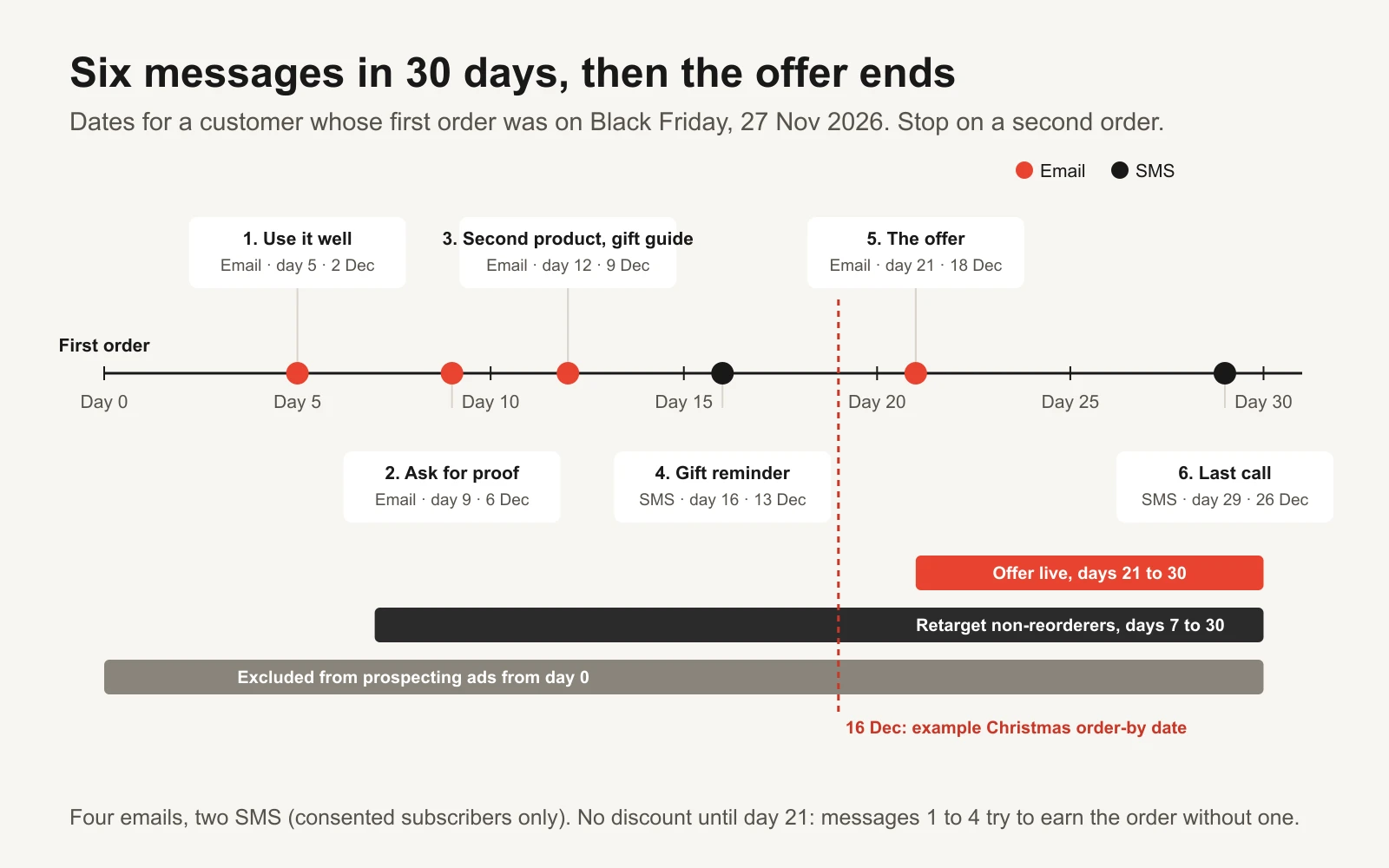
For a Cyber Monday buyer every date moves three days later. The workbook shows both.
| # | Day | Channel | Job | What it says | Offer? |
|---|---|---|---|---|---|
| 1 | 5 (delivery + 1) | Use it well | A 3-step how-to, a short video, one tip people miss | No | |
| 2 | 9 | Ask for proof | Ask for a review or photo; show what other customers pair it with | No | |
| 3 | 12 | Second product | One cross-sell picked from their first product, plus a gift guide with your Christmas order-by date | No | |
| 4 | 16 | SMS | Gift reminder | A gift for someone else, ordered by your Christmas order-by date | No |
| 5 | 21 | The offer | The second-order offer, with its end date | Yes | |
| 6 | 29 | SMS | Last call | "Last day tomorrow" | Yes |
Why no discount until day 21? These customers just bought on a discount. Sending another one on day 2 teaches them to wait for one. The first four messages try to earn the second order with use, proof and relevance; the offer is there for the people they don't reach. Anyone who reorders before day 21 never sees it, which keeps the offer's cost down.
Why this order? A customer who uses the product well and likes it is the one who buys again, so message 1 is about use, not selling. Message 2 asks for a review while the product is new, and the reviews you collect feed messages 3 and 5 and your ads. Messages 3 and 4 ride the one thing December gives you for free: people need gifts, and you already know this customer likes what you sell.
Christmas changes the calendar. For a Black Friday buyer on 27 November 2026, day 16 is 13 December, before the main USPS cutoffs (Ground Advantage on 17 December, so a customer order-by date around 16 December in the example store). For a Cyber Monday buyer, day 16 is 16 December, right on that date. The workbook checks each gift message against your own order-by date and tells you when to send a gift-card version instead. Our last 10 days before Christmas plan works those dates out for your carriers.
Rules that keep the flow honest:
- Stop on a second order. Messages 3 to 6 stop the moment the customer orders again. Messages 1 and 2 are useful to everyone, so let them run.
- SMS only with consent. Send the two SMS only to people who opted in to marketing texts, with your provider's consent wording. In the US the TCPA and state laws apply; don't improvise this part.
- Email deliverability. A December send to thousands of new subscribers is exactly when spam filters look hardest. Google requires SPF and DKIM, DMARC for bulk senders, one-click unsubscribe and a spam rate kept below 0.3% (Google: Email sender guidelines).
- A real end date. If the offer says it ends on day 30, it ends on day 30.
The ads: exclude, then retarget
Your ads should know who bought on Black Friday, too. Four audiences do the work. On Meta, upload them as customer list custom audiences (Meta: About customer list custom audiences) and sync them at least weekly; most email tools and Shopify apps can do this automatically.
| Audience | Window | Use | Ads |
|---|---|---|---|
| Sale-window first-time buyers | Day 0 to 120 | Exclude from prospecting | None: stop paying to reach people who just bought |
| Sale-window first-time buyers who haven't reordered | Day 7 to 30 | Retarget | Reviews, how-to clips, the second product; the offer only after day 21 |
| Everyone with 2 or more orders | Last 180 days | Exclude from this retargeting | None: they already did it |
| Engaged non-buyers from the sale (site visitors, add to cart) | Last 30 days | Retarget separately | Gift cards and best sellers, not the second-order offer |
The exclusion is the cheapest win in this guide. Without it, prospecting ads can keep reaching people who bought last week, and you pay new-customer prices to show them an ad for something they already own. If you run Advantage+ sales campaigns on Meta, check how existing customers are defined in your audience settings, so the sale buyers are counted as existing (Meta: Choose audience settings in Advantage+ campaigns).
Keep the retargeting budget small and fixed. The example uses $400 for days 7 to 30. These are warm people; you don't need reach, you need the right message in front of a few thousand people a few times.
Does it pay? Work out the break-even repeat rate
The flow costs money: the offer on every second order that uses it (including orders that would have happened anyway), the SMS, and the retargeting. The question is how many extra second orders it must bring to cover that.
Here is the example from the workbook's Economics tab: 1,200 first-time buyers in the sale window, a $55 second order, 50% contribution margin before ads (after product, shipping and fees), a $5 free gift on the second order, 40% of buyers with SMS consent at $0.015 a message, and $400 of retargeting.
| Without the flow | With the flow at 7% | |
|---|---|---|
| 30-day repeat rate | 3.5% | 7.0% |
| Second orders | 42 | 84 |
| Contribution per second order | $27.50 | $22.50 after the gift |
| Contribution from second orders | $1,155 | $1,890 |
| SMS and retargeting | $414 | |
| Extra profit inside 30 days | $321 |
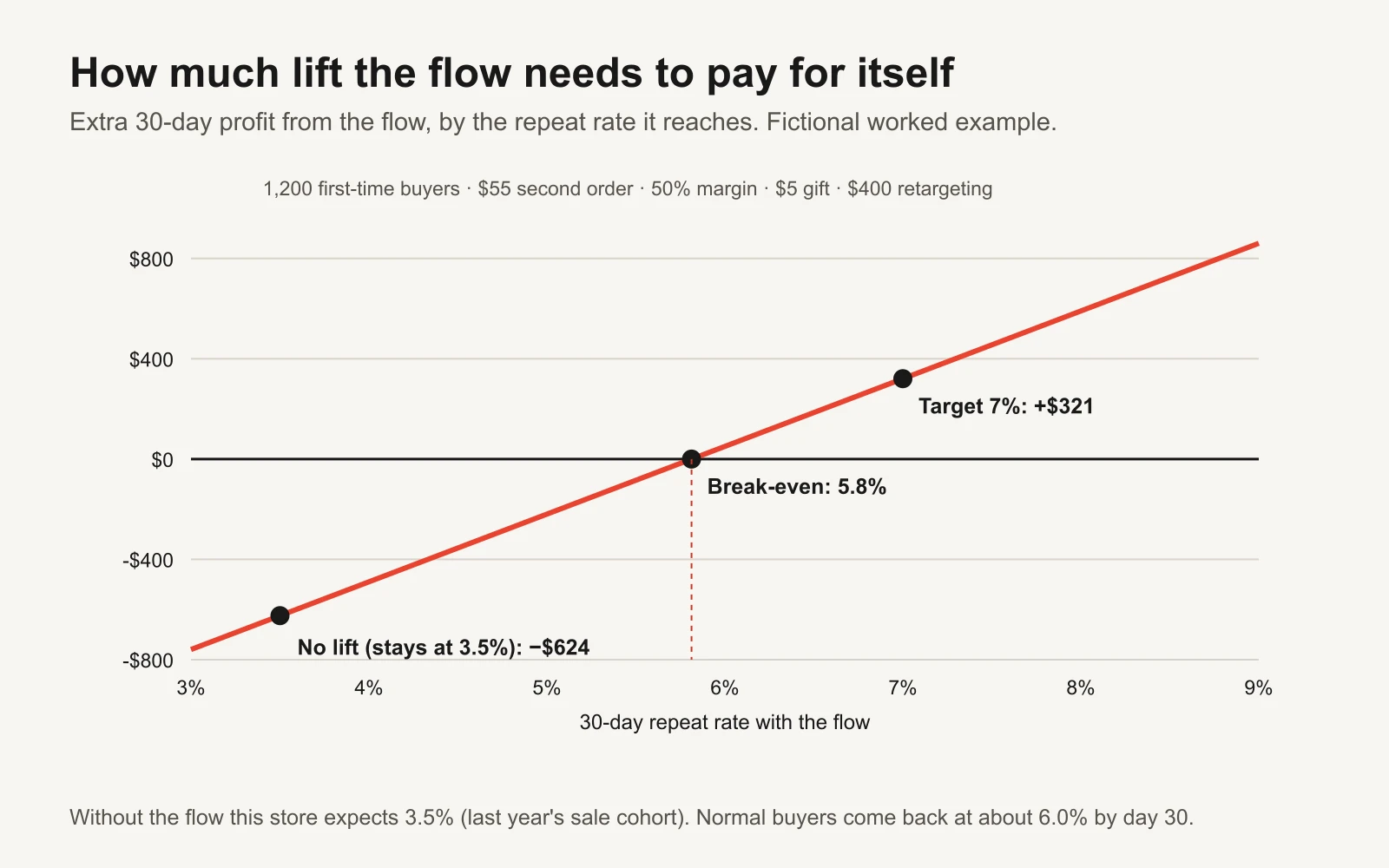
In this example, the flow must lift the 30-day repeat rate from 3.5% to 5.8% just to pay for itself.
Three things come out of this:
- The break-even is 5.8%. Below it, the flow loses money inside 30 days. If the flow did nothing at all, it would cost $624: the gift on the 42 orders that would have happened anyway, plus the SMS and the ads.
- Each extra second order costs about $20 in offer, messages and ads ($834 of costs for 42 extra orders), against $27.50 of contribution before the gift.
- Later orders are a bonus. The sheet counts only second orders inside 30 days. A customer who orders twice is more likely to order a third time, so the real value is higher. That is also why it is fine to break even inside 30 days.
If your numbers don't clear break-even, the levers are in order of size: a cheaper offer (or none, if messages 1 to 4 do the job), a smaller retargeting budget, and a better cross-sell in message 3. For the deeper discount maths, see the economics of promotional discounts.
Track it: sale cohorts against normal cohorts
The only way to know if the flow works is to compare like with like. A cohort is a group of customers who placed their first order in the same window. Track the share who placed a second order within 7, 14, 30, 60 and 90 days, for your normal months and for each Black Friday window.
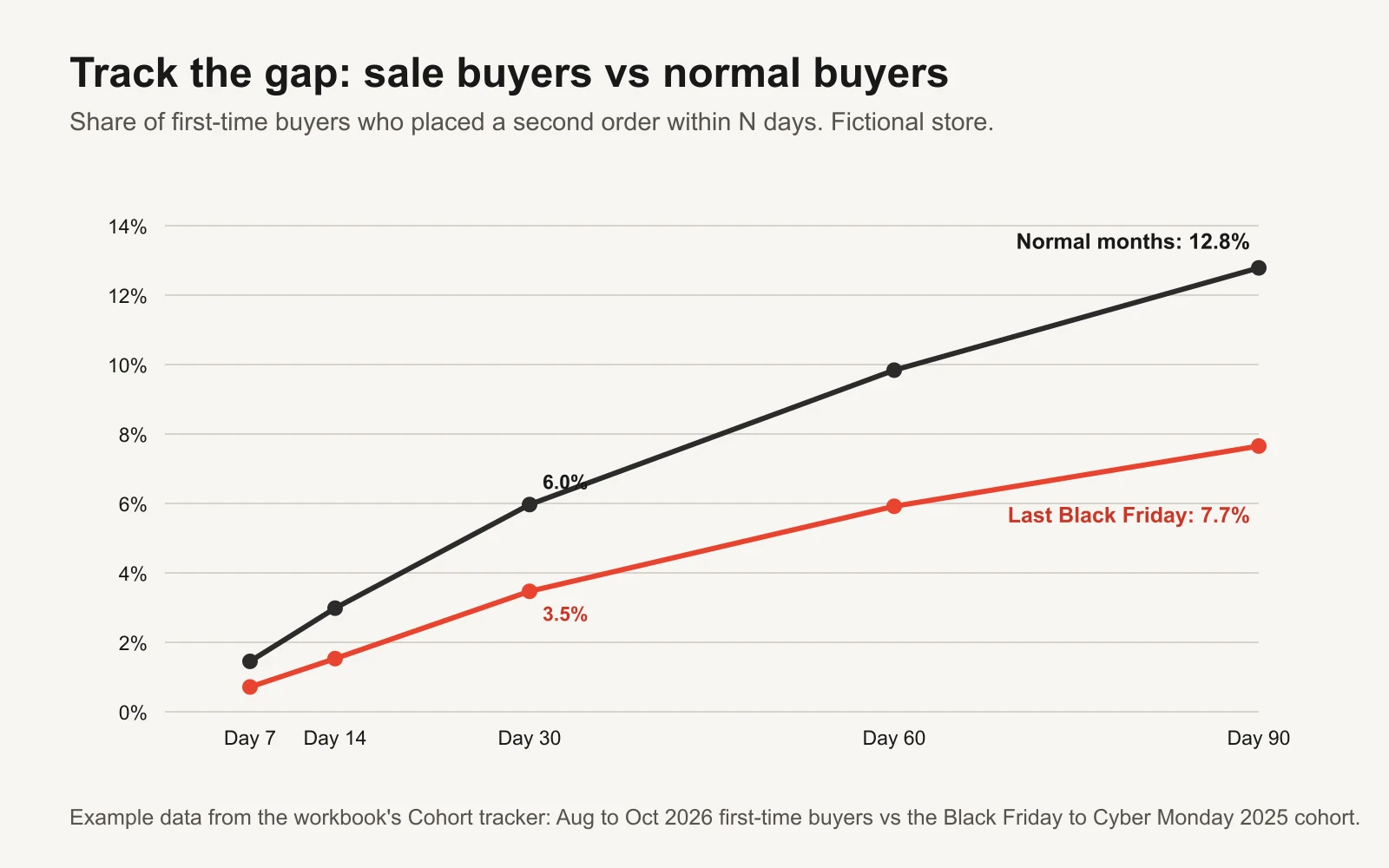
In this fictional store, last year's sale buyers came back at about half the rate of normal buyers at every point.
The workbook's Cohort tracker does this with five numbers per cohort. Type first-time buyers and second orders by each day as the days pass; it works out the rates, averages your normal months, flags each sale cohort against them and draws the curves. Leave a cell blank until that day has passed, or the rate will look worse than it is.
To pull the numbers, export orders with customer ID and order date from your store, then count, for each first-time customer, whether a second order falls within N days. Shopify's customer reports, most email tools and a simple spreadsheet formula can all do it. The repeat-order measurement guide shows how to keep first orders and repeat orders separate in your ad reporting, and subscription CAC payback cohorts goes deeper on cohort maths.
What good looks like: this year's sale cohort at day 30 within 80% of your normal cohorts' rate. In the example, that would be about 4.8% or better against a normal 6.0%. Last year's 3.5% was well below; the flow's target of 7% would put sale buyers ahead of normal ones.
The checklist
- Flow built in your email/SMS tool, triggered by a first-ever order between Black Friday and Cyber Monday, exiting on a second order.
- Message 1's how-to content and message 3's cross-sell picked per best-selling product.
- Review request working (message 2), with a way to reuse reviews in ads.
- Your Christmas order-by date in messages 3 and 4; a gift-card version ready for late buyers.
- Second-order offer created with a real end date and a unique code or link.
- SMS sent only to consented subscribers; SPF, DKIM, DMARC and one-click unsubscribe checked.
- Sale-window first-time buyers excluded from prospecting from day 0.
- Retargeting audience of non-reorderers live from day 7, synced weekly.
- Economics tab filled in with your numbers; break-even repeat rate known.
- Cohort tracker started with your last three normal months and last year's sale cohort.
Tools and repos that help
| Tool or repo | What it is for | Who should use it |
|---|---|---|
| Meta: customer list custom audiences | Upload buyer lists to exclude or retarget them | Everyone running Meta ads |
| Google: Email sender guidelines | The authentication and spam-rate rules your December sends must meet | Anyone sending marketing email |
| meta/facebook-python-business-sdk | Official Python SDK for Meta's Marketing API, including custom audience uploads | Developers who want to sync the buyer audiences on a schedule |
| anthropics/skills | Public agent skills, including an xlsx skill that lets Claude read and edit spreadsheets like this workbook | Anyone who wants an assistant to fill in the cohort tracker from an order export |
Or let GaaS run it
GaaS is an AI agent that creates, launches and optimizes Meta and Google ads from three inputs: your website, a spend limit and a one-line goal. It builds the exclusion and retargeting audiences, writes the second-purchase ads, and nothing spends without your approval. If you would rather review a plan than build one, see how GaaS works. Either way, the kit below is yours to keep.