
10 days before Black Friday, most DTC ad accounts look the same: a wall of percentages. Bombas is no exception. On 17 November 2026 it had 82 ads live in the US Meta Ad Library, and 68 of them said "% off".
But the two ads that have lasted are the opposite. Both started on 10 April and had been running for 221 days. Neither has a hook, a headline or a discount in its text. One is a photo of a sock and the words "Women's Running Ankle Socks - Charcoal - Med". The other is "Women's Lightweight No Show Sock 12-Pack".
This teardown shows the numbers, what the split tells you about running a sale without letting it eat your account, and a planner and tracker to do the same.
How we read the library, and what it can't tell you
We opened the Bombas Page in the Meta Ad Library on 17 November 2026, signed in, with active ads, all ad types and the United States selected, and scrolled to the end. 82 distinct ad cards loaded; the header said "~120 results", which counts versions. For each card we logged the start date, format, advertiser line, first line and whether the text contained "% off".
Three limits matter before any conclusion:
- Live ads only. Outside the EU, Meta's library shows ordinary product ads only while they run (Meta Transparency Center: Ad Library tools). "221 days" means still running after 221 days.
- No results. The library shows no spend or sales, so we can see what Bombas keeps running, not what earns most.
- "Catalog card" is our description. The two oldest ads look like catalog ads, the format Meta builds from a product feed (Meta for Developers: Advantage+ catalog ads): a product photo, the domain and a product title. The library card does not say how an ad was built, so treat that as a reading of what the ad looks like.
Bombas was one of the smaller reads in our batch, so this is a focused teardown built on one strong contrast rather than a full map of the account.
Finding 1: a promo account, rebuilt every few days
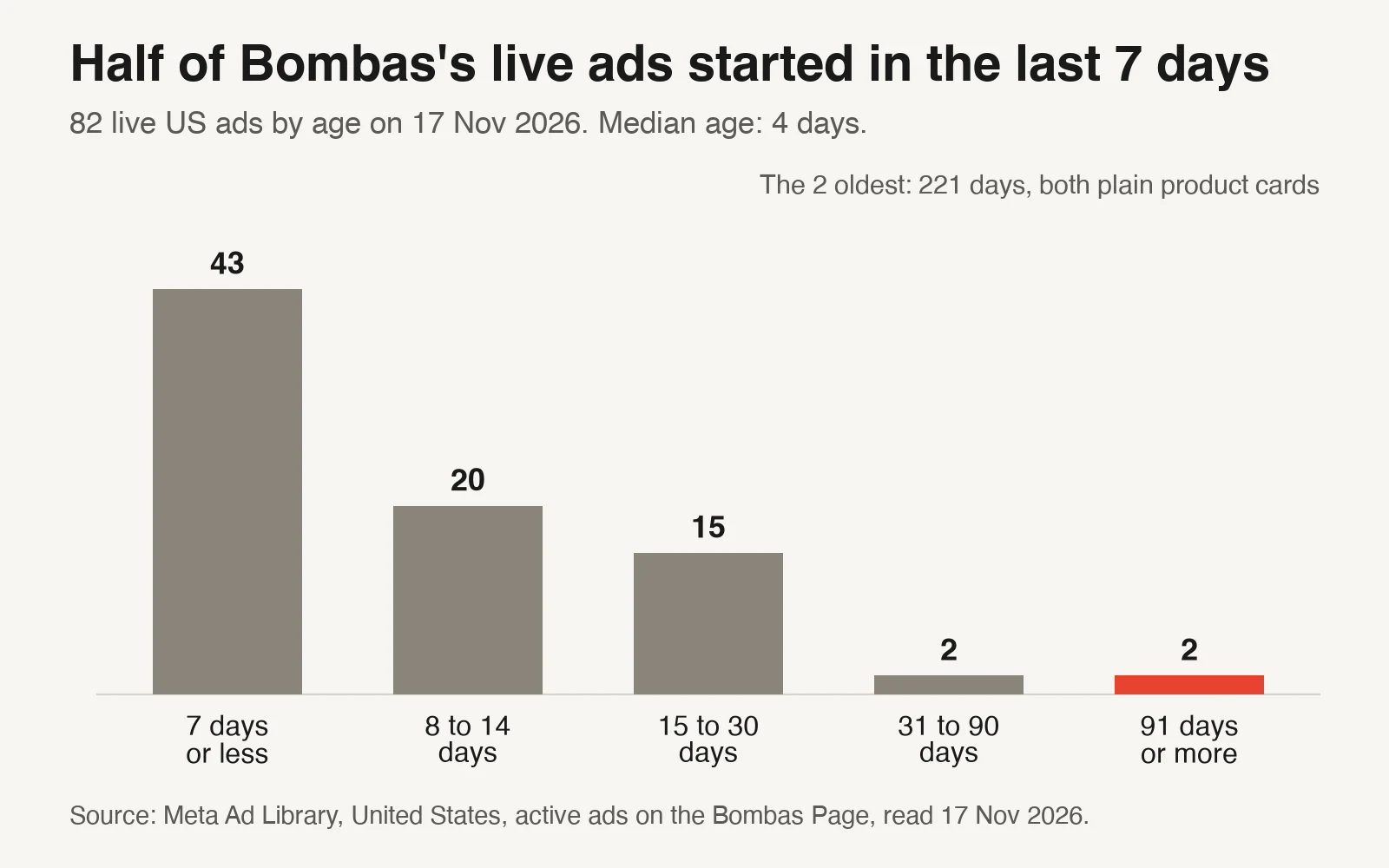
Median 4 days. 43 of 82 started in the 7 days before we looked.
Half of the live ads started in the last week, and 9 in 10 are 17 days old or less. Only 4 of 82 are older than 30 days. 27 are video; only 2 are partnership ads.
Finding 2: 68 of 82 say "% off"
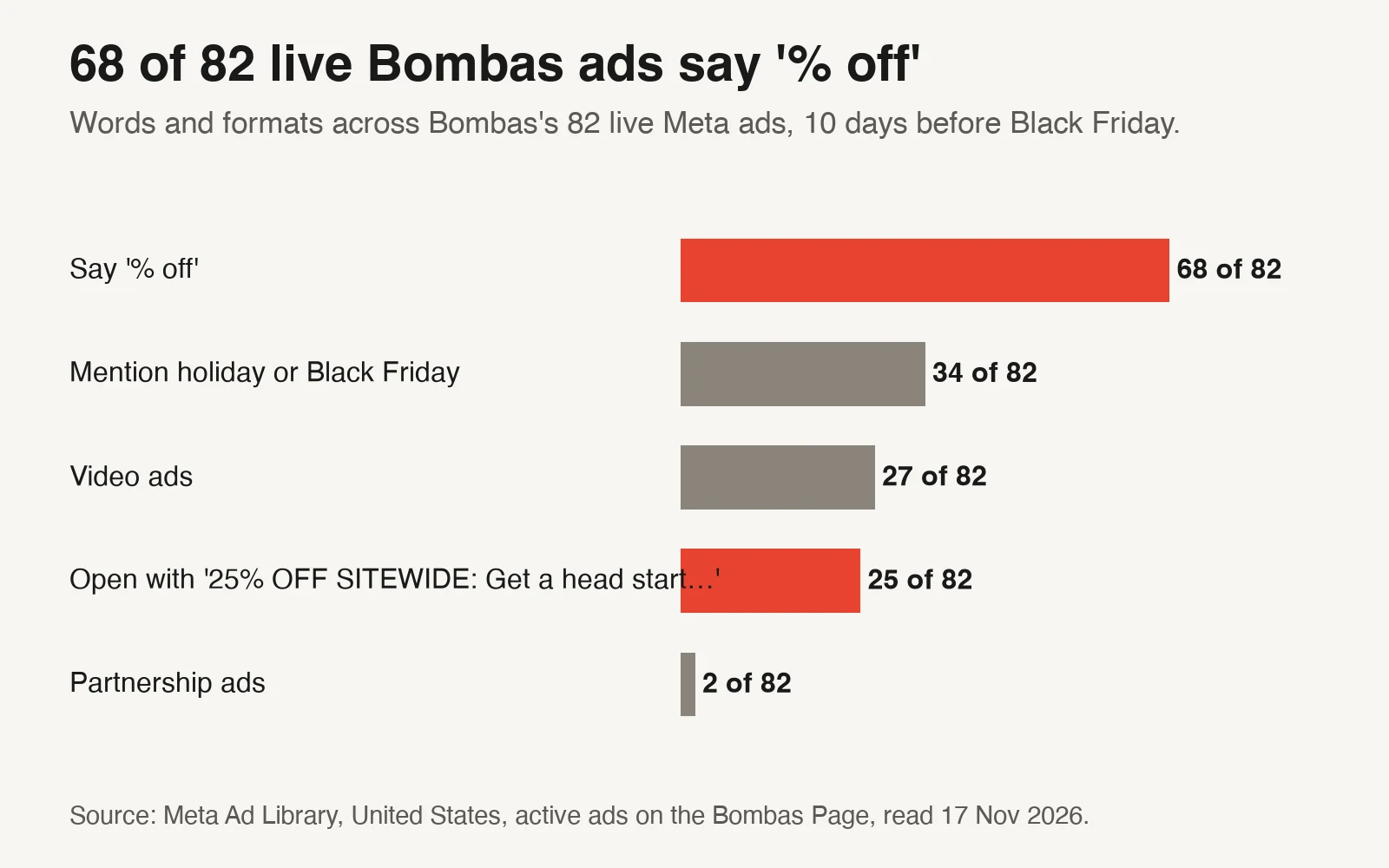
One offer line, many versions.
| Opening line | Ads |
|---|---|
| "25% OFF SITEWIDE: Get a head start on your holiday shop[ping]" | 25 |
| "Grippy and cozy…" | 6 |
| "A new holiday classic—our super soft and cushy calf soc[ks]" | 5 |
| "What a relief. Everyday Compression Socks…" | 3 |
The promo is one message, repeated: 25% off sitewide, early, framed as a head start on holiday shopping. 25 ads open with exactly that line, and 68 carry "% off" somewhere in their text. The product ads underneath ("Grippy and cozy…", the calf sock "new holiday classic") mostly carry it too.
This is a normal and sensible way to run a sale. One offer, said clearly, in many formats, launched fresh so the ads don't tire before the sale ends. The interesting part is what sits underneath it.
Finding 3: the ads that lasted have no hook and no offer
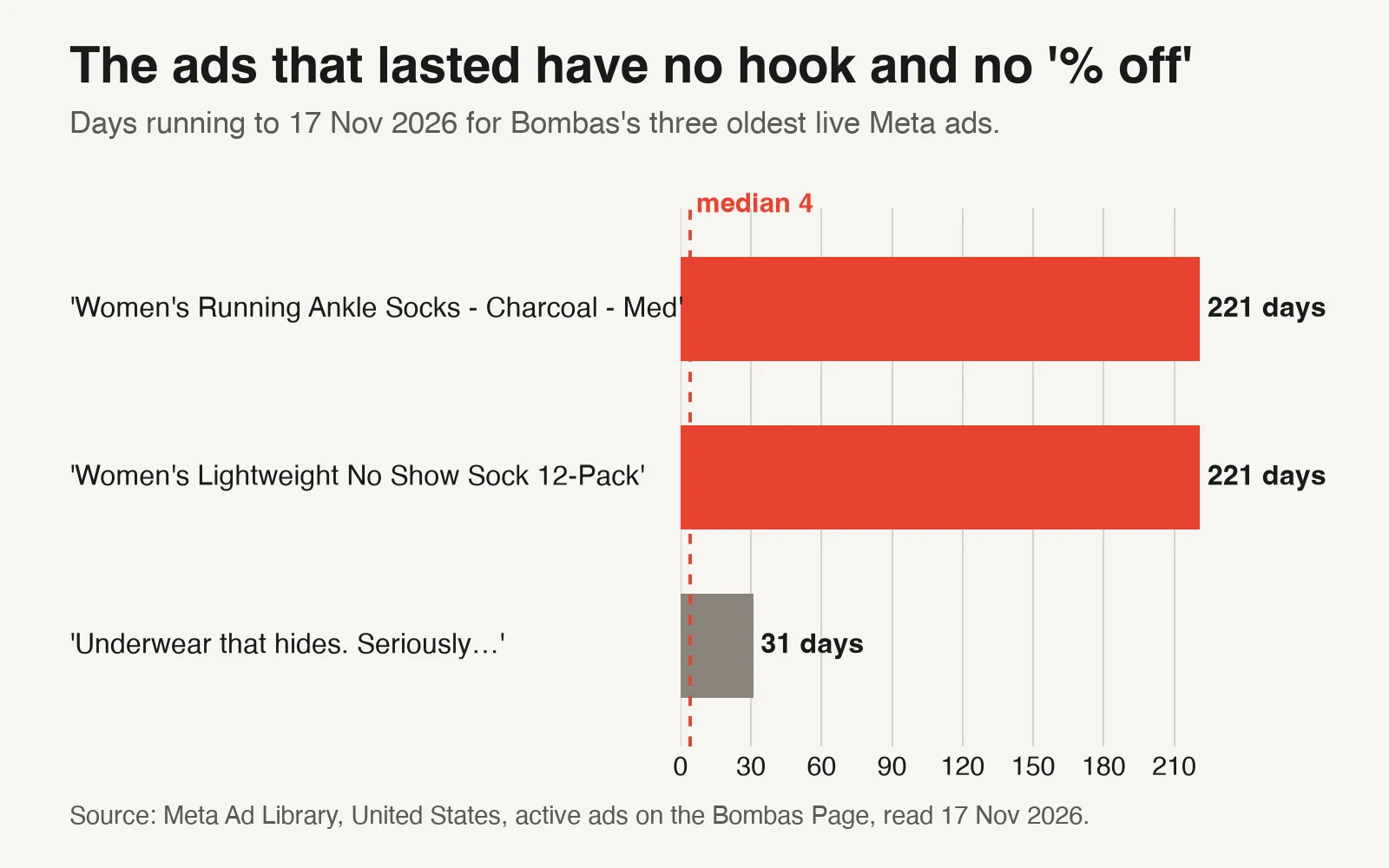
221 days against a median of 4.
| Started | Days running (to 17 Nov) | Format | Text | Library link |
|---|---|---|---|---|
| 10 Apr | 221 | Image | "BOMBAS.COM Women's Running Ankle Socks - Charcoal - Med" | Ad |
| 10 Apr | 221 | Image | "BOMBAS.COM Women's Lightweight No Show Sock 12-Pack" | Ad |
| 17 Oct | 31 | Image | "Underwear that hides. Seriously, our No Show material i[s]…" | Ad |
The two oldest have run through spring, summer and into the Black Friday push, while every promo around them came and went. Their visible text is a domain and a product title in the style of a product feed: product, colour, size, pack count. No benefit, no story, no "% off".
Why would a plain card outlast clever ads? Again, a reading, not a result we can see. A product card has nothing to expire: no sale date, no seasonal line, no joke that gets old. It answers one question for someone who already knows the brand ("which sock, which colour, how much"), which is often the last question before a purchase. And it costs almost nothing to make, so there is no pressure to replace it.
How Bombas runs a sale without losing the account: two lanes
1. An evergreen lane of plain product cards. Photo plus product name, made from the catalogue. It runs all year and has no reason to stop.
2. A promo lane with one offer line, in many versions. "25% OFF SITEWIDE" on 25 ads, "% off" on 68. New ads every few days so the sale message stays fresh for the length of the sale.
3. The promo lane switches off; the evergreen lane doesn't. When the sale ends, the percentages stop being true and the promo ads have to go. The product cards are still there the next morning.
4. Judge each lane on its own terms. A promo ad bought during a sale and a product card bought in a normal week aren't comparable. Compare promo ads with promo ads, and product cards over months.
If your account goes to zero ads the day your sale ends, you have only built the second lane. The promotional discount economics post shows what a sitewide percentage costs in margin, and the Black Friday ad playbook covers the sale itself.
The template: two lanes, four rules
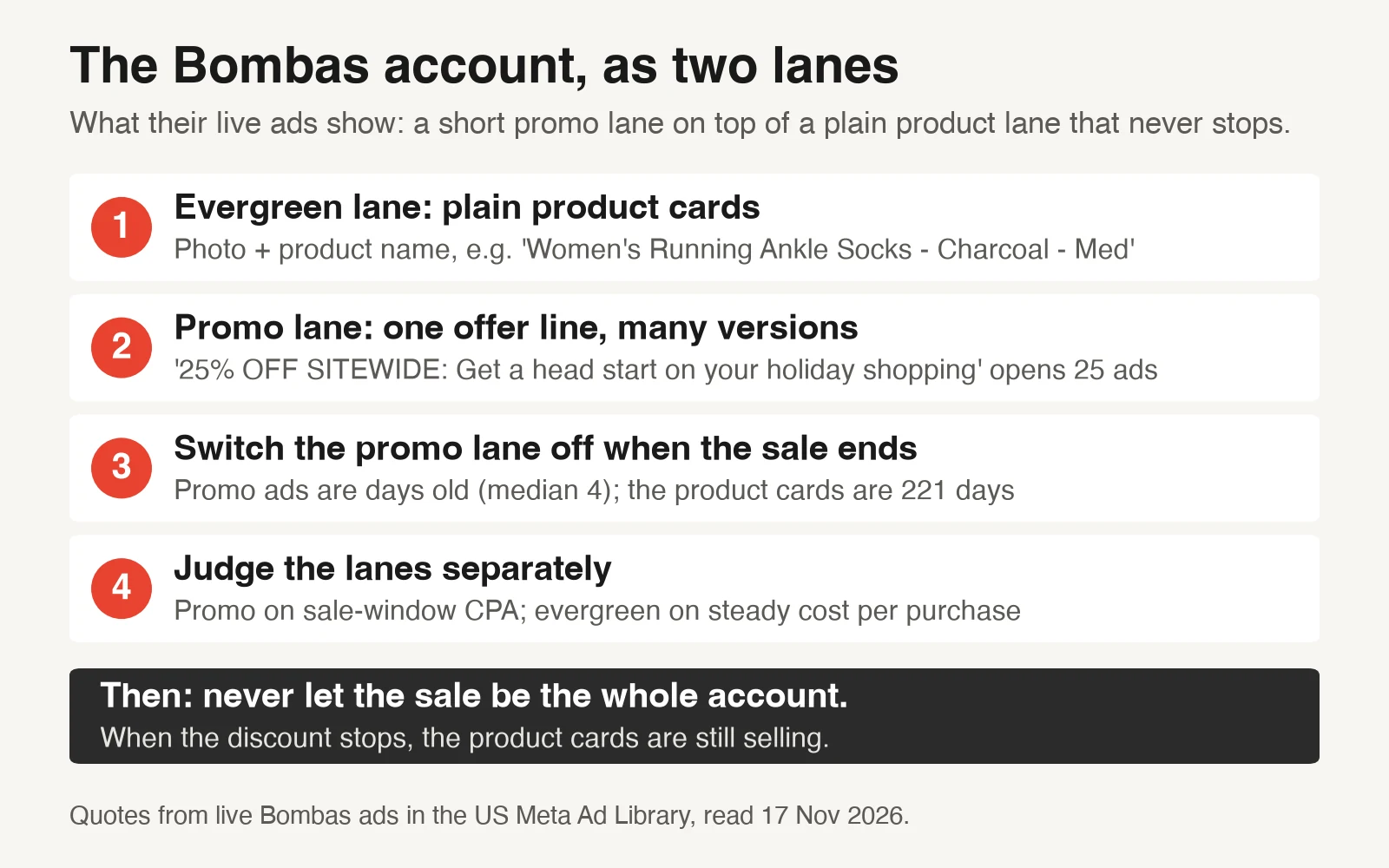
The workbook's "Copy the system" tab has the template with Bombas's examples next to an empty column for yours, and a product card title builder: type the product, variant, size and pack, and it writes the title in the same "Product - Colour - Size" pattern as the Bombas cards. A clean title in your product feed is the whole ad in this lane, so it is worth getting right; the product feed price mismatch audit covers the feed side.
Plan the two lanes in the sheet
The "Two-lane planner" tab splits a daily budget across the lanes before, during and after a sale:
- Type your daily budget, the sale start and end dates, and the share of budget the evergreen lane keeps outside and during the sale.
- The sheet works out daily spend for each lane in each period and the total for the sale window.
- In the "Lane check" table, type spend and purchases for each lane. The sheet works out cost per purchase and compares each lane with its own target, flagging "On target", "Over target" or "Not enough spend yet".
In the fictional example, a $300 daily budget keeps 70% ($210 a day) on product cards outside the sale and 30% ($90 a day) during a 7-day sale, which puts $1,470 a week behind the promo lane. The split is yours to choose; the point is that the evergreen lane never goes to zero.
Read any competitor the same way
The "Ad log" tab is prefilled with Bombas's three oldest live ads. Add your own competitor below: open their Page in the Meta Ad Library with active ads and your country, scroll to the end, and log each card's library ID, start date, format, lane (promo or evergreen) and first line. The "Summary" tab gives the share of ads that say "% off", the share older than 30 days, the oldest ad and the count in each lane. A competitor with 80% promo ads and a few very old product cards is running two lanes; one with only new promo ads is running one.
Tools and repos that help
| Tool or repo | What it is for | Who should use it |
|---|---|---|
| Meta Ad Library | Every live ad for a Page, with start dates and formats | Everyone; this teardown is built on it |
| Meta for Developers: Advantage+ catalog ads | How Meta builds ads from a product catalogue feed | Anyone setting up the evergreen lane |
| Meta Transparency Center: Ad Library tools | What the library keeps, for how long | Anyone drawing conclusions from "days running" |
| anthropics/skills | Public agent skills, including an xlsx skill that lets Claude fill in the planner and the log | Anyone who wants an assistant to keep the tracker up to date |
Or let GaaS run it
GaaS is an AI agent that creates, launches and optimizes Meta ads from three inputs: your website, a spend limit and a one-line goal. It reads your catalogue, keeps a product lane running, builds the sale ads when you have a sale and stops them when it ends, and nothing spends without your approval. See how GaaS works. Either way, the planner below is yours to keep.