
It's 17 November, ten days before Black Friday. And a CELSIUS energy drink ad in a US feed can still say "Sip into summer".
On that day, CELSIUS had 67 Meta ads live in the US. 55 of them went up in a short window between 30 September and 17 October and have been running ever since. Two of the oldest open with summer and festival lines. None offers a discount, and only 2 mention a holiday, ten days before Black Friday.
It would be easy to call that lazy. It isn't quite. For a drink people mostly buy in a store, a stable set of ads that keeps the brand and flavours familiar is a reasonable plan. The problem is narrower: a few lines carry a date they've outlived. This teardown shows both, and gives you a check that catches the second.
How we read the library, and what it can't tell you
We opened CELSIUS's Page in the Meta Ad Library on 17 November 2026, signed in, with active ads, the United States and all media selected, and scrolled to the end. The header said "~260 results"; that counts every version of every ad. We counted 67 distinct ad cards, and 46 of them had several versions. For each card we logged the start date, format, advertiser line and opening text.
The limits:
- Live ads only. Outside the EU, the library shows only running ads (Meta Transparency Center: Ad Library tools). We can't see what CELSIUS ran and stopped before 30 September.
- No results. No spend, sales or reach is shown. "Still running" means CELSIUS keeps paying for it, not that it performs.
- Words, not the whole picture. We logged the text above each image. The images may carry more.
Product context: celsius.com, checked the same day, links to a Spritz VIBE Winter Edition, and its "Buy Online" button goes to an Amazon store (celsius.com).
Finding 1: one launch window, then nothing came down
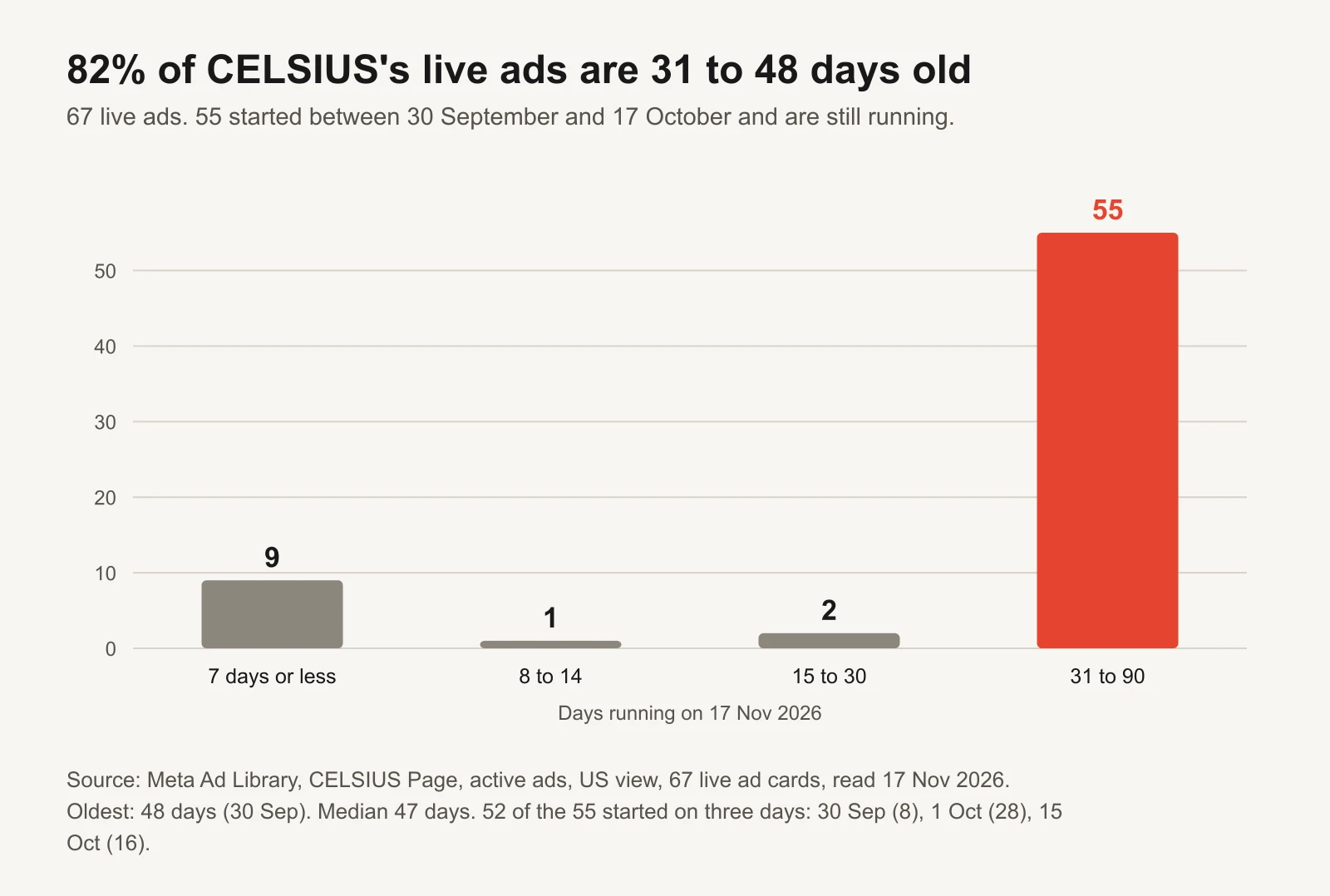
55 of 67 are 31 to 48 days old. 52 of them started on 30 September (8), 1 October (28) or 15 October (16).
The median live CELSIUS ad is 47 days old; the oldest is 48. That shape is unusual. Most brands in our teardowns show a long tail of new ads and a few old ones. CELSIUS shows the opposite: one large set launched in about two weeks, a gap, then 8 new ads on 16 November.
Finding 2: the oldest ads still say summer
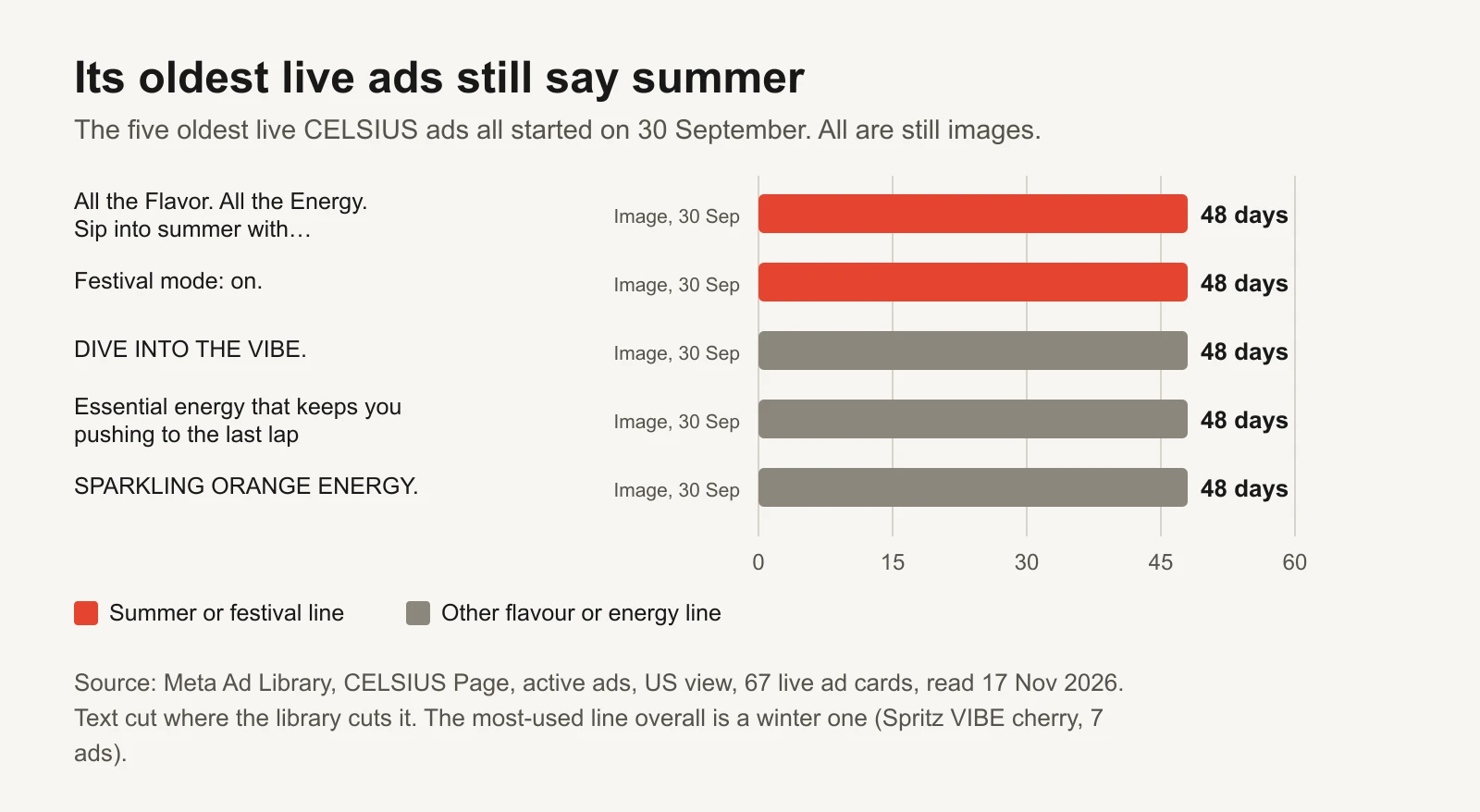
Two of the five oldest carry a summer or festival line.
| Started | Days running (to 17 Nov) | Format | Opening line | Library link |
|---|---|---|---|---|
| 30 Sep | 48 | Image | "All the Flavor. All the Energy. 🍉 Sip into summer with…" | Ad |
| 30 Sep | 48 | Image | "Festival mode: on." | Ad |
| 30 Sep | 48 | Image | "DIVE INTO THE VIBE. 🌊🍑" | Ad |
| 30 Sep | 48 | Image | "Essential energy that keeps you pushing to the last lap" | Ad |
| 30 Sep | 48 | Image | "SPARKLING ORANGE ENERGY. 🍊" | Ad |
To be fair to CELSIUS: this is "still running summer ads", not "only summer ads". The single most-used opening line in the account is a winter one, "Celebrate with sparkling cherry flavor in Spritz VIBE…", on 7 ads, which matches the Winter Edition on its site. The summer lines are a few holdovers in a set that has partly moved on.
Finding 3: no discounts, no Black Friday, mostly stills
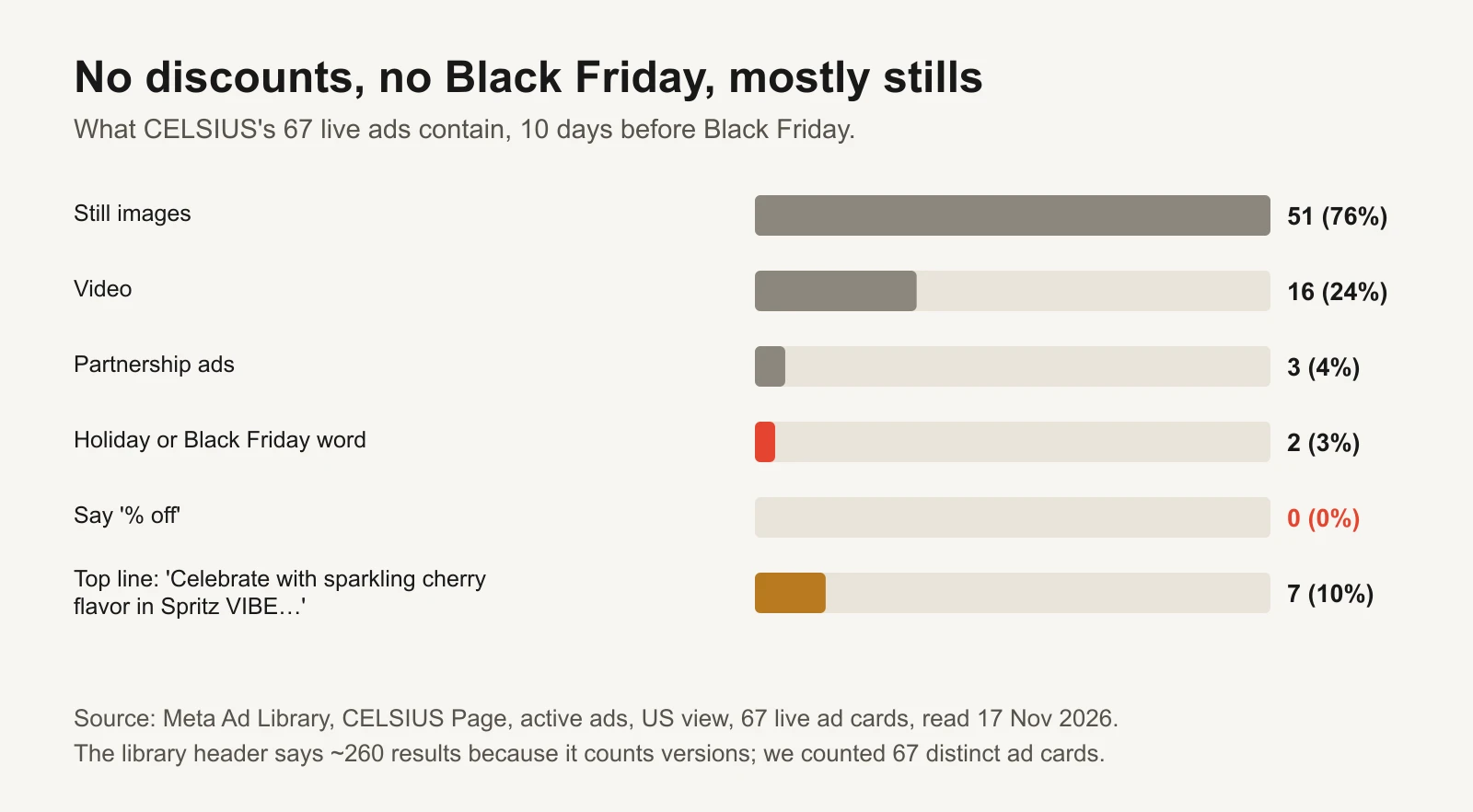
Ten days before Black Friday, 0 of 67 ads offer a discount.
| Most-repeated opening line | Ads |
|---|---|
| "Celebrate with sparkling cherry flavor in Spritz VIBE…" | 7 |
| "Flavor meets function with great-tasting CELSIUS. Zero…" | 5 |
| "PEACH VIBE. NO CRASH. 🍑" | 3 |
| "NO CRASH. ALL CITRUS. 🍊" | 2 |
| "Race-day energy that keeps you locked in until the fina[l]…" | 2 |
The copy is short and shouty: a flavour in capitals, a two-word function claim ("NO CRASH."), sometimes a moment (a festival, race day, the last lap). Only 3 ads are partnerships. 51 of 67 are still images.
Why set-and-leave can work here
The sale happens on a shelf. CELSIUS is sold in stores and on Amazon; its own site's buy button goes to Amazon, not a cart of its own. A Meta ad's job here is to make the can familiar so it gets picked up later, not to push a checkout today. That kind of job rewards repetition more than novelty.
Few ads, lots of versions. 46 of the 67 cards have several versions. CELSIUS seems to vary placements and crops inside a small set rather than make many new ideas.
No discount to protect. A shelf brand doesn't control the store's price promotions, so a "% off" in a Meta ad would often be one it can't honour everywhere.
Stability lets delivery settle. Ads that run for weeks without edits give Meta's delivery time to settle. For a reach-and-familiarity goal, that is a feature.
Where it slips, and the fix
A line that names a season is a line with an expiry date. "Sip into summer" was fine on 30 September in many places. By 17 November it reads as an ad nobody is watching. "Festival mode: on." has the same problem once festival season is over.
The fix is not to churn the whole set. It's to give every dated line an end date when you write it, and check the list on a schedule. That costs ten minutes a month, and it catches the one thing a stable account gets wrong.
The template: a flavour, a mood, no discount
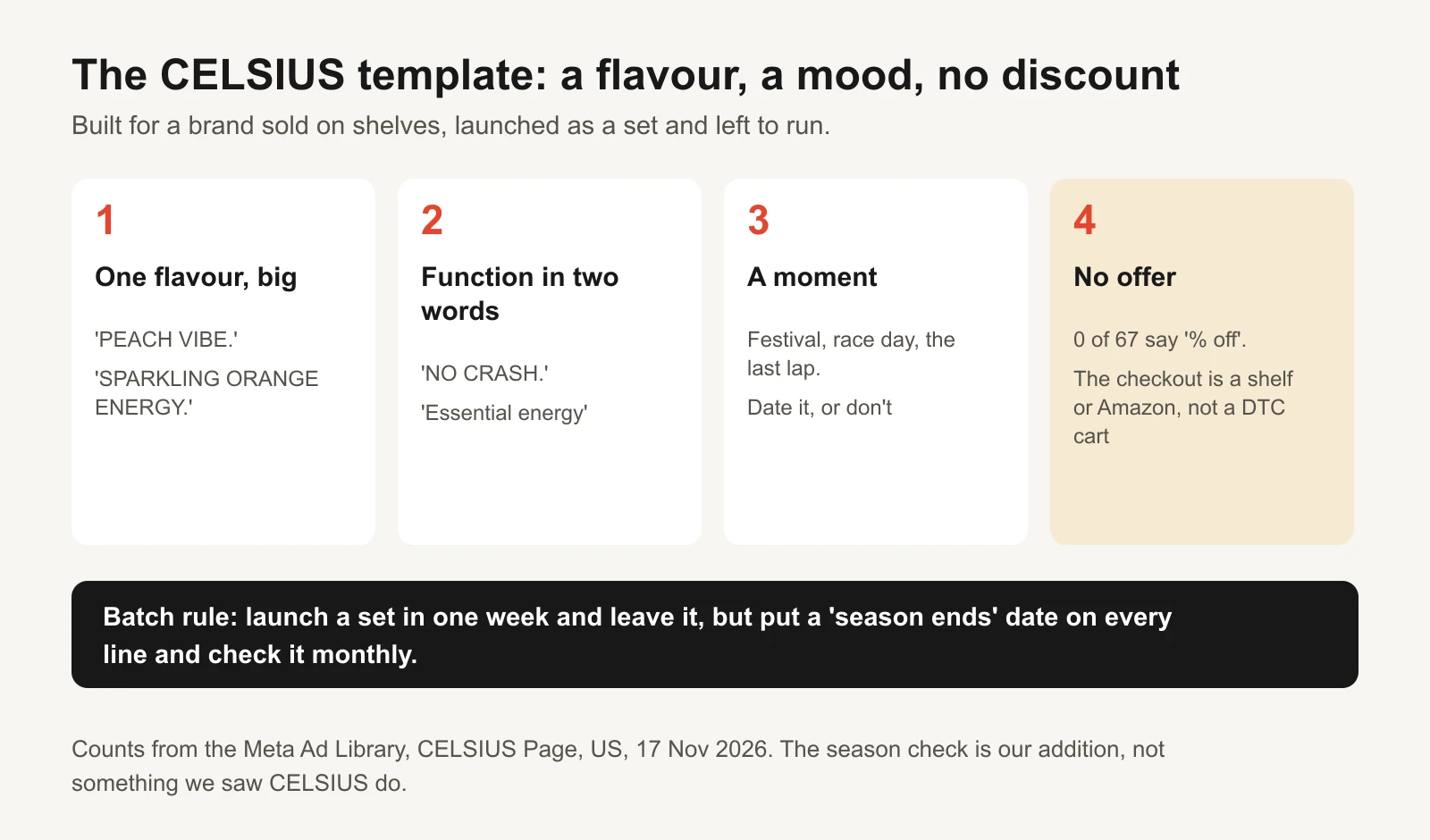
The season check is our addition, not something we saw CELSIUS do.
- One flavour, big. One product per ad, named in capitals.
- Function in two words. The benefit as a tag, not a sentence. Make sure it's a claim you can substantiate.
- A moment. Where and when people drink it. If the moment has a season, write down when it ends.
- No offer, if most of your sales happen in stores you don't control.
This fits brands sold mainly through retail or Amazon: drinks, snacks, household goods. A direct-to-consumer brand that needs online sales this week will usually need an offer, and fresher ads; see the Grüns teardown for the opposite approach, and AI for seasonal CPG for planning around seasons.
Run the season check
The workbook's Season check tab lists each live ad's line, its start date and the date its season ends:
- Type every live line and its start date.
- Give each dated line an end date. Leave it blank for lines that work all year.
- Set the check date. The sheet marks each line: in season, ending within 14 days, or out of season with the number of days past.
The example uses CELSIUS's real lines with end dates we assumed (summer ends 22 September, festival season 30 September, the winter Spritz line 31 January). On 17 November, 3 lines are out of season, "Sip into summer" by 56 days. Change any date to match your market.
Read any competitor the same way
The Ad log is prefilled with CELSIUS's five oldest live ads, with links. Add a competitor below:
- Open their Page in the Meta Ad Library with active ads, your country and all media, and scroll to the end.
- Log each ad's library ID, start date, format, face, angle, offer and first line.
- The Summary tab counts by age and format and gives the share older than 30 days. A share that high with almost nothing new (like CELSIUS) means a set-and-leave account: read its lines for anything out of date, and its gaps for an opening.
The Ad Library competitor playbook covers turning what you see into your own briefs.
Tools and repos that help
| Tool or repo | What it is for | Who should use it |
|---|---|---|
| Meta Ad Library | Every live ad for a Page, with start dates, formats and versions | Everyone; this teardown is built on it |
| Meta Transparency Center: Ad Library tools | What the library keeps and for how long | Anyone reading "days running" |
| facebookresearch/Ad-Library-API-Script-Repository | Meta's Python examples for the Ad Library API; ordinary product ads only if they reached the EU | Developers |
| anthropics/skills | Public agent skills, including an xlsx skill for spreadsheets like this one | Anyone who wants an assistant to keep the season list |
Or let GaaS run it
GaaS is an AI agent that creates, launches and optimizes Meta and Google ads from three inputs: your website, a spend limit and a one-line goal. It can review the ads live in your account, flag a "summer" line in November, and propose a replacement that runs only once you approve it. See how GaaS works. Either way, the season check below is yours to keep.