
It's 10 days before Black Friday. Plenty of brands are already running "% off" ads. Jones Road Beauty, the makeup brand Bobbi Brown launched in October 2020 (Quartz), put up 235 new Meta ads on 16 November instead.
On 17 November it had 408 ads live in the US. Only one of them mentioned a discount. Nothing live was older than 16 days. And the lines it repeats most don't sound like an ad at all. They sound like a customer texting a friend: "Not gonna lie, these might be gifts I end up keeping for myself."
This teardown covers what the library showed, the system behind it, and a planner to launch and judge your own batch the same way.
How we read the library, and what it can't tell you
We opened the Jones Road Beauty Page in the Meta Ad Library on 17 November 2026, signed in, with the United States, active ads and all media selected, and scrolled to the end. 408 ad cards loaded; the header said "~790 results" because it counts each version of an ad. For each card we logged the start date, format, advertiser line and first line, and counted keywords in the copy.
The limits:
- Live ads only. Outside the EU the library shows only ads running now (Meta Transparency Center: Ad Library tools). "Nothing older than 16 days" means nothing older is still running.
- No results. No spend, sales or ROAS. We see what Jones Road chose to run, not what worked.
- One day. Black Friday 2026 is 27 November. A brand that runs no discount 10 days out may still run one on the day; check again closer in.
Finding 1: 235 ads in one day
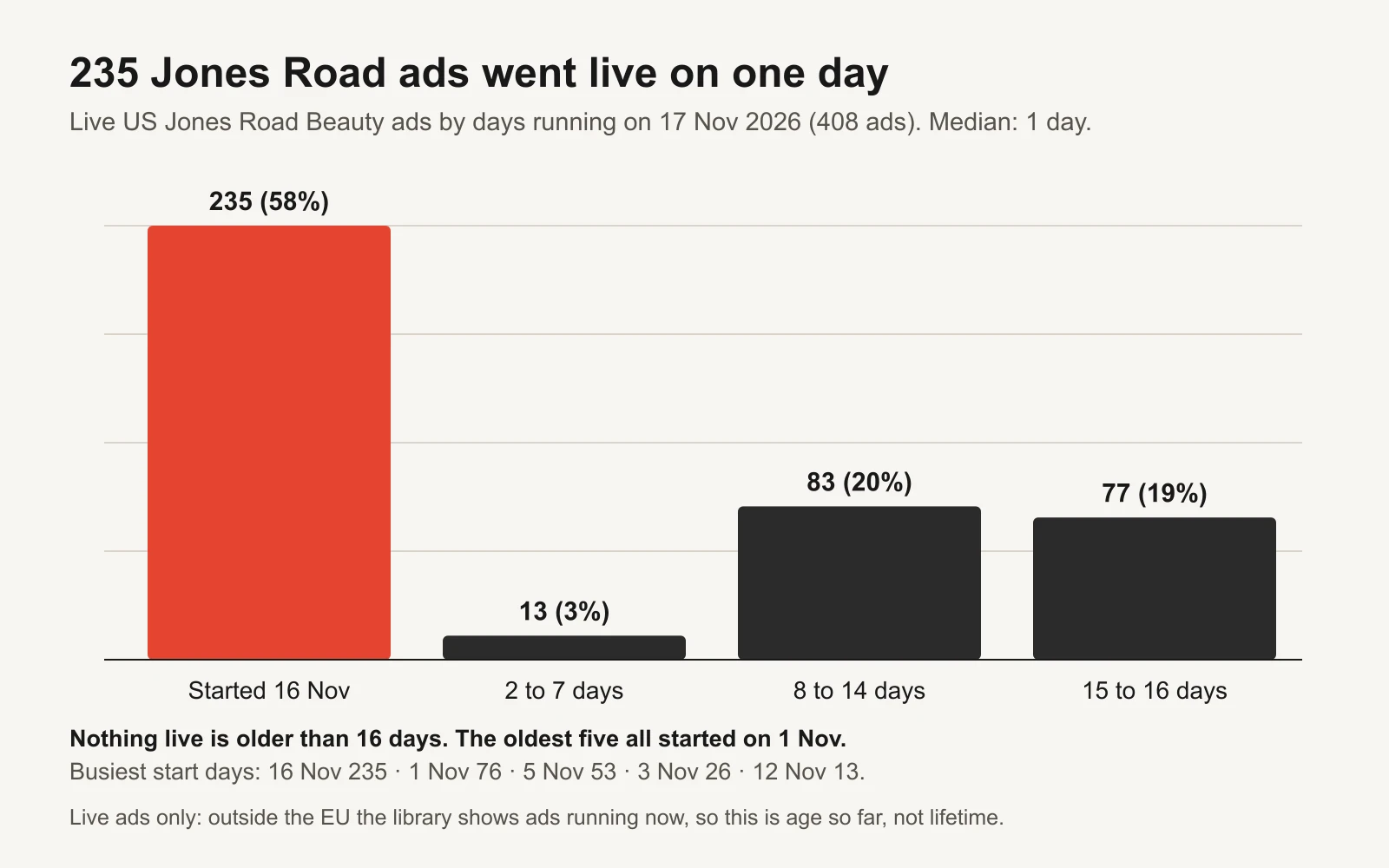
Busiest start days: 16 Nov (235), 1 Nov (76), 5 Nov (53), 3 Nov (26), 12 Nov (13).
The median live Jones Road ad was 1 day old. The account moves in waves: 76 ads on 1 November, 53 on 5 November, 26 on 3 November, then 235 on 16 November. The oldest live ads all started on 1 November, including statics about the Miracle Balm ("No-makeup makeup, but better.", library ID 2040326499990203) and a shade quiz ("The glow you've been looking for is just one quiz away.", library ID 937534906105561).
So Jones Road isn't keeping a few evergreen winners. It launches big, keeps what works for a couple of weeks, and launches again.
Finding 2: one discount in 408 ads
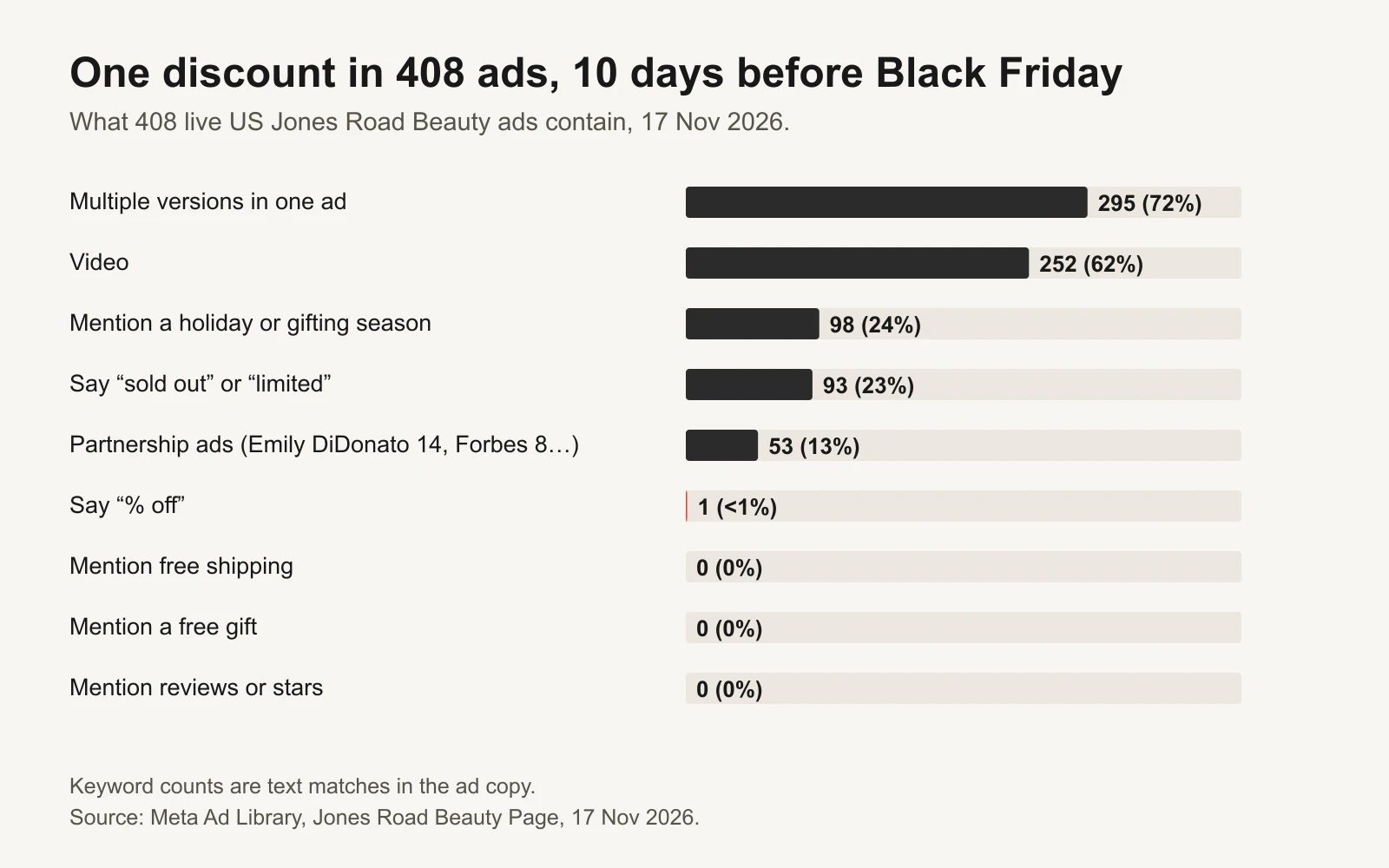
Keyword counts are text matches in the ad copy.
One ad says "% off". None mention free shipping or a free gift. None mention reviews or stars. What they do mention: the holidays and gifting (98) and "sold out" or "limited" (93). The urgency comes from scarcity and the season, not from a price cut.
It's a choice, and not every brand makes it. We read 19 other DTC brands' live ads the same day:
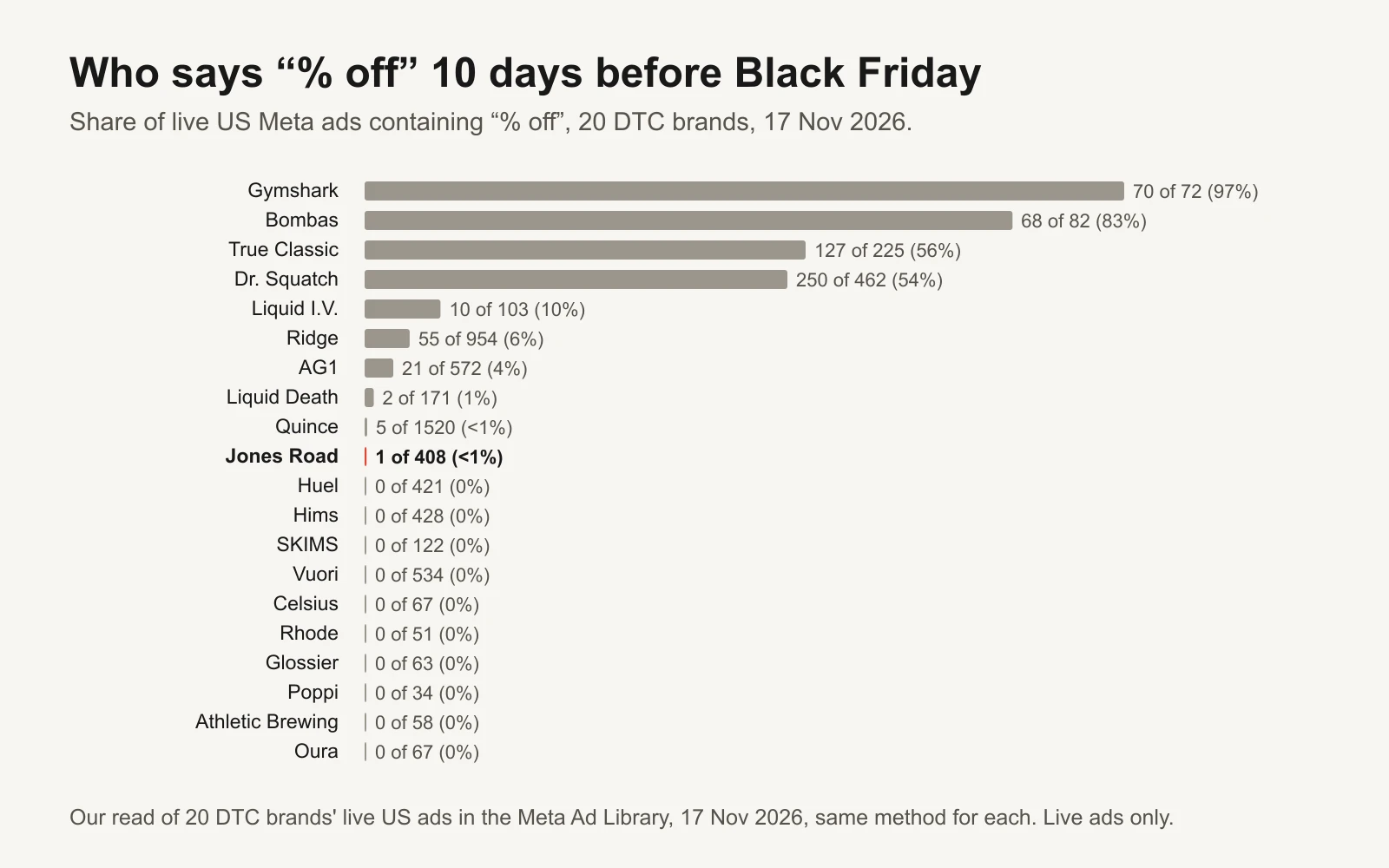
Same method for every brand: live US ads, read on 17 November 2026. A "% off" match misses discounts written another way, such as "$10 off".
Gymshark and Bombas were already deep in discounting. Jones Road sits with Hims, SKIMS, Huel and others at or near zero. Neither group is "right"; discounts work when your margin can carry them. Our discount economics guide shows how to check whether yours can.
Finding 3: the customer's voice, not the brand's
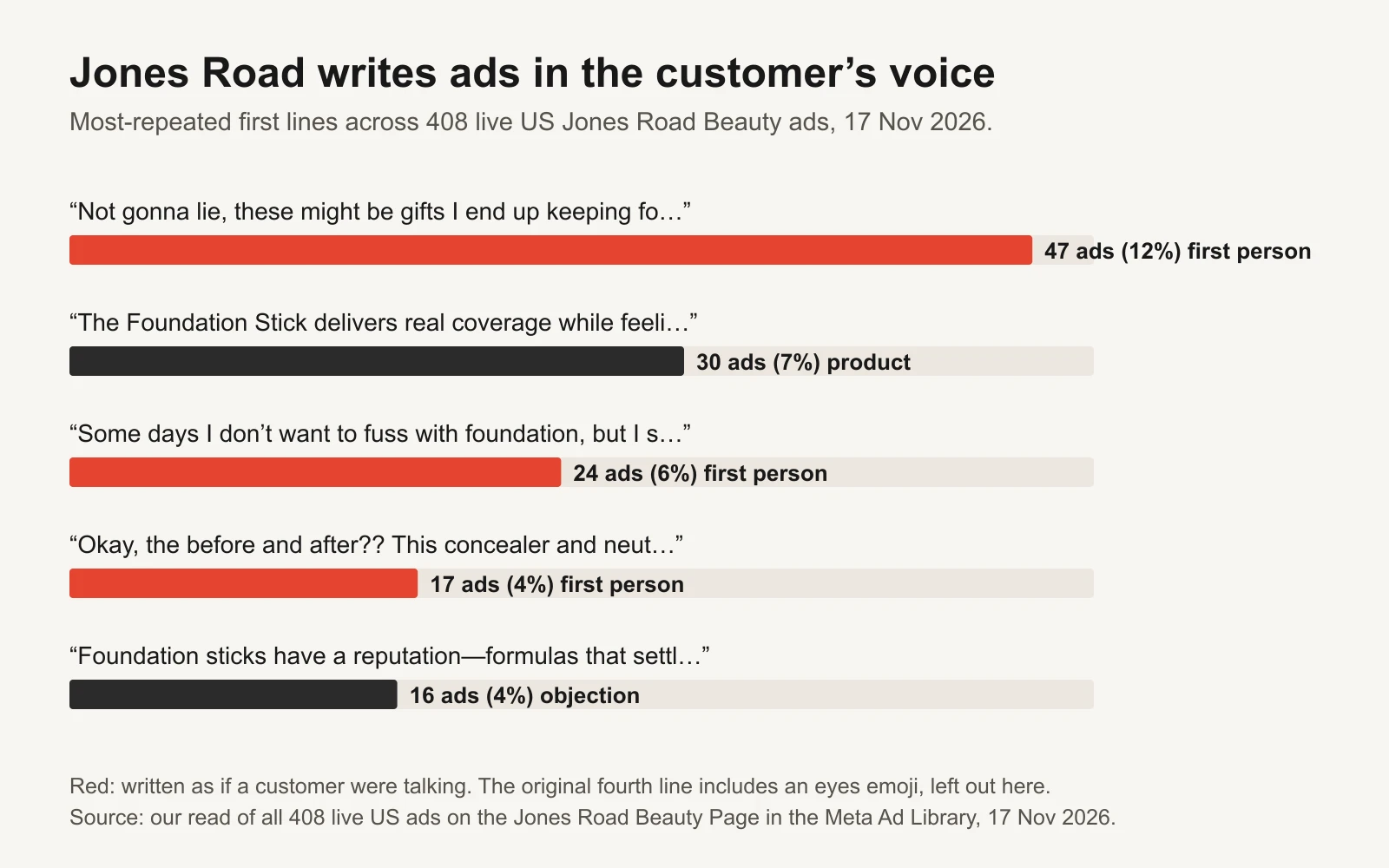
Red: written as if a customer were talking.
Three of the top five lines are first person, in the loose way people actually talk: "Not gonna lie…", "Some days I don't want to fuss with foundation…", "Okay, the before and after?? 👀". The other two are the brand speaking, but still plainly: one product, one benefit, or the category's bad reputation said out loud ("Foundation sticks have a reputation…").
| Opening line | Live ads | What it does |
|---|---|---|
| "Not gonna lie, these might be gifts I end up keeping fo[r myself]…" | 47 | The gift angle, without a discount, in a customer's words |
| "The Foundation Stick delivers real coverage while feeli[ng]…" | 30 | One product, the result, then how it feels |
| "Some days I don't want to fuss with foundation, but I s…" | 24 | Starts from the customer's lazy day, not the product |
| "Okay, the before and after?? 👀 This concealer and neut…" | 17 | Sounds like a text; points at the proof |
| "Foundation sticks have a reputation—formulas that settl[e]…" | 16 | Says the objection first, then answers it |
Most of these run from Jones Road's own Page (355 of 408). The 53 partnership ads include Emily DiDonato (14) and Forbes (8).
A first-person line works because it skips the part of your brain that filters ads. But it has to be honest: either a real customer's words, used with permission, or clearly your brand writing in a casual voice. Never invent a review. Our guide to testimonial ads that don't feel fake covers how to collect and use real words.
Copy the system
- A customer's sentence as the first line. Write the opening the way your buyer would say it to a friend. Better still, take it from a real review or survey answer.
- One product per ad. Foundation Stick, Miracle Balm, a concealer. One thing, one result.
- Say the objection. "Foundation sticks have a reputation…" / "Tired of foundation making you look older?" Name the doubt before the buyer does.
- Urgency without a discount. "Sold out", "limited", "gifts": only when they're true.
- Launch the batch in one go, then judge it.
The workbook's Copy the system tab has these five parts with Jones Road's live example next to an empty column for yours.
Plan and judge your own batch
The Batch planner tab runs the launch-big system on a small budget:
- Size the batch. Type how many voice lines, products and formats you have. 4 lines x 3 products x 2 formats = 24 variants.
- Set the bar. Your target CPA (cost per purchase) and the minimum spend before you judge a variant (1.5 times target CPA by default). In the fictional example, 24 variants at a $35 target need $1,260 of test budget, about $90 a day for 14 days.
- Launch together, judge at day 14. Type spend and purchases for each variant. The sheet marks each one keep and make versions, kill, or too early to judge.
In the example's first 12 variants, 4 are keepers, 3 are kills and 5 haven't spent enough to judge. Make new versions of the keepers, replace the kills, give the rest a few more days.
If $90 a day is too much, cut the variants, not the spend per variant: 2 lines x 2 products x 2 formats is 8 variants, about $30 a day. A variant that spent $15 has told you nothing. The kill, hold, scale rulebook has more on judging with small numbers.
Read any competitor the same way
The Ad log tab is prefilled with Jones Road's five oldest live ads, with links. Add your own competitor, set the check date, and the Summary tab gives you their share of ads older than 14 days and the mix of formats and faces. Do it again a week later; batch rhythms only show across two or three reads. The Ad Library competitor playbook covers the rest.
Tools and repos that help
| Tool or repo | What it is for | Who should use it |
|---|---|---|
| Meta Ad Library | Every live ad for a Page, with start dates and versions | Everyone |
| Meta Transparency Center: Ad Library tools | What the library keeps, for how long | Anyone reading ad ages |
| facebookresearch/Ad-Library-API-Script-Repository | Meta's Python examples for the Ad Library API (ordinary product ads only if they reached the EU) | Developers |
| anthropics/skills | Public agent skills, including one for spreadsheets like this planner | Anyone who wants an assistant to draft voice lines from reviews |
Or let GaaS run it
GaaS is an AI agent that creates, launches and optimizes Meta and Google ads from three inputs: your website, a spend limit and a one-line goal. It writes batches of ads from your real reviews and product pages, launches them together and judges them on your numbers, and nothing spends without your approval. See how GaaS works. Either way, the planner below is yours to keep.