
Liquid Death sells canned water with a heavy-metal brand: skulls, "murder your thirst", ads that look like horror-movie trailers. It is one of the most talked-about brands in advertising, and it was valued at $1.4 billion in a $67 million round in March 2024 (Business Wire).
So we expected its paid social to be the jokes. The Meta Ad Library tells a quieter story. On 17 November 2026 Liquid Death had 171 ads live in the US. The median one had been running for 78 days. The oldest, 202 days. And the ads that have lasted longest read like the side of the can: calories, caffeine, sugar.
How we read the library, and what it can't tell you
We opened the Liquid Death Page in the Meta Ad Library on 17 November 2026, signed in, with the United States, active ads and all media selected, and scrolled to the end. 171 ad cards loaded; the header said "~200 results" because it counts versions. For each card we logged the start date, format, advertiser line and first line of text, and counted keywords in the copy.
The limits:
- Live ads only. Outside the EU the library shows only ads that are running now; ordinary US product ads disappear when they stop (Meta Transparency Center: Ad Library tools). "202 days" is how long that ad has run so far.
- No results. No spend, sales or ROAS are shown. A brand keeps paying for an ad for a reason, but we can't see the reason.
- One day, 10 days before Black Friday.
Finding 1: the median ad is 78 days old
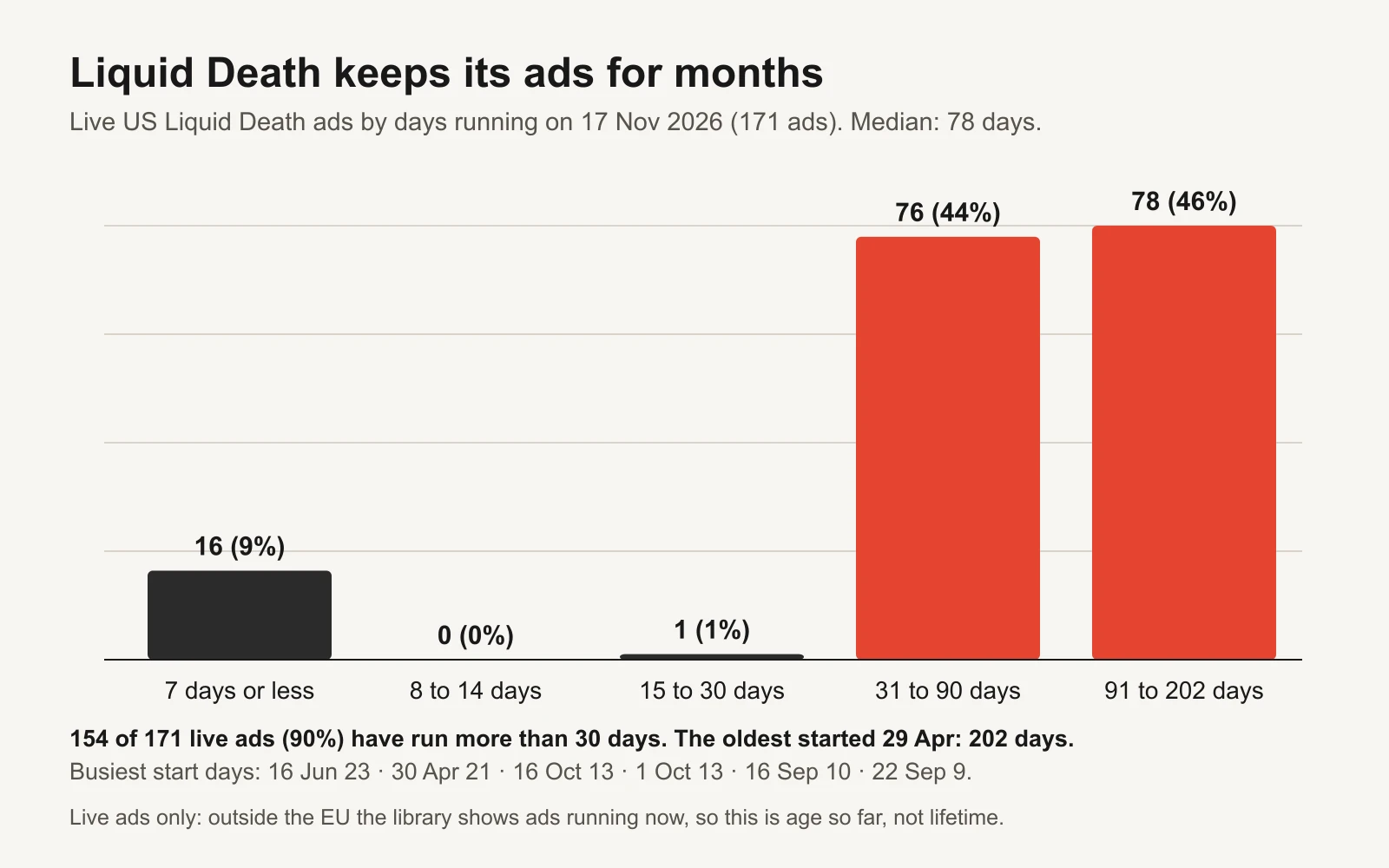
Busiest start days: 16 Jun (23 ads), 30 Apr (21), 16 Oct (13), 1 Oct (13).
154 of 171 live ads (90%) had run more than 30 days, and 78 had run more than 90. Only 16 were from the last week, and none at all were 8 to 14 days old. Liquid Death adds new ads in small groups and leaves the ones that work alone.
That is the opposite of most of the brands we read the same day. Of 20 DTC brands, Liquid Death's live ads were the oldest by median age.
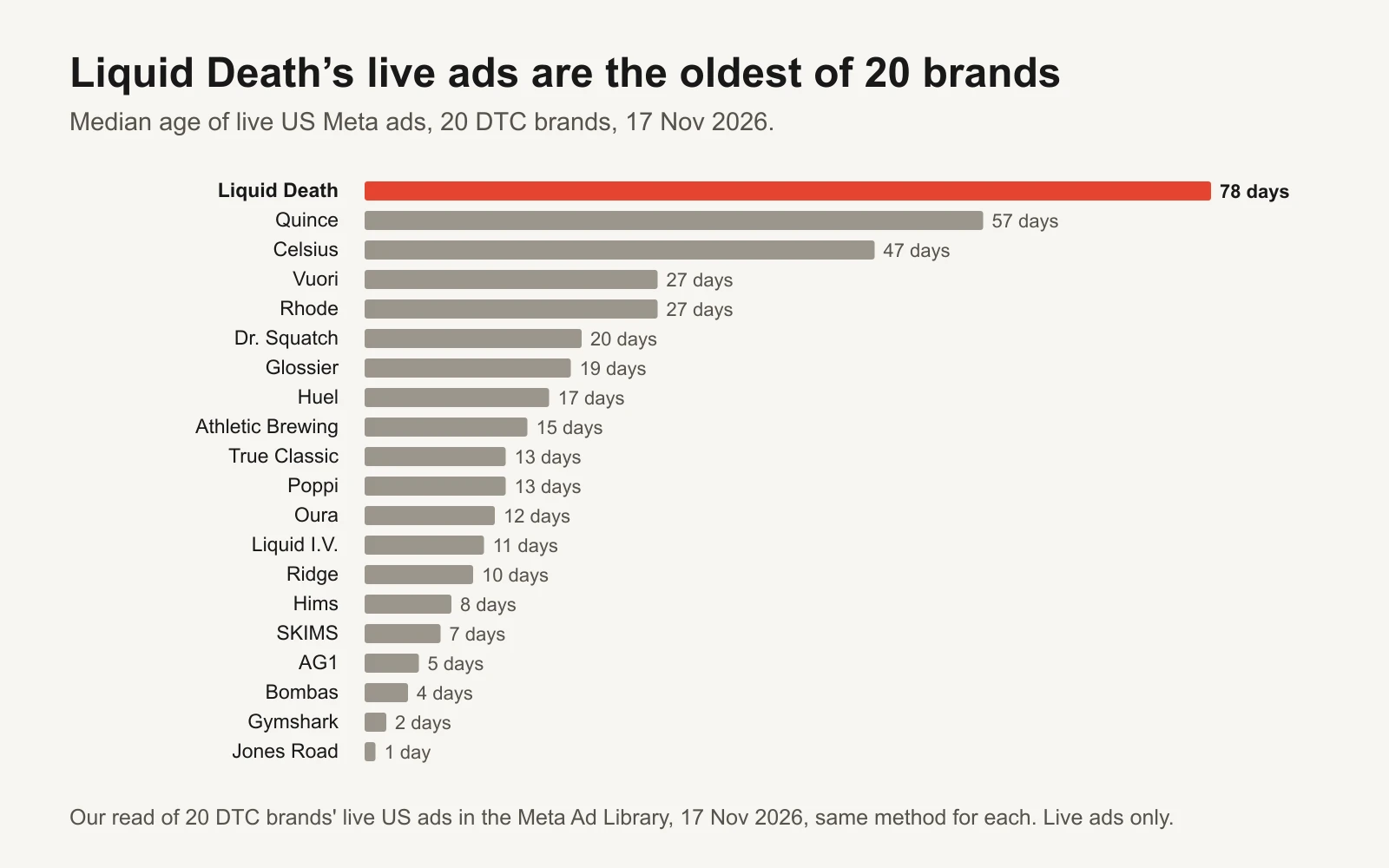
Same method for every brand: live US ads in the Meta Ad Library, read on 17 November 2026.
Compare Grüns, which replaces almost every ad within two weeks. Both approaches can work. They suit different situations, which we come back to below.
Finding 2: the survivors read like a nutrition label
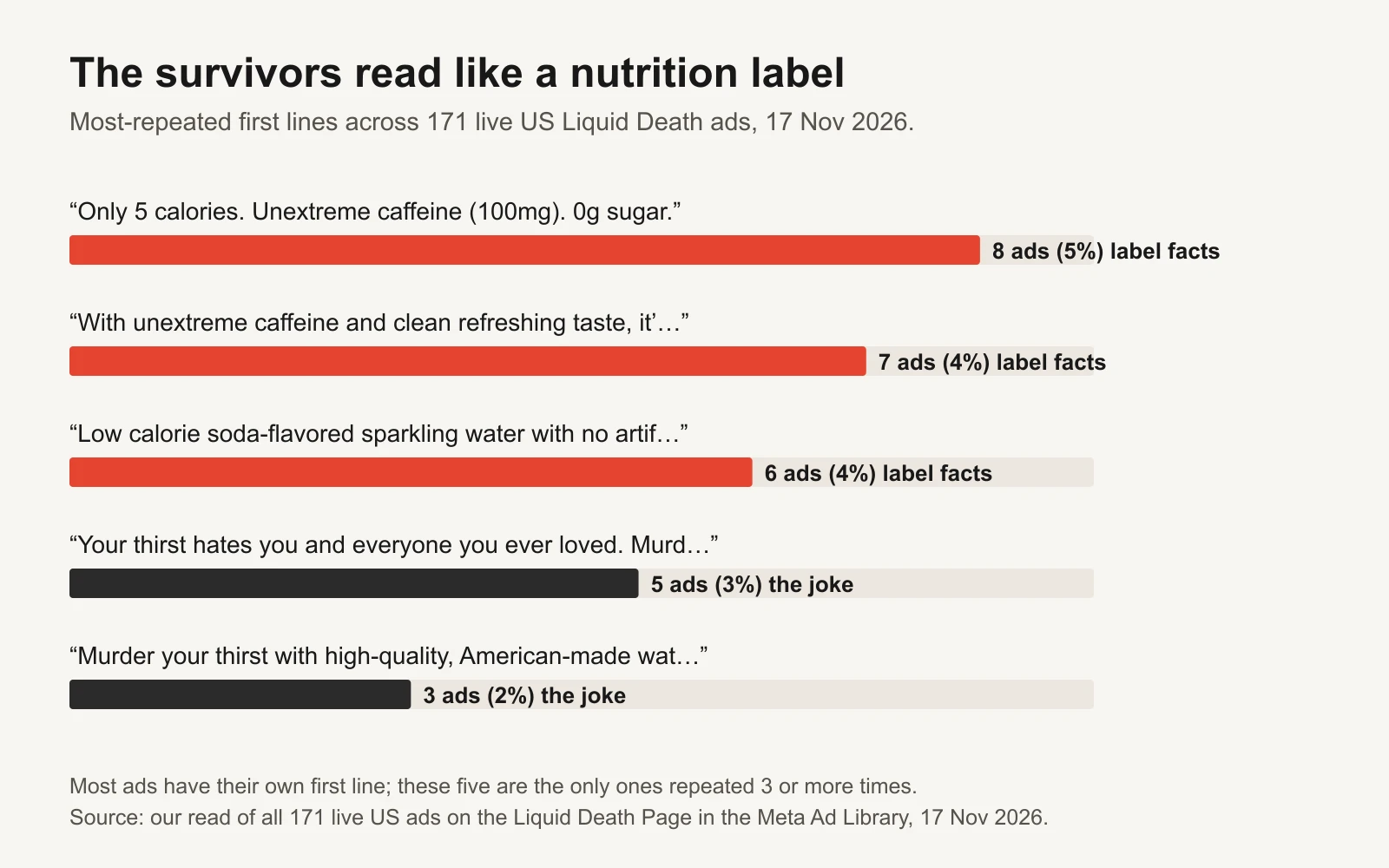
Most ads have their own first line; these five are the only ones repeated three or more times.
The three most-repeated first lines are plain product facts. The two joke lines, including the famous "murder your thirst", open fewer ads.
The oldest live ads tell the same story. All started on 29 April:
| Started | Days running | Advertiser | Format | First line | Library link |
|---|---|---|---|---|---|
| 29 Apr | 202 | Liquid Death | Image | "Only 5 calories. Unextreme caffeine (100mg). 0g sugar." | Ad |
| 29 Apr | 202 | Liquid Death | Image | "With unextreme caffeine and clean refreshing taste…" | Ad |
| 29 Apr | 202 | Prince I AM with Liquid Death | Video | "when you make it out of the hotel room and into the gym" | Ad |
One honest caveat: the 202-day group isn't only label statics. The partnership video with the creator Prince I AM started the same day. What we can say is that the two image ads from that day are both label lines, and label lines are the most-repeated openings across the whole account.
Why would facts outlast jokes? We can't see results, but there's a reasonable read. The joke is the brand; it's already on the can, in the design, in every picture. A shopper who stops on the ad wants to know what's in it. "5 calories, 100mg caffeine, 0g sugar" answers that in one line, and it doesn't get old the way a punchline does after the third time you see it.
Finding 3: almost no offers
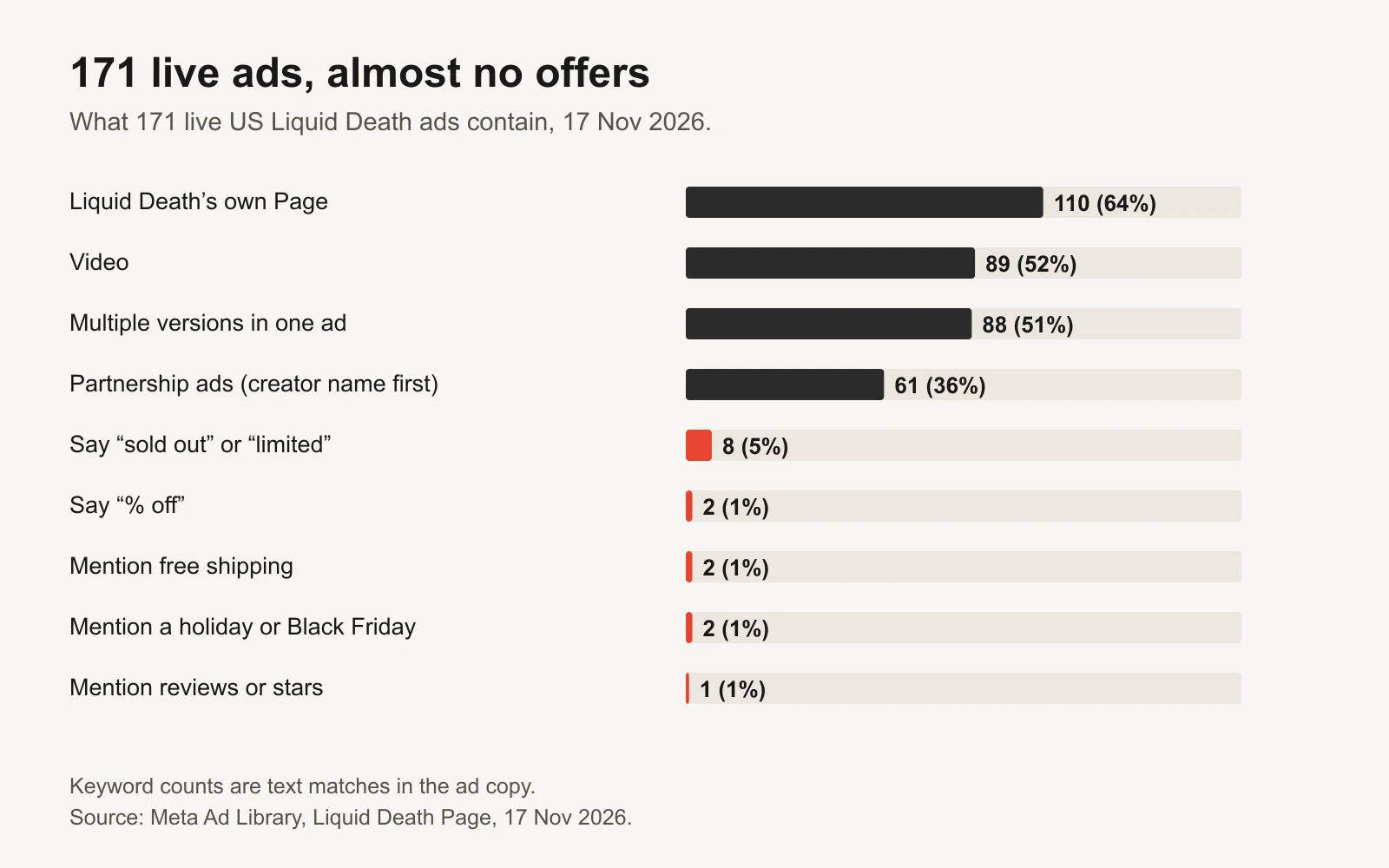
Keyword counts are text matches in the ad copy.
2 of 171 ads say "% off". 2 mention free shipping, 2 a holiday. Ten days before Black Friday, Liquid Death's live ads are almost entirely product and brand. Half are video (89) and half show several versions in one ad (88). 61 are partnership ads with creators, mostly fitness and lifestyle accounts with a handful of ads each.
Copy the system
- A plain fact line. Three numbers from your label or spec sheet, in the order your buyer cares about. "Only 5 calories. Unextreme caffeine (100mg). 0g sugar."
- One coined word. "Unextreme caffeine" sets the product apart without a claim you'd need to defend.
- The attitude in the picture, the facts in the copy. Let the design carry the brand. Keep the first line checkable.
- Creators in real moments. "When you make it out of the hotel room and into the gym." A situation, not a script.
- Leave keepers alone. Add new ads beside a working one, not instead of it.
The workbook's Copy the system tab has these five parts next to an empty column for yours. Use your own facts and words; never copy another brand's.
When to keep ads for months, and when to churn
Liquid Death's approach suits brands whose ad is mostly a reminder: a known product, bought again and again, where the job is to stay in front of people with a clear reason. Fact-led statics are cheap to make and slow to tire, because there's no punchline to wear out.
The Grüns or Jones Road approach, big batches replaced within two weeks, suits brands still finding their message, or selling to people who have never heard of them. You need many tries to learn what works.
Most small brands need both: a few keepers that pay the bills, and a steady trickle of new tests beside them. The mistake is killing a keeper because you're bored of it. You've seen it a hundred times; most of your audience hasn't. Our creative fatigue system shows how to tell real fatigue from boredom using the ad's own numbers.
Run a keeper review
The workbook's Keeper review tab makes this a 10-minute monthly check. List your live ads with their start date and the last 30 days' spend and purchases, set your target CPA and the minimum spend you need to judge an ad (3 times target CPA by default). Each ad gets one verdict:
- Good: keeper, leave it alone if it spent enough and its CPA is at or under target.
- Watch: refresh the first line only if CPA is up to 20% over target. Change one line, not the whole ad.
- Bad: replace it if CPA is further over, or it spent enough with no purchases.
- Watch: not enough spend if it's too early to say.
In the fictional example, a 202-day label static at a $25 CPA and a newer low-calorie static at $25 are keepers, two others need only a new first line, and the joke video at $50 gets replaced. The keepers take 41% of the month's spend. The thresholds are starting points we chose; change them in the sheet.
Read any competitor the same way
The Ad log tab is prefilled with Liquid Death's five oldest live ads, with links. Add a competitor, set the check date, and the Summary tab tells you their share of ads older than 14 days: under 20% means they churn, over half means they keep winners like Liquid Death. The Ad Library competitor playbook covers turning what you see into briefs of your own.
Tools and repos that help
| Tool or repo | What it is for | Who should use it |
|---|---|---|
| Meta Ad Library | Every live ad for a Page, with start dates and formats | Everyone |
| Meta Transparency Center: Ad Library tools | What the library keeps, for how long | Anyone reading ad ages |
| facebookresearch/Ad-Library-API-Script-Repository | Meta's Python examples for the Ad Library API (ordinary product ads only if they reached the EU) | Developers |
| anthropics/skills | Public agent skills, including one for spreadsheets like this workbook | Anyone who wants an assistant to fill in the review |
Or let GaaS run it
GaaS is an AI agent that creates, launches and optimizes Meta and Google ads from three inputs: your website, a spend limit and a one-line goal. It keeps the ads that still earn, tests new ones beside them and tells you why, and nothing spends without your approval. See how GaaS works. Either way, the workbook below is yours to keep.