
10 days before Black Friday, the feed fills with percentages. We counted: the same morning, Ridge had 954 Meta ads live in the US and 55 of them said "% off"; AG1 had 572, with 21.
Oura had 67. 45 of them went live on a single day, 5 November, selling its Ring 5. And not one says "% off", "free shipping", "holiday" or "Black Friday".
This teardown covers what Oura is running instead, how a premium product fills the pre-Black Friday window without a discount, and a calculator to see what a discount would really cost you.
How we read the library, and what it can't tell you
We opened the Oura Page in the Meta Ad Library on 17 November 2026, signed in, with active ads, all ad types and the United States selected, and scrolled to the end. 67 distinct ad cards loaded; the header said "~72 results", which counts versions. For each card we logged the start date, format, advertiser line and first line, and searched the text for offer words. We read AG1 and Ridge the same way on the same day.
Four limits matter before any conclusion:
- Live ads only. Outside the EU, Meta's library shows ordinary product ads only while they run (Meta Transparency Center: Ad Library tools). We can't see what Oura ran before 5 November.
- No results. The library shows no spend or sales.
- A snapshot. Zero discounts on 17 November does not mean zero discounts on Black Friday. Oura may add sale ads closer to the day; a second read in a week would show it.
- Not a launch. The Ring 5 was announced on 28 May 2026 and shipped from 4 June (TechCrunch). The 45 ads that started on 5 November are a fresh push for a product that is already six months old, not its launch.
Finding 1: 45 ads on one day, nothing older than 12 days
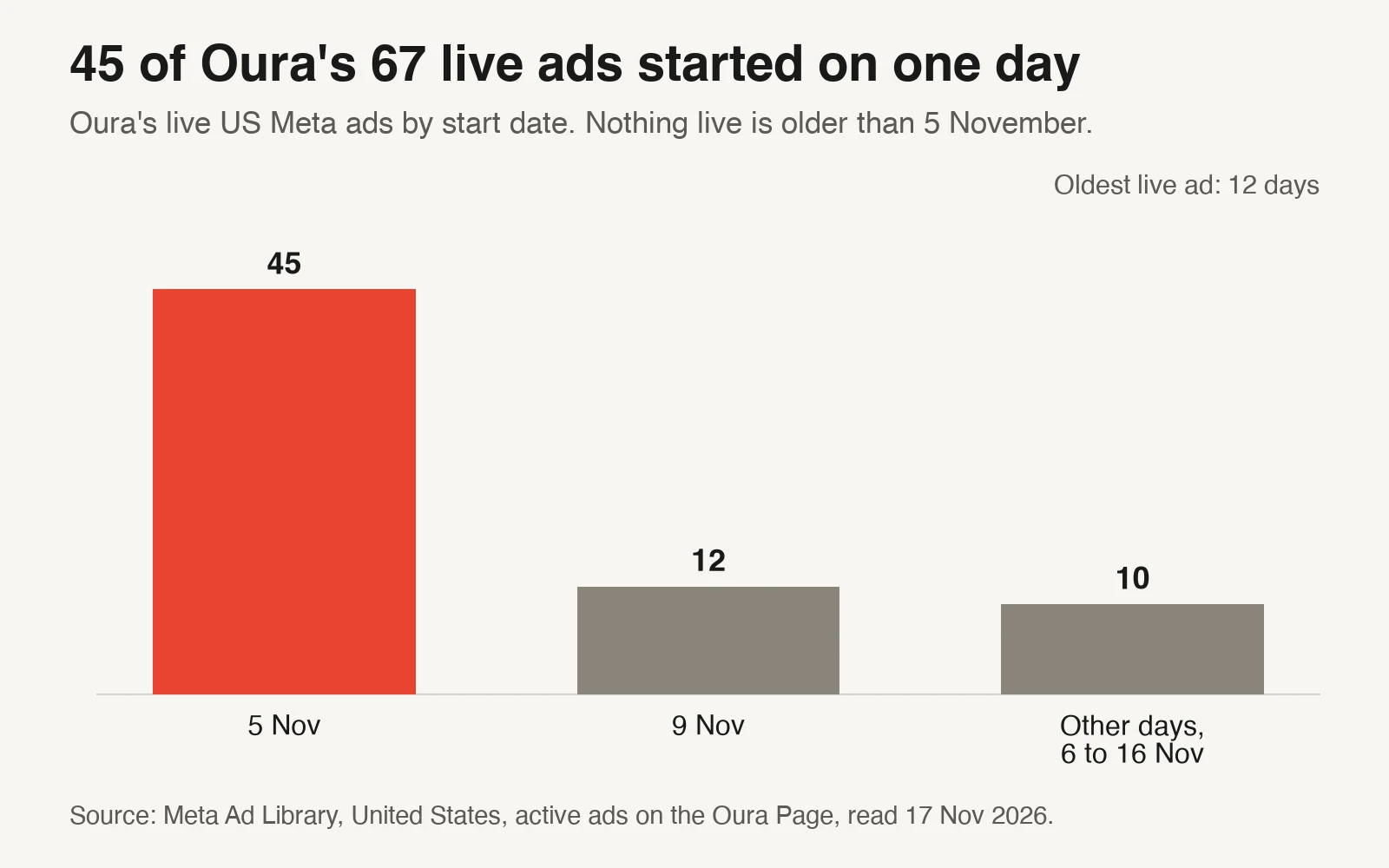
The whole account is less than two weeks old.
Every live Oura ad started on or after 5 November. 45 started that day and 12 on 9 November; the other 10 are spread across the days in between and after. 44 of the 67 are video, 46 have more than one version, and only 5 are partnership ads that run under someone else's name.
That is the shape of a planned push, not of an always-on testing machine: one large set built and approved together, then a second smaller set four days later.
Finding 2: a small account, by DTC standards
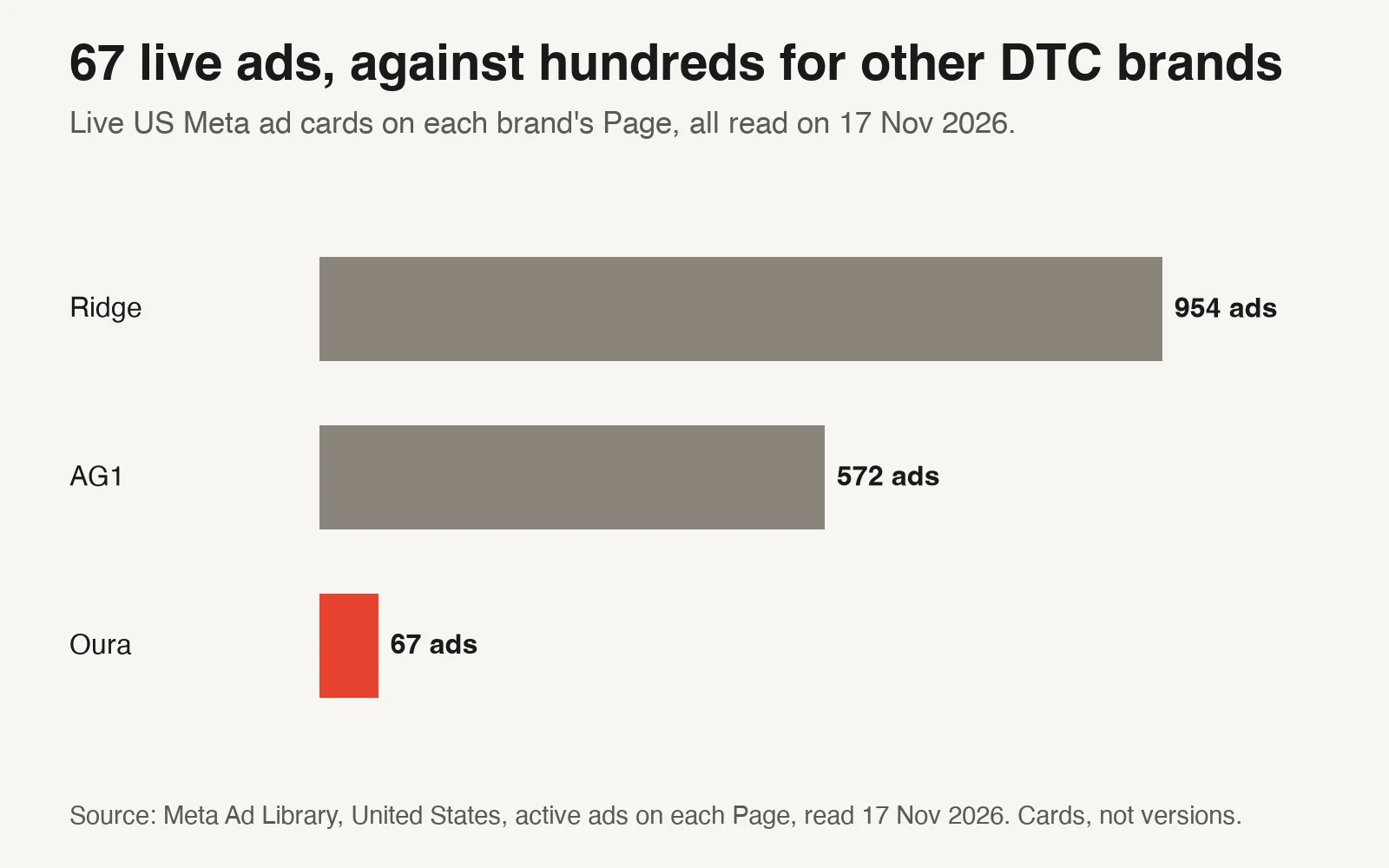
Cards, not versions. All three read on the same day.
Ridge and AG1 run hundreds of live ads; Oura runs 67. Both of the big accounts are built around many versions of a few messages (AG1's top opening line, for example, runs on 382 of its 572 ads). Oura's 67 ads repeat a handful of lines too:
| Opening line | Ads |
|---|---|
| "Oura provides daily, personalized guidance that helps y[ou]…" | 9 |
| "See what's possible with the world's smallest smart rin[g]" | 5 |
| "Wherever life takes you, Oura keeps your health in sync" | 5 |
| "Smaller, thinner, and more comfortable. Oura Ring 5 del[ivers]…" | 2 |
The five oldest live ads all started on 5 November; one is an image that opens "Get real-time, just-for-you health insights…" (Ad), and four are videos.
The messages are about the product (smallest, thinner, more comfortable) and about what it does every day (personalized guidance, health in sync). "World's smallest smart ring" is Oura's own claim for the Ring 5, which TechCrunch reports as 40% smaller than the Ring 4.
Finding 3: zero discount words, while others lean in
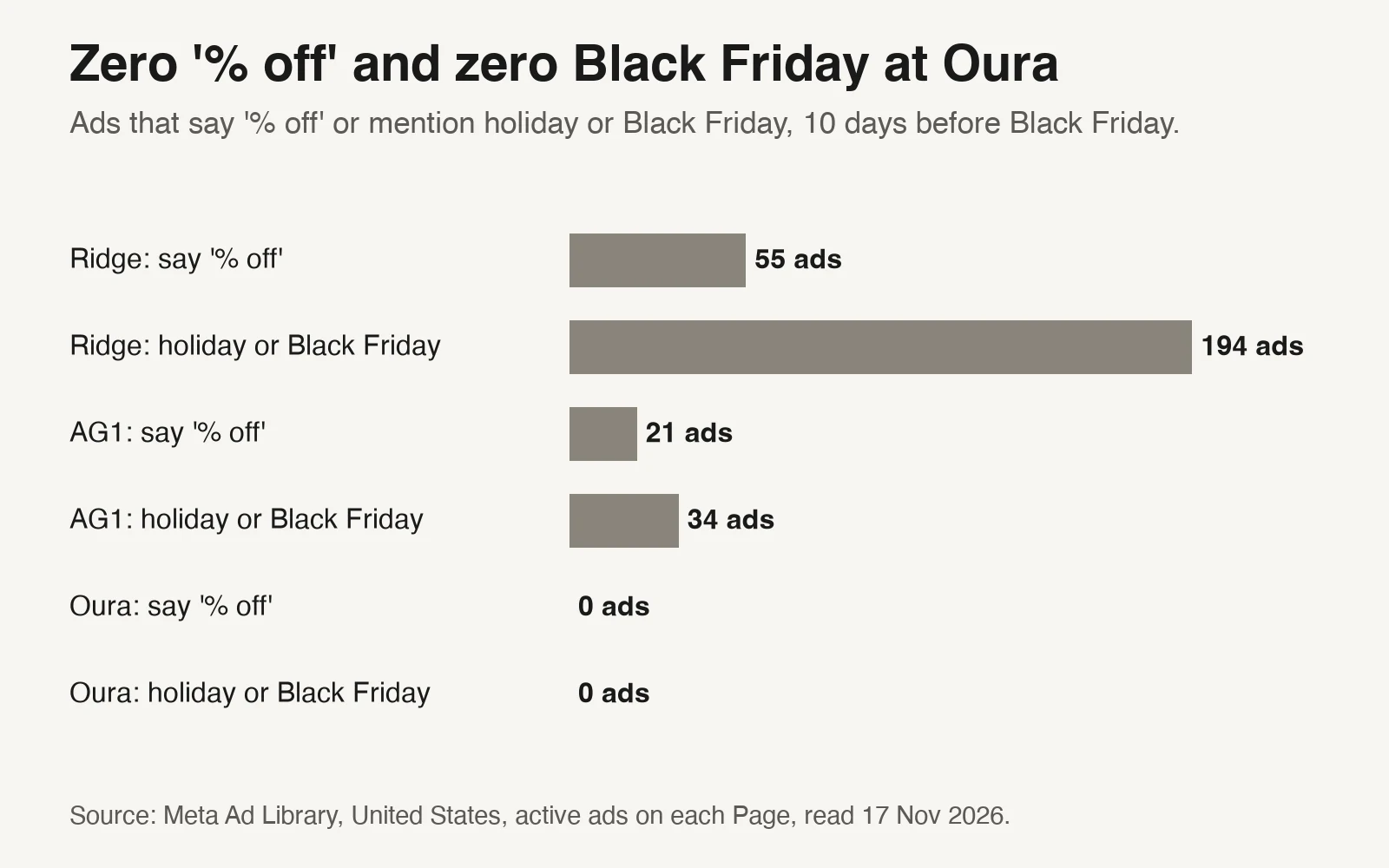
Oura: 0 '% off', 0 free shipping, 0 holiday or Black Friday.
None of Oura's 67 ads says "% off", "free shipping", "holiday" or "Black Friday". The other two accounts are already in the season: Ridge has 194 ads mentioning the holidays or Black Friday and 55 with "% off"; AG1 has 34 and 21.
There are good reasons a brand like Oura might hold the price, and we can name them without claiming to know Oura's own:
- The price is part of the product. The Ring 5 starts at $399 for the Black and Silver finishes and $499 for the others (TechCrunch). A premium price that drops every November teaches buyers to wait for November.
- Profit continues after the sale. Oura requires a $5.99 monthly membership (TechCrunch). A brand with income after the first purchase can win on the number of new customers rather than the margin on the device, but a discount on the device still costs real money on every unit, including the ones that would have sold at full price.
- The season is still a season. A gift-buying shopper is in the market either way. Ads that make the product clear may do as much in November as ads that make it cheaper.
None of this means discounts are wrong. It means a discount is a cost you should be able to put a number on, which is what the calculator in the workbook does.
How Oura fills the pre-Black Friday feed: four moves
1. One product, one clear claim. "Smaller, thinner, and more comfortable." The ad makes the product easy to understand before it asks for anything.
2. A superlative you can back up. "The world's smallest smart ring." A claim like this needs evidence behind it, and Oura states it about its own product.
3. Sell the daily benefit. "Daily, personalized guidance" opens the most ads. People buy what the product does for them every morning, not the hardware.
4. Launch the set together, then top up once. 45 ads on 5 November, 12 on 9 November. Then let it run.
The template: the no-discount push
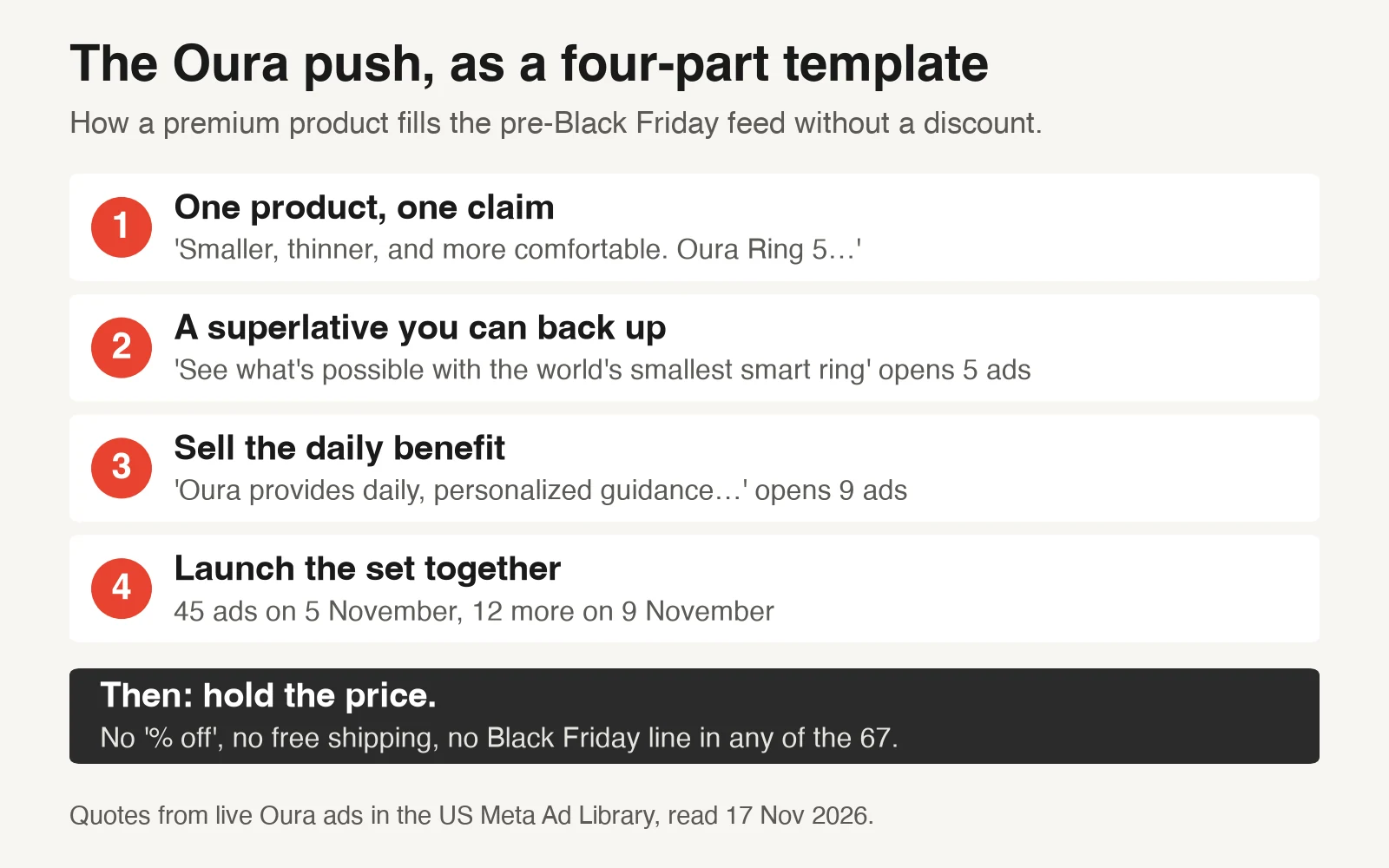
The workbook's "Copy the system" tab has this template with Oura's examples next to an empty column for yours:
- The product claim. One sentence on what is better about this product. "Smaller, thinner, and more comfortable."
- The proof or superlative. Only if you can substantiate it: a measurement, a first, a comparison you can show.
- The daily benefit. What it does for the buyer every day. "Daily, personalized guidance."
- The push. Write 30 to 50 variants (claim x benefit x format), launch them together a few weeks before the season, and add one top-up set.
Copy the system, never the claims. A superlative such as "smallest" or "first" needs evidence that holds for your product; the FTC's guidance on health products covers substantiation for health-related claims in the US.
What would a discount cost you? The calculator
The workbook's "Discount cost" tab answers the question every brand asks in November: how many more sales would a discount need to bring in just to earn the same profit?
Type your price, your gross margin per unit, the discount you are considering, and (if you have one) the profit you earn after the first sale, such as a subscription. The sheet works out profit per unit at full price and at the discount, and the extra sales you need to break even, with and without the later profit.
In the fictional example, a $399 device with a 50% gross margin earns $199.50 a unit. At 20% off it earns $119.70, so you need 67% more units just to stand still. If each buyer also brings $57.50 of profit later (12 months of a $5.99 membership at 80% margin, fictional), the discount needs 45% more units instead. The later profit softens the cost of a discount, but at these numbers you still need almost half as many sales again.
The promotional discount economics post covers the same maths for sitewide sales, and offer vs creative covers when changing the ad beats changing the price.
Read any competitor the same way
The "Ad log" tab is prefilled with the five oldest Oura ads. Add your own competitor below: open their Page in the Meta Ad Library with active ads and your country, scroll to the end, and log each card's library ID, start date, format, offer words and first line. The "Summary" tab counts ads by age, format, angle and offer words, and gives the share that say "% off" with a one-line reading: holding the price, or discounting into the season. Run it on two or three competitors in the same week and you will see who is discounting into the season and who is holding the price. The Ad Library competitor playbook covers the rest of the method.
Tools and repos that help
| Tool or repo | What it is for | Who should use it |
|---|---|---|
| Meta Ad Library | Every live ad for a Page, with start dates and formats | Everyone; this teardown is built on it |
| Meta Transparency Center: Ad Library tools | What the library keeps, for how long | Anyone drawing conclusions from "days running" |
| facebookresearch/Ad-Library-API-Script-Repository | Meta's Python examples for the Ad Library API (EU-delivered ads only for ordinary product ads) | Developers tracking ads in a spreadsheet |
| anthropics/skills | Public agent skills, including an xlsx skill that lets Claude fill in the calculator and the log | Anyone who wants an assistant to keep the tracker up to date |
Or let GaaS run it
GaaS is an AI agent that creates, launches and optimizes Meta ads from three inputs: your website, a spend limit and a one-line goal. It writes product-led ads in batches, launches them together, keeps what earns, and never runs a discount you didn't approve. See how GaaS works. Either way, the calculator below is yours to keep.