
The standard advice for a beauty brand on Meta is UGC: dozens of creators, talking to camera, holding the product. rhode, the skincare brand Hailey Bieber founded, does none of it.
On 17 November 2026 we could count 51 live rhode ads in the US Meta Ad Library. 47 of them aren't video. None is a creator partnership. No ad's text says "% off" or "free shipping". The two oldest that we could read say "meet rhode" and "welcome to the world of rhode", and they have been running for 76 days.
This is a brand that e.l.f. Beauty agreed to buy in a deal worth up to $1 billion. So what is it doing, and how much of it can a brand without a famous founder copy? This teardown answers both, with a planner for how many ads your creative budget really buys.
How we read the library, and what it can't tell you
We opened rhode's Page in the Meta Ad Library on 17 November 2026, signed in, with active ads, the United States and all media selected. The header said "~79 results", which counts versions; we could count 51 distinct ad cards, and we use 51 throughout. 43 of the 51 cards have several versions. For each we logged the start date, format, advertiser line and opening text.
The limits:
- Live ads only. Outside the EU, the library shows only running ads (Meta Transparency Center: Ad Library tools).
- No results. No spend or sales are shown.
- "Not video" isn't always a single photo. Some of the 47 may be carousels. We say "aren't video", not "single images".
- "No discount" means the ad text. No ad's text says "% off" or "free shipping". rhode's site does offer free US shipping on orders over $45 (rhodeskin.com, checked 17 November 2026); the ads just don't mention it.
The deal: e.l.f. Beauty agreed in May 2025 to buy rhode for up to $1 billion, made up of $600 million in cash, $200 million in e.l.f. stock and up to $200 million more depending on rhode's growth over three years (WSLS / Associated Press, 29 May 2025). So "$1B" is the deal's value including the earnout.
Finding 1: stills, no creators, no offer
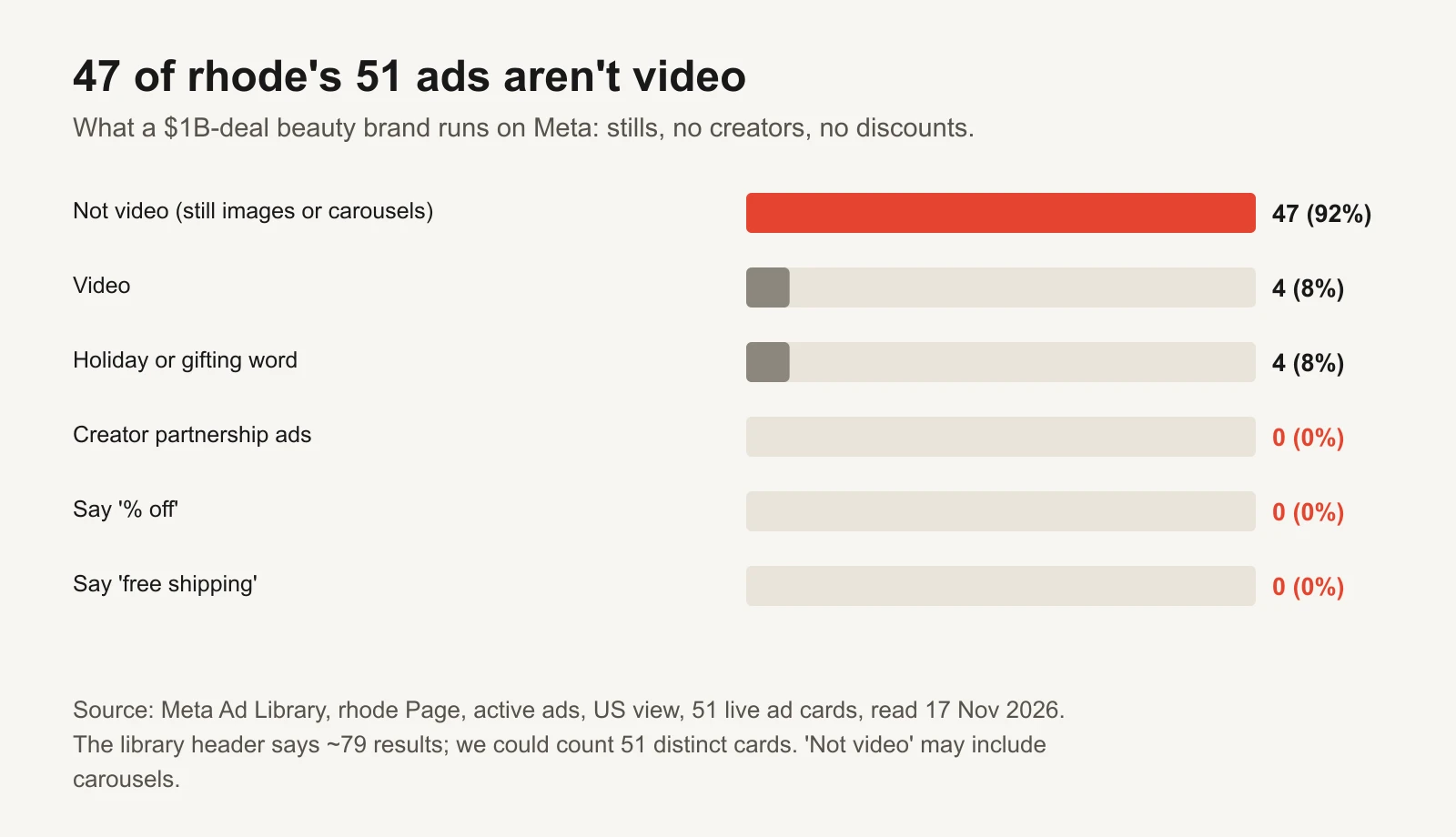
All 51 run from rhode's own Page. The advertiser card lists 5.5M Instagram followers.
| What we counted | Ads | Share of 51 |
|---|---|---|
| Not video (stills or carousels) | 47 | 92% |
| Video | 4 | 8% |
| Creator partnership ads | 0 | 0% |
| "% off" in the text | 0 | 0% |
| "free shipping" in the text | 0 | 0% |
| A holiday or gifting word | 4 | 8% |
Finding 2: half of them have run more than a month
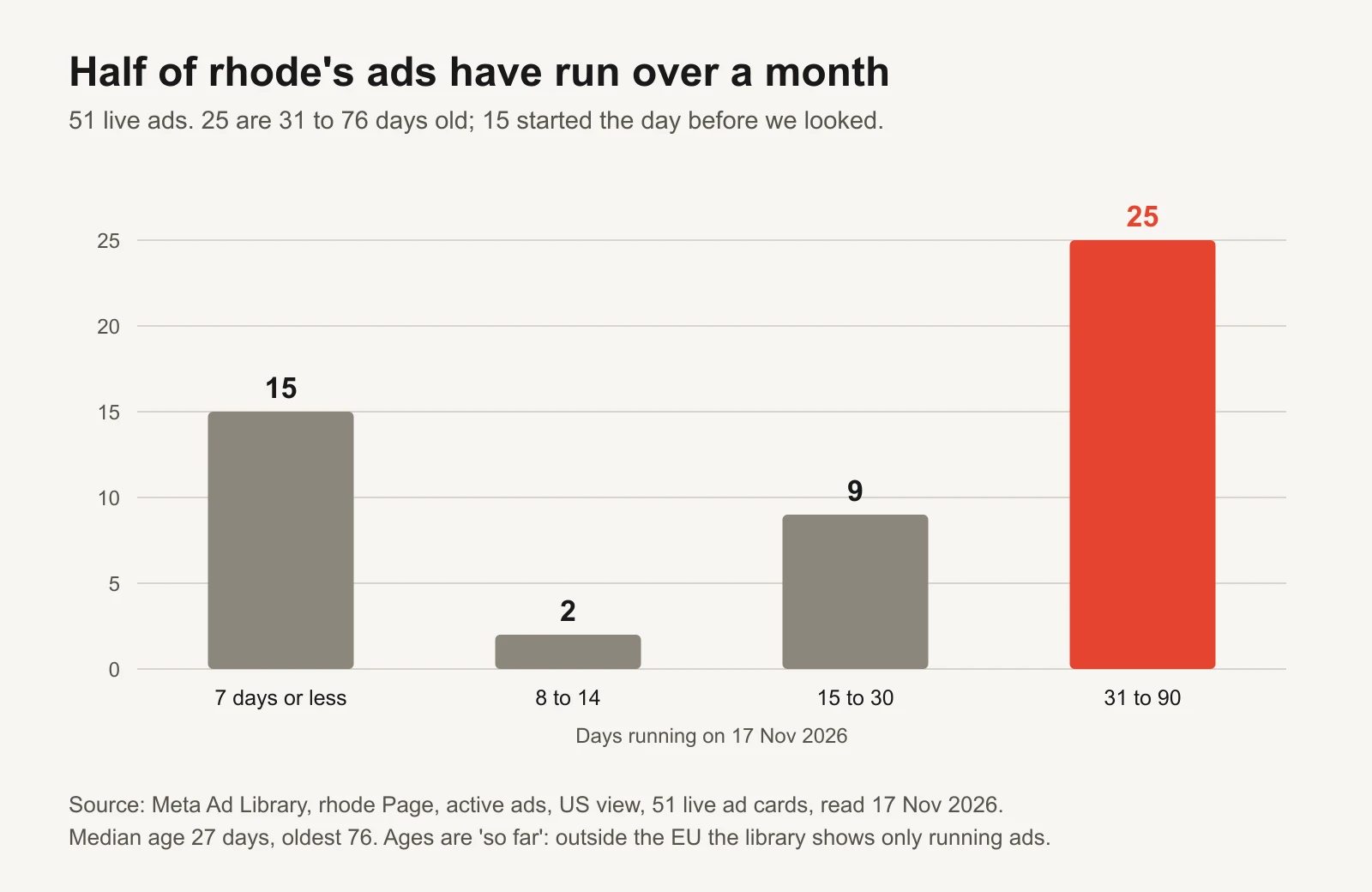
Median age 27 days, oldest 76. 15 started on 16 November, the day before we looked.
rhode launches ads in small sets around moments: 5 on 2 September, 7 on 21 October, 15 on 16 November. The new set lines up with a birthday capsule for Hailey Bieber's 30th, which rhodeskin.com was counting down to on the same day. Older sets keep running alongside.
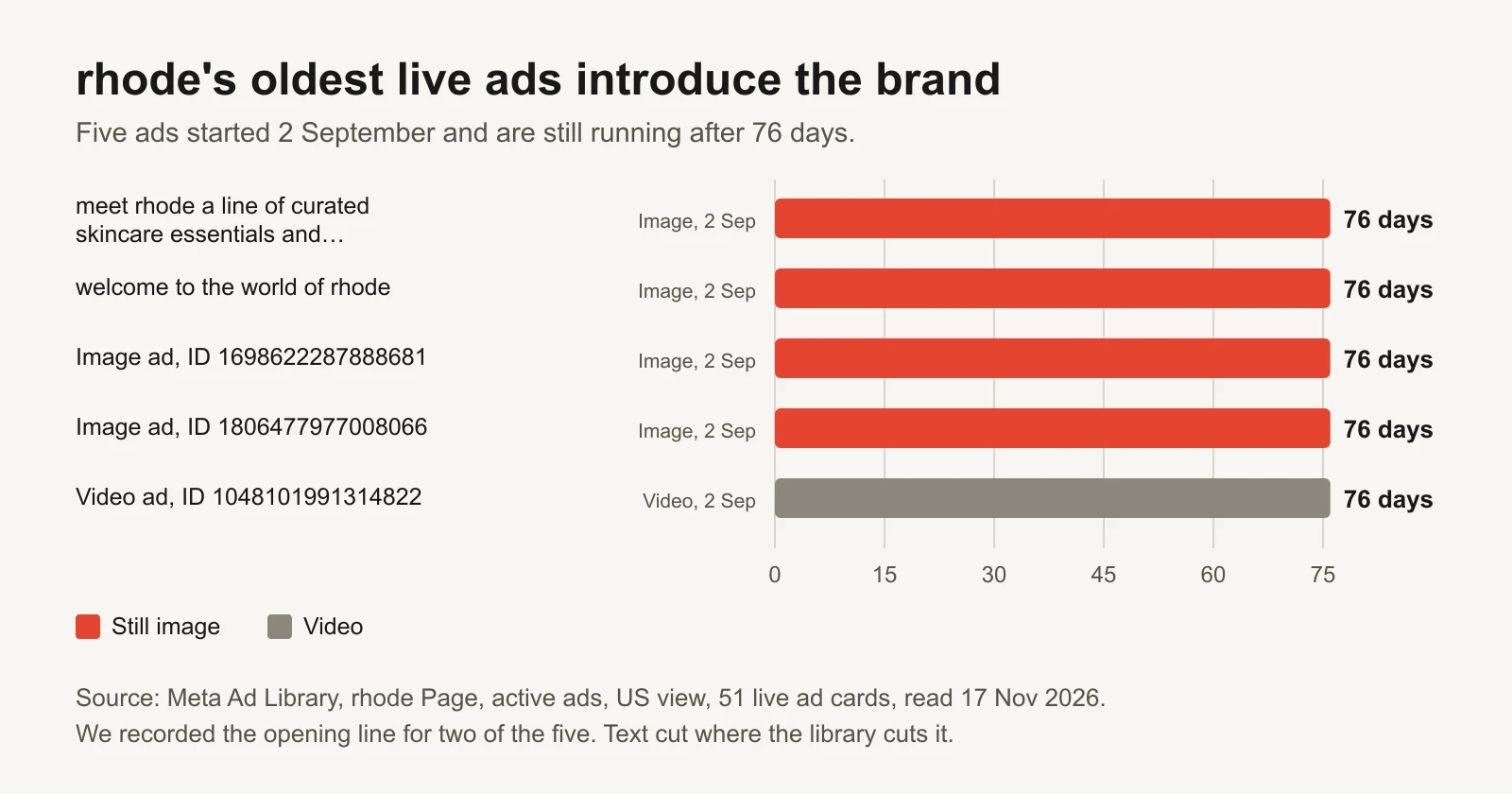
Four of the five oldest are stills.
| Started | Days running (to 17 Nov) | Format | Opening line | Library link |
|---|---|---|---|---|
| 2 Sep | 76 | Image | "meet rhode 🌟 a line of curated skincare essentials and…" | Ad |
| 2 Sep | 76 | Image | "welcome to the world of rhode 🤍" | Ad |
| 2 Sep | 76 | Image | Not recorded | Ad |
| 2 Sep | 76 | Image | Not recorded | Ad |
| 2 Sep | 76 | Video | Not recorded | Ad |
Finding 3: the words are a brand, not a pitch
The most repeated opening lines:
| Opening line | Ads |
|---|---|
| "BIRTHDAY CHAPTER 30. a new decade for hailey is around…" | 4 |
| "meet rhode 🌟 a line of curated skincare essentials and…" | 3 |
| "glazed skin for everyone on your list ❄️ the rhode kit…" | 3 |
| "welcome to the world of rhode 🤍" | 2 |
| "scented tints are here forever ☕️🩰" | 2 |
No problem-agitate-solve, no before and after, no price. The lines introduce the brand, mark a moment (a birthday, gifting season, a product staying in the range) and let the product photo do the rest. Most of the voice is lowercase, though not all of it: the birthday set opens in capitals.
What transfers, and what doesn't
What doesn't transfer: the reach. rhode's ads ride on a founder millions of people already follow. "meet rhode" works when people half-know rhode already. A new brand saying "meet us" to strangers starts from zero. That is the main reason not to copy rhode's approach whole.
What does transfer:
- A clean product still is a real ad. Stills are cheap to make, quick to vary and easy to read at a glance. If your product is visual, a well-lit photo with one line can carry a launch.
- Launch around moments. rhode's sets map to moments: the brand, a gifting season, a birthday capsule. Each gives you a reason for new ads without inventing one.
- Keep the brand-intro ads on. The oldest live ads are the simplest ones. An ad that says who you are and shows the product doesn't go out of date.
- No discount is a choice. Leaving price out of the ad protects a premium position. It works when demand already exists; a brand that needs first orders may still need an offer.
And "no creators" is not a rule. rhode has its founder; most brands need someone else's face to earn trust. If you use creators, run them as partnership ads with the right disclosure. The 30 UGC ad script templates cover that side.
The template: the product, plainly
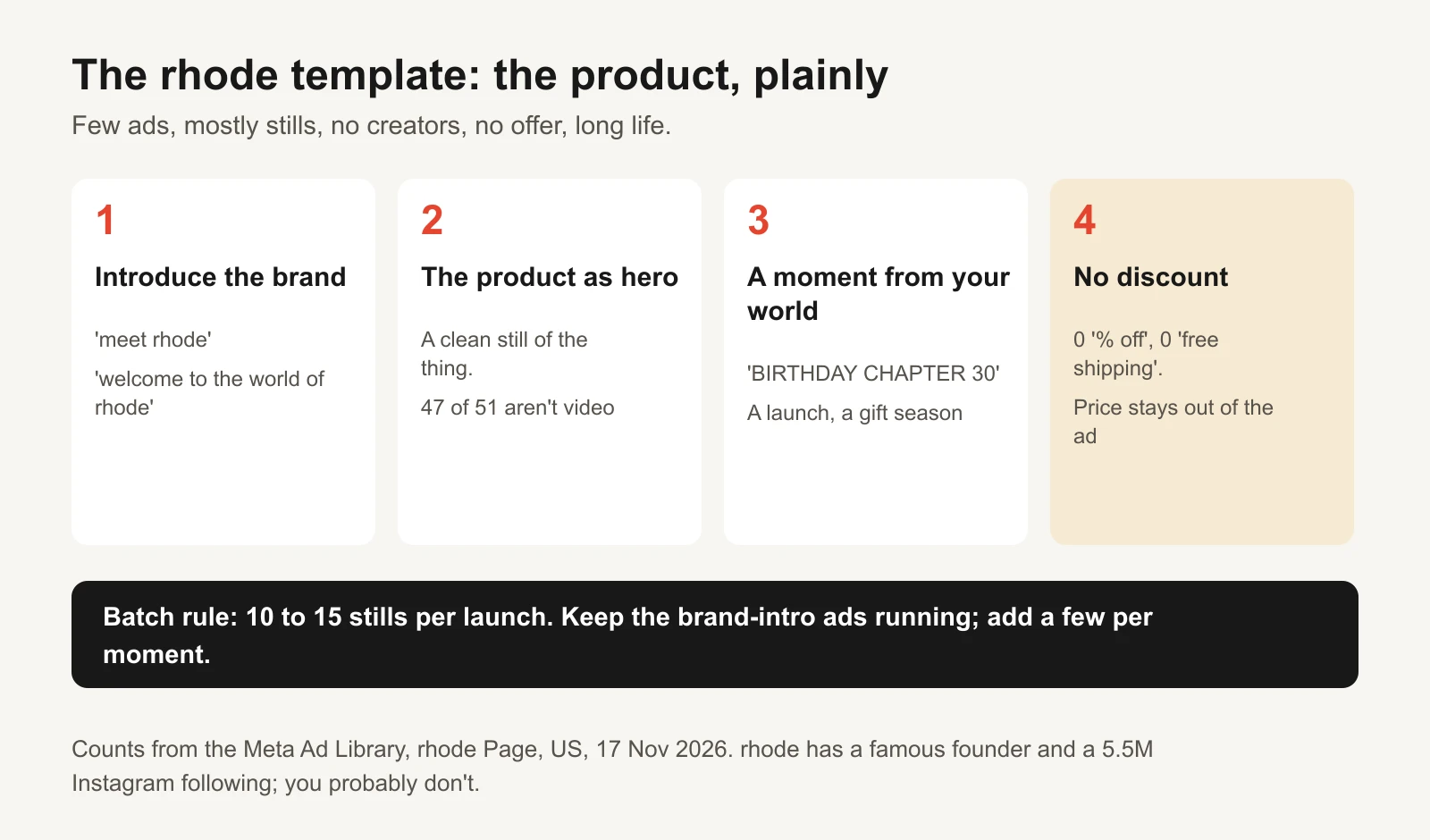
rhode has a famous founder and a 5.5M Instagram following; you probably don't. Plan more ads and test an offer.
- Introduce the brand in one line, in your own voice.
- The product as hero: one clean still, the product doing nothing but being itself.
- A moment from your world: a launch, a season, a milestone.
- No discount, if you can afford to keep price out of it. Test one if you can't.
Plan the mix: how many ads your budget buys
The workbook's Static vs video planner turns cost per ad into count of ads:
- Type your creative budget for a launch and what one still and one video cost you to make.
- Set the share of budget that goes on stills.
- The sheet shows how many of each you can make, the total, and how many stills one video costs.
In the fictional example, a $3,000 budget with stills at $60 and videos at $400, split 60/40, makes 30 stills and 3 videos: 33 ads, 91% stills, close to rhode's 92%. All on video, the same money makes 7 ads. One video costs as much as about 7 stills. The sheet flags launches with fewer than 5 ads (too little for Meta to choose from) and fewer than 10 as thin; those lines are our starting points. To size the test budget that runs them, see ad creative test budget planning.
Read any competitor the same way
The Ad log is prefilled with rhode's five oldest live ads, with links. Add a competitor below:
- Open their Page in the Meta Ad Library with active ads, your country and all media, and scroll to the end.
- Log each ad's library ID, start date, format, face, angle, offer and first line.
- The Summary tab counts by age and format and gives the share older than 30 days, with a one-line reading.
Count the faces as you go. A brand with zero creators and a famous founder is playing a different game from one with hundreds of partnership ads, and the Ad Library competitor playbook helps you pick which game you are in.
Tools and repos that help
| Tool or repo | What it is for | Who should use it |
|---|---|---|
| Meta Ad Library | Every live ad for a Page, with start dates, formats and versions | Everyone; this teardown is built on it |
| Meta Transparency Center: Ad Library tools | What the library keeps and for how long | Anyone reading "days running" |
| facebookresearch/Ad-Library-API-Script-Repository | Meta's Python examples for the Ad Library API; ordinary product ads only if they reached the EU | Developers |
| anthropics/skills | Public agent skills, including an xlsx skill for spreadsheets like this one | Anyone who wants an assistant to fill in the log |
Or let GaaS run it
GaaS is an AI agent that creates, launches and optimizes Meta and Google ads from three inputs: your website, a spend limit and a one-line goal. It can turn your product photos into a set of clean stills, test them against each other and against an offer, and keep what earns, with nothing spending until you approve it. See how GaaS works. Either way, the planner below is yours to keep.