
Ten days before Black Friday, most apparel brands are writing longer ads, louder offers and bigger percentages. Vuori, the activewear brand, is doing almost the opposite.
On 17 November 2026, Vuori had 534 Meta ads live in the US. On about 235 of them, the whole text above the image is six words and a button: "Free Shipping $75+ Free Returns". Not one of the 534 says "% off". The photo does the selling.
This teardown shows what we counted, why a brand with a large ad budget would write so little, and how to run the same system with your own photos. The workbook has every count, a tracker to read any competitor the same way, and a planner for a one-line photo batch.
How we read the library, and what it can't tell you
We opened Vuori's Page in the Meta Ad Library on 17 November 2026, signed in, with active ads, the United States and all media selected, and scrolled to the end. The library's header said "~970 results"; that number counts each version of an ad separately. 534 distinct ad cards loaded, and that is the number we use. For each card we logged the "Started running on" date, the format, the advertiser line and the opening text.
Three limits matter before any conclusion:
- Live ads only. Outside the EU, the library shows ads that are running now. Meta keeps social issue, election and political ads for seven years and archives EU ads for a year after their last impression; ordinary US product ads drop out when they stop (Meta Transparency Center: Ad Library tools). So "393 days" means "still running after 393 days", not the longest any Vuori ad has ever run.
- No results. The library shows no spend, sales or return for these ads. We can see what Vuori keeps paying to run, not what earns most.
- The text, not the picture. "The whole text is the shipping line" describes the words above the image. The image or video itself may carry words we did not log.
The shipping offer is real: Vuori's homepage header reads "Free Standard Shipping With Orders Over $75" (vuoriclothing.com, checked 17 November 2026).
Finding 1: about 235 ads say one thing, and none says "% off"
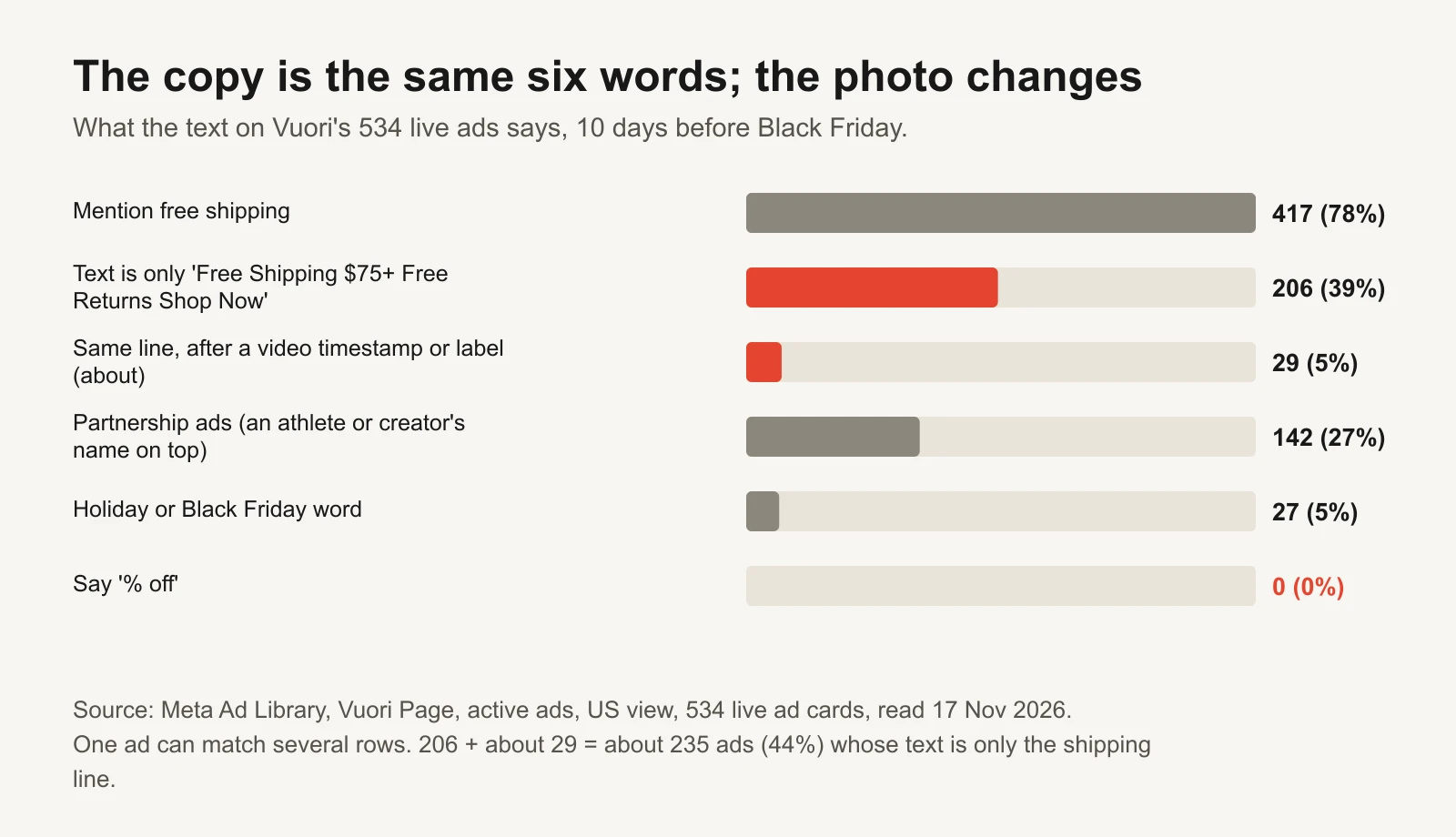
The 206 and the about 29 together make about 235 ads, 44% of the 534.
206 ads open with exactly "Free Shipping $75+ Free Returns Shop Now" and have no other text. About 29 more carry the same line after a video timestamp or a "Low impression count" label, which is why we say "about 235". If you want a number nobody can argue with, it is "more than 200".
What is not there matters as much:
| What we looked for | Ads |
|---|---|
| Mention free shipping | 417 |
| Text is only the shipping line | about 235 |
| A holiday or Black Friday word | 27 |
| "% off" | 0 |
The next most repeated opening, "Our famous, ultra-plush heavyweight fleece…", runs on only 10 ads. Vuori writes one line and lets hundreds of different photos carry it.
Finding 2: Vuori lets ads run
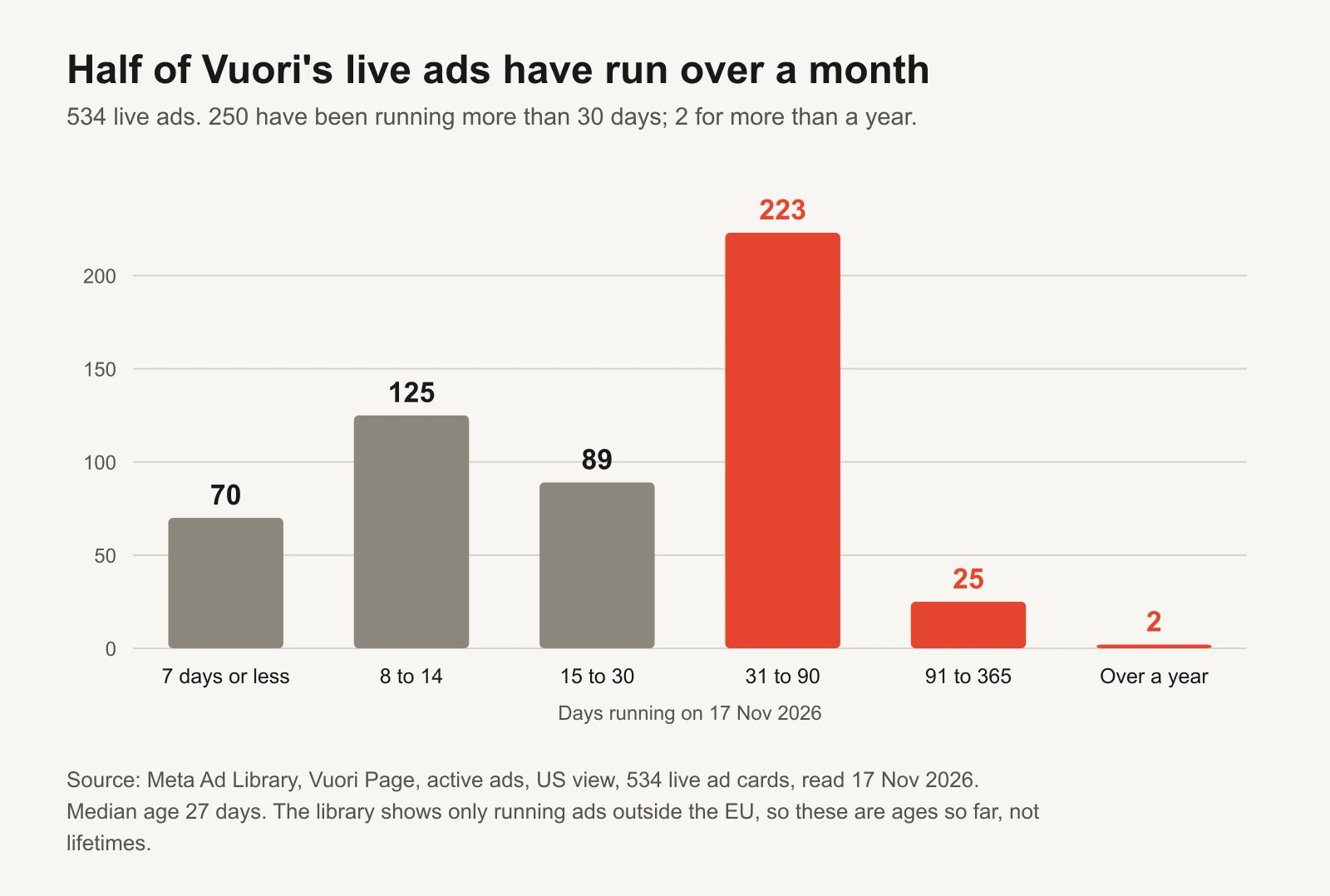
Median age 27 days. 250 of 534 have run more than a month.
Compare this with Grüns, where almost nothing was older than two weeks. Vuori launches in batches too (54 ads started on 4 November, 37 on 2 November, 37 on 13 November, 33 on 1 September), but it doesn't clear them out. 223 live ads are 31 to 90 days old, 25 are 91 to 365 days old, and two have run for more than a year.
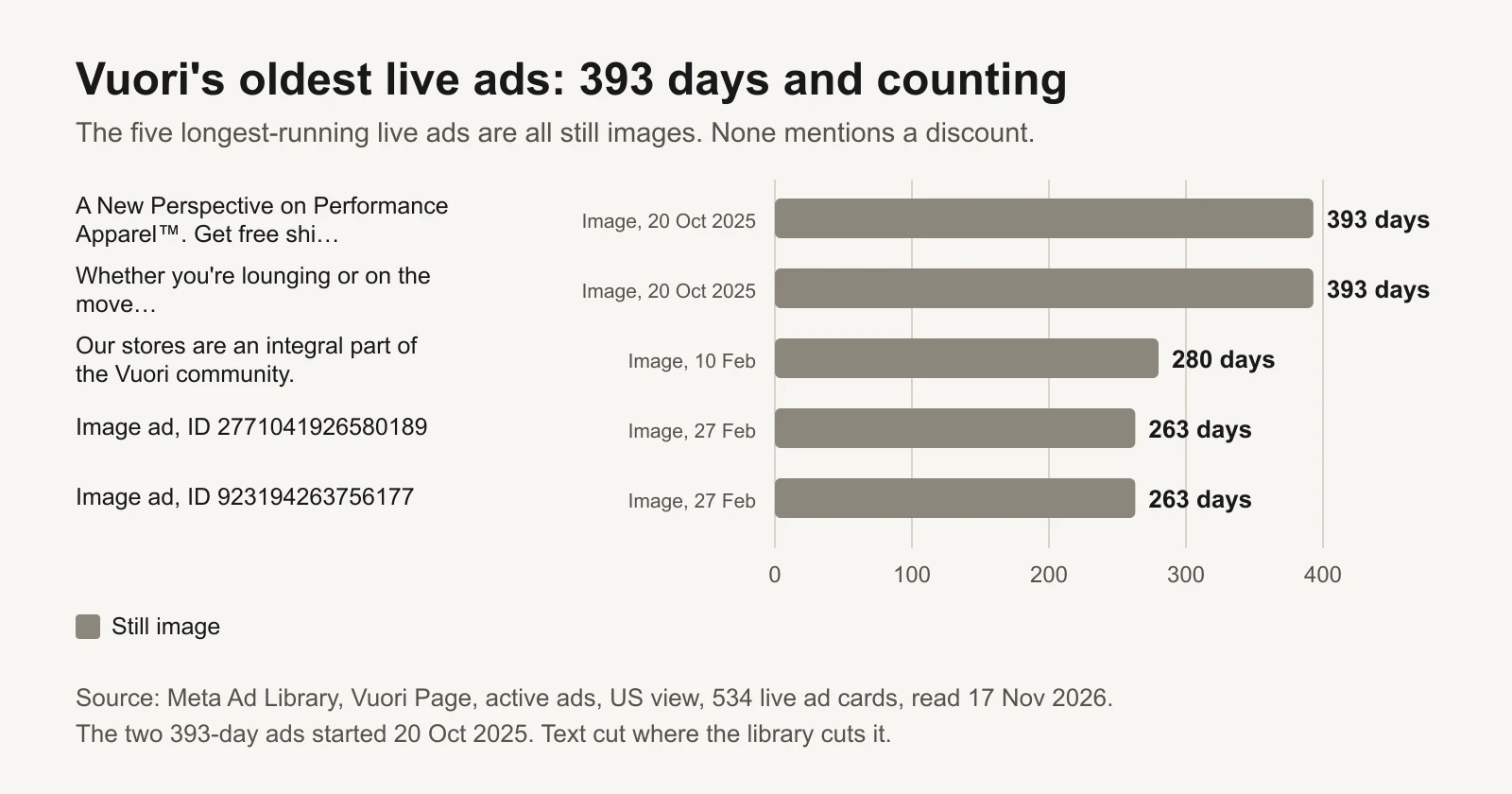
All five long-runners are still images. None mentions a discount.
| Started | Days running (to 17 Nov) | Format | Opening line | Library link |
|---|---|---|---|---|
| 20 Oct 2025 | 393 | Image | "A New Perspective on Performance Apparel™. Get free shi[pping]…" | Ad |
| 20 Oct 2025 | 393 | Image | "Whether you're lounging or on the move…" | Ad |
| 10 Feb 2026 | 280 | Image | "Our stores are an integral part of the Vuori community." | Ad |
| 27 Feb 2026 | 263 | Image | Not recorded | Ad |
| 27 Feb 2026 | 263 | Image | Not recorded | Ad |
Finding 3: stills, and other people wearing it
- 376 of 534 (70%) are still images. 158 are video. A brand this size can afford video; it still mostly runs photos.
- 142 are partnership ads, so the ad shows an athlete's or creator's name next to Vuori's. The biggest: Building Pickleball (11), Tyler Ruiz (11), bradleygoulddd (8), Junior kennedy (6), Sienna Mae Gomez (5). Vuori's own Page runs the other 392.
- 452 cards have several versions, which is how one card can show different crops or placements of the same picture.
Why so little text works for Vuori
We can't see Vuori's results, so this is reasoning, not proof.
The photo is the argument. Clothes are judged by how they look on a person. A shot of joggers on a trail, or fleece at a campfire, answers "would I wear this?" faster than a paragraph. Text above the picture mostly gets skipped on the way to it.
The line removes the last worry, not the first. "Free Shipping $75+ Free Returns" doesn't try to make you want the product; the photo did that. It answers the question that stops a first order online: what if it doesn't fit? Free returns make the order safe. The $75 threshold nudges a bigger basket without a discount.
No discount protects the price. Vuori sells at full price. Training buyers to wait for "% off" would cost more than it brings in. Ten days before Black Friday, 0 of 534 ads offered one.
One line makes testing clean. When every ad carries the same words, the only thing that changes between ads is the picture. Whatever Meta picks up and spends on tells Vuori which photo works, without the copy muddying the read. It turns hundreds of ads into a large photo test.
Patience lets winners pay back. An ad that keeps working for 393 days has made its production cost back many times. Vuori's habit of leaving ads live suggests it judges them over weeks, not days.
The template: one line, many photos
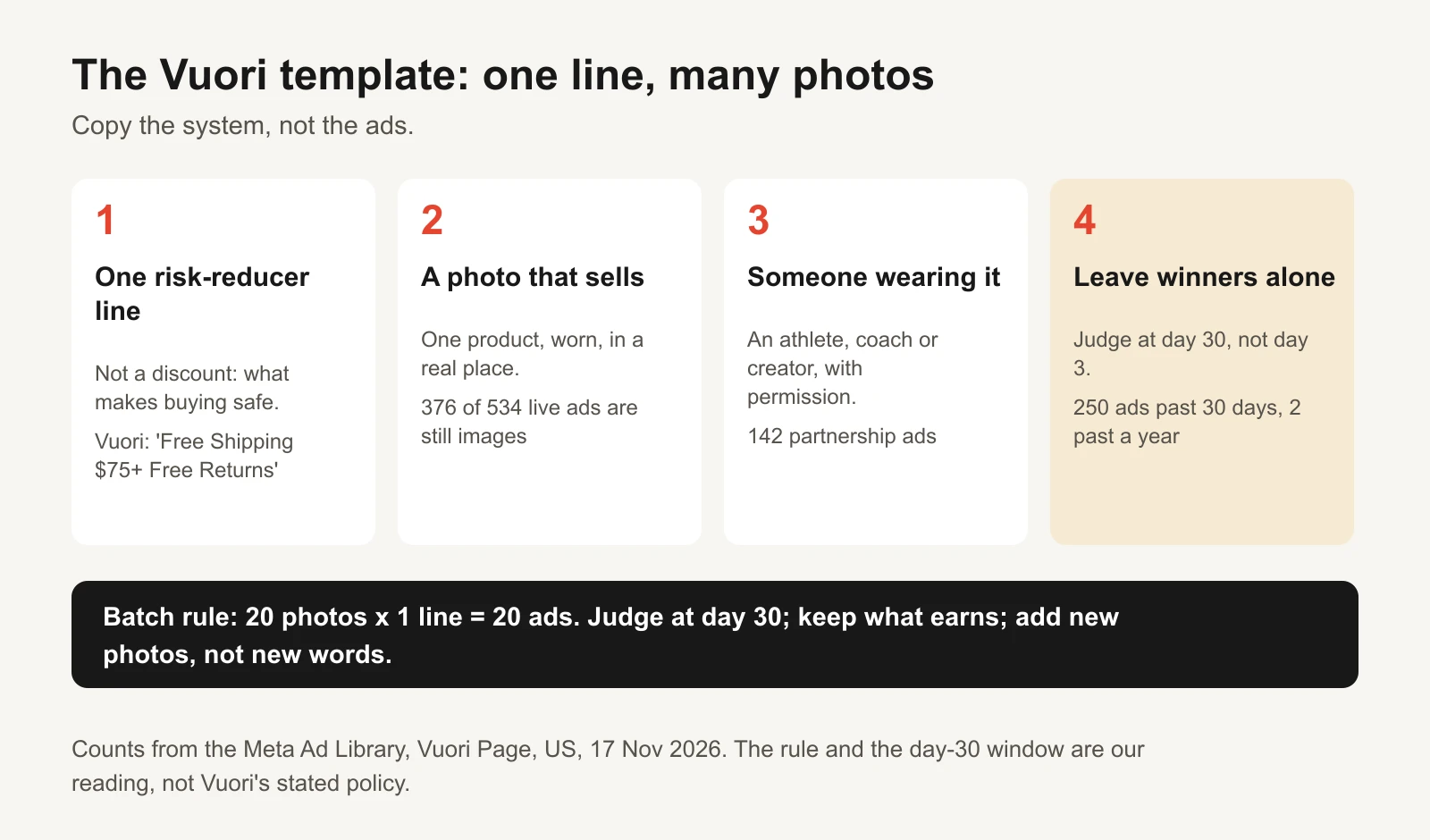
The day-30 window is our reading of the data, not a stated Vuori rule.
- One risk-reducer line. Not a discount: the reason buying from you is safe. Free returns, a fit guarantee, "try it for 30 days", free shipping over a threshold. Only use what you actually offer.
- A photo that sells. One product, worn by a person, in a place your buyer recognises. Swap the photo, not the words.
- Someone wearing it. Coaches, athletes, customers or creators who agreed to it, run as partnership ads with the right disclosure.
- Leave winners alone. Give each ad enough spend and time to be judged, then let the keepers run for months.
This works best for products people judge by eye: clothing, shoes, furniture, homeware, food. It works less well when the buyer needs an explanation before they care, like software or a supplement. There, a line of text has to do more work.
Plan the batch, and judge it at day 30
The workbook's Photo batch planner turns the template into a test:
- Size the batch. Type how many photos and copy lines you have. With 20 photos and 1 line, that's 20 ads. With a $45 target CPA (cost per acquisition) and a rule that each ad needs 2 times that in spend before you judge it, the batch needs $1,800, about $60 a day over 30 days.
- Launch them together under the same line, so the only difference is the picture.
- At day 30, type spend and purchases for each photo. The sheet marks each one: keep (enough spend, CPA at or under target), kill (enough spend, no purchases or CPA over target) or too early (not enough spend yet).
In the fictional example's first 12 photos, 3 are keepers, 4 are kills and 5 are too early to judge. Shoot more photos like the 3 keepers; leave the copy alone.
Thirty days and 2 times CPA are starting points we chose because half of Vuori's live ads have run past a month. With a small budget, use fewer photos, not a shorter window. For how to read early numbers, see the offer vs visual test and creative fatigue vs saturation.
Read any competitor the same way
The workbook's Ad log is prefilled with Vuori's five oldest live ads, each with a link. Add your competitor below them:
- Open their Page in the Meta Ad Library with active ads, your country and all media selected. Scroll to the end.
- Log each ad's library ID, start date, format, face, angle, offer and first line. Set the check date at the top.
- The Summary tab counts ads by age and format and gives the share older than 30 days. Under 20% means the brand replaces ads fast; over half means it keeps winners, so study the long-runners.
Read the same brand again a week later. A rhythm only shows across two or three checks. The Ad Library competitor playbook covers turning what you see into briefs that are yours.
Tools and repos that help
| Tool or repo | What it is for | Who should use it |
|---|---|---|
| Meta Ad Library | Every live ad for a Page, with start dates, formats and versions | Everyone; this teardown is built on it |
| Meta Transparency Center: Ad Library tools | What the library keeps, for how long, and the research tools around it | Anyone drawing conclusions from "days running" |
| facebookresearch/Ad-Library-API-Script-Repository | Meta's Python examples for the Ad Library API. The API returns ordinary product ads only if they reached the EU | Developers tracking EU ads in a spreadsheet |
| anthropics/skills | Public agent skills, including an xlsx skill that lets Claude read and edit spreadsheets like this tracker | Anyone who wants an assistant to fill in the log |
Or let GaaS run it
GaaS is an AI agent that creates, launches and optimizes Meta and Google ads from three inputs: your website, a spend limit and a one-line goal. It can run the one-line, many-photos test for you: it builds the batch from your product photos, judges each ad on spend and cost per purchase, keeps the winners and asks before anything spends. If you would rather approve batches than build them, see how GaaS works. Either way, the planner below is yours to keep.