
Meta ads got 60% cheaper the week after Christmas. And most brands are about to pause theirs.
Every December the same thing happens. Ad prices climb through Black Friday, peak in early December, and the moment Christmas is over, big advertisers switch their holiday budgets off. Fewer bidders, same audience, lower prices. Marketers call the stretch from Dec 26 to the end of January "Q5". Most small brands spend it with their ads paused, because the team is off and "nobody buys in January".
This guide shows what last season's prices actually did, what the data can and can't tell you, and a day-by-day plan to use the window. It's written for business owners who run their own Meta ads (Facebook and Instagram), with enough detail for a performance marketer to put in the calendar today.
The workbook has last season's weekly CPMs and what your budget buys at each, a day-by-day Planner that moves with your restart date, and a Judge tab that tells you after Jan 15 whether January was cheaper per purchase or only per impression. Example numbers that aren't linked to a source are a fictional worked example.
What prices did last season
CPM is the cost per 1,000 impressions: what you pay for reach. Gupta Media publishes a weekly Meta CPM tracker in its guide to Q5 (Gupta Media: What Is Q5 in Marketing?). For the 2025 to 2026 season:
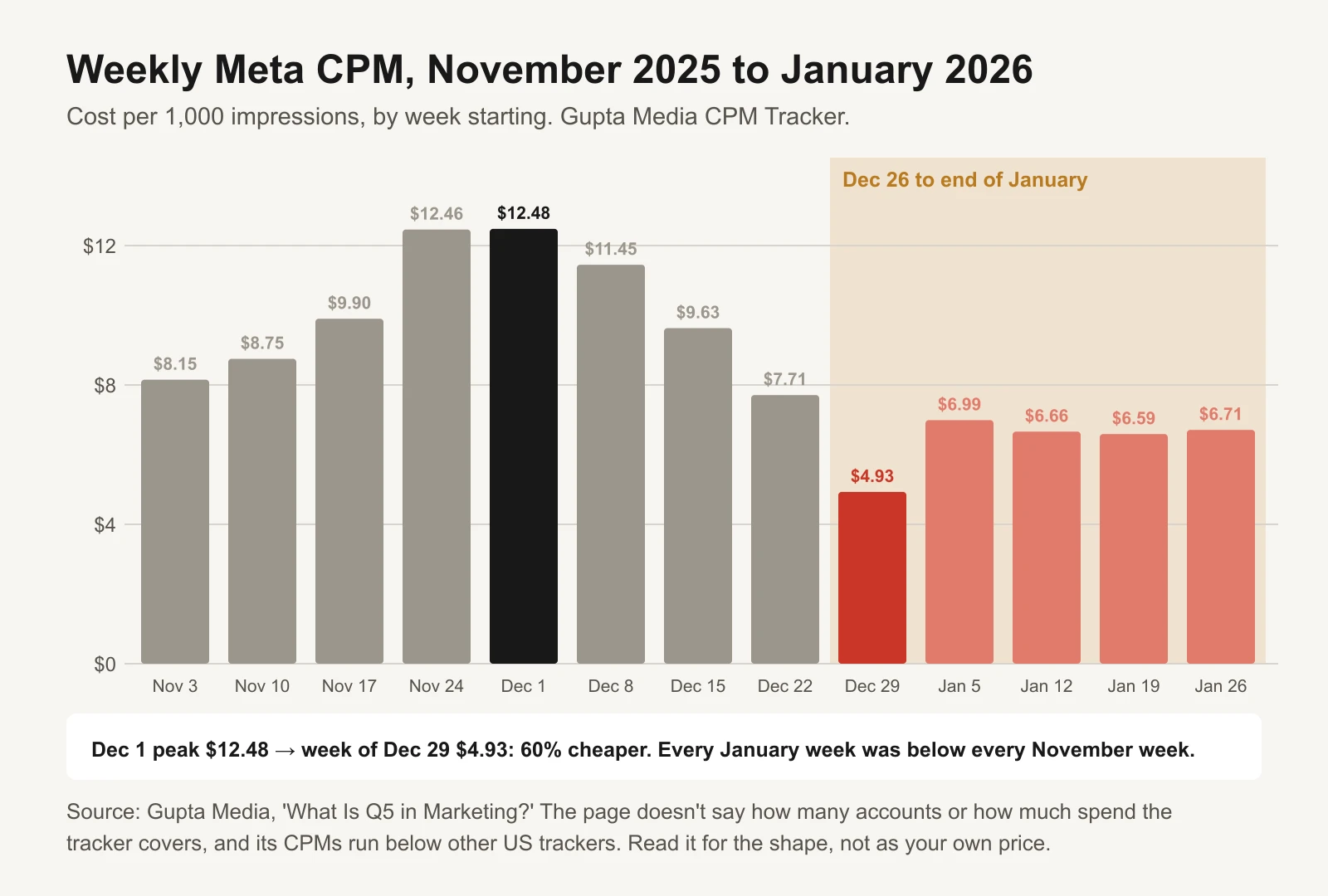
Source: Gupta Media CPM Tracker, weeks starting on the dates shown.
- Dec 1 to the week of Dec 29: $12.48 to $4.93, 60% cheaper.
- January didn't bounce back to December prices. Every January week was $6.59 to $6.99, still about 45% below the Dec 1 peak and below every week of November.
- Gupta's own averages: Dec 1 to 24 at $10.83 against Dec 26 to Jan 31 at $6.48, about 40% lower. Its monthly figures show December to January drops of 21% (2023 to 2024), 24% (2024 to 2025) and 36% (2025 to 2026).
Read the tracker for its shape, not its dollar figures. The page doesn't say how many accounts or how much spend it covers. Its CPMs ($5 to $12) run well below other US trackers, which put US Facebook CPMs at $20 to $27 over the same year. Its byline date (October 2023) is older than the 2026 data on the page, and one of its averages matches the December 2024 monthly figure rather than December 2025. The weekly series is still the clearest public picture of the season we found.
What the same $10,000 buys
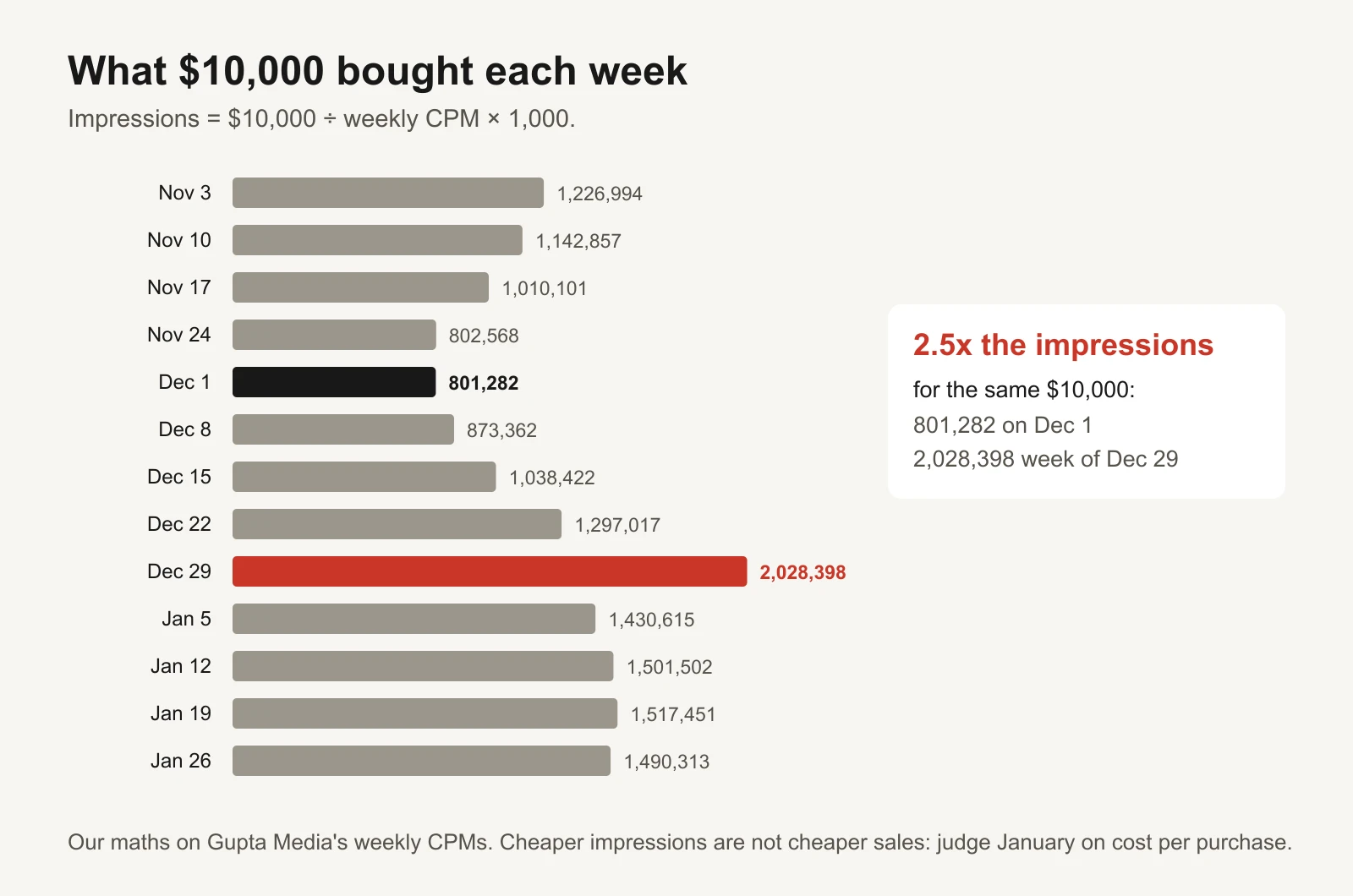
At Gupta's CPMs, $10,000 bought 801,282 impressions the week of Dec 1 and 2,028,398 the week of Dec 29: 2.5 times as many people reached for the same money. The workbook's CPM tab does this sum for your own budget, and uses your own account's CPMs instead if you type them in.
Is January the cheapest month of the whole year?
Every source we found agrees January is cheaper than December. They don't all agree it's the cheapest month of the year.
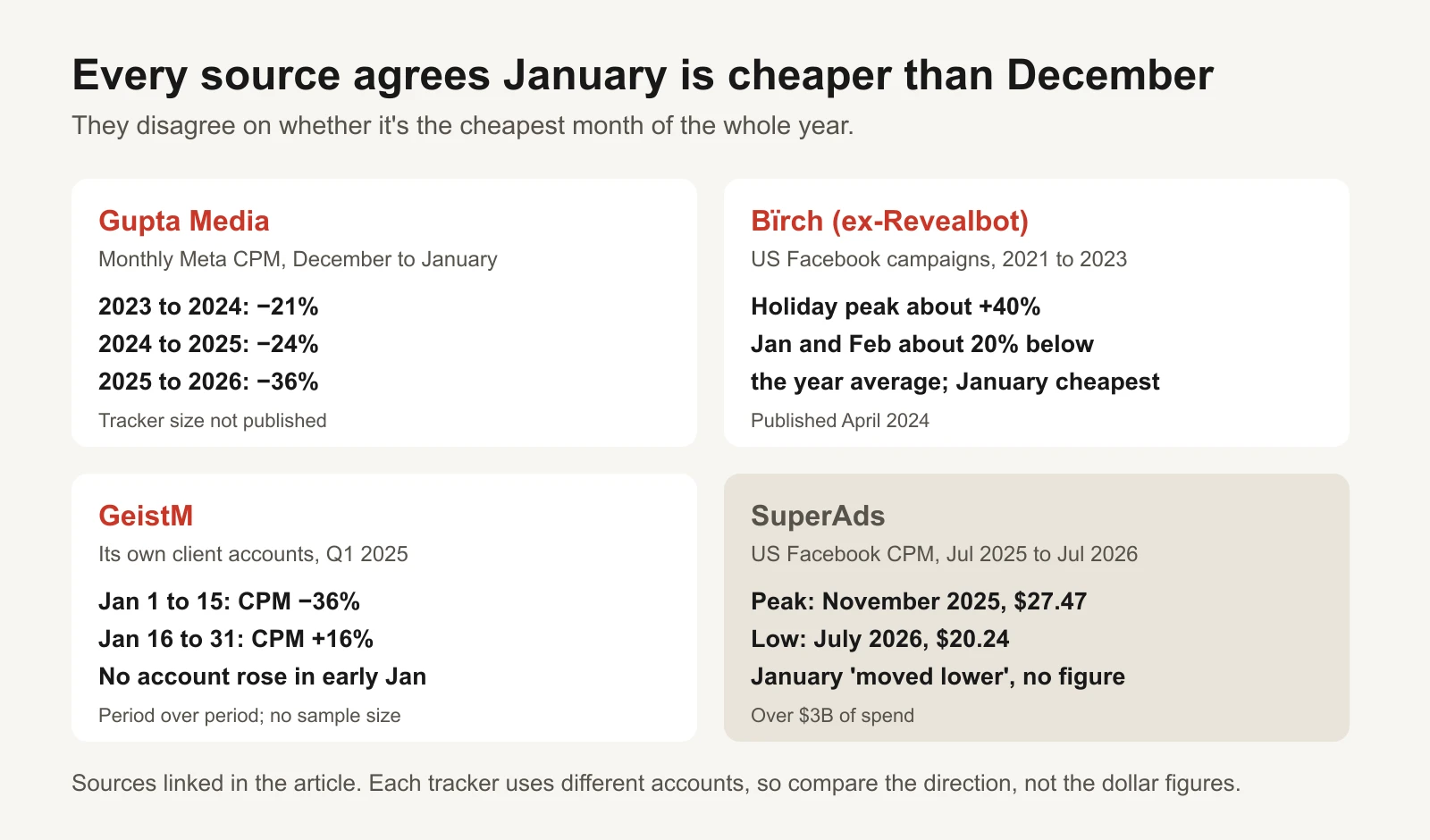
- Bïrch (formerly Revealbot), US Facebook campaigns from 2021 to 2023: CPMs peak about 40% higher in the holidays, then dip about 20% below the year's average in January and February; "the least expensive impressions are available in January" (Bïrch: Meta ad costs analysis).
- GeistM, its own client accounts: CPMs fell 36% in the first half of January 2025, then rose 16% from Jan 16 to 31 (GeistM: Meta rate trends Q1 2025). So the cheapest stretch can be the first two weeks.
- SuperAds, over $3 billion of US Facebook spend from July 2025 to July 2026: November 2025 was the peak at $27.47, January "moved lower", but its low for that year was July 2026 at $20.24 (SuperAds: US Facebook CPM).
So: the week after Christmas is reliably cheap, and January is cheaper than November and December in every source. Whether it is the single cheapest month depends on whose data you read.
Cheap impressions are not cheap sales
None of these trackers measure purchases. People also spend less after the holidays, and a lot of January traffic is browsing, returning and gift-card spending. If your click-through rate or purchase rate falls further than CPM did, each sale still costs more.
So the plan below treats the window as a cheap time to reach new people and test new creative, and the Judge tab decides on cost per purchase whether it worked for you.
The playbook, day by day
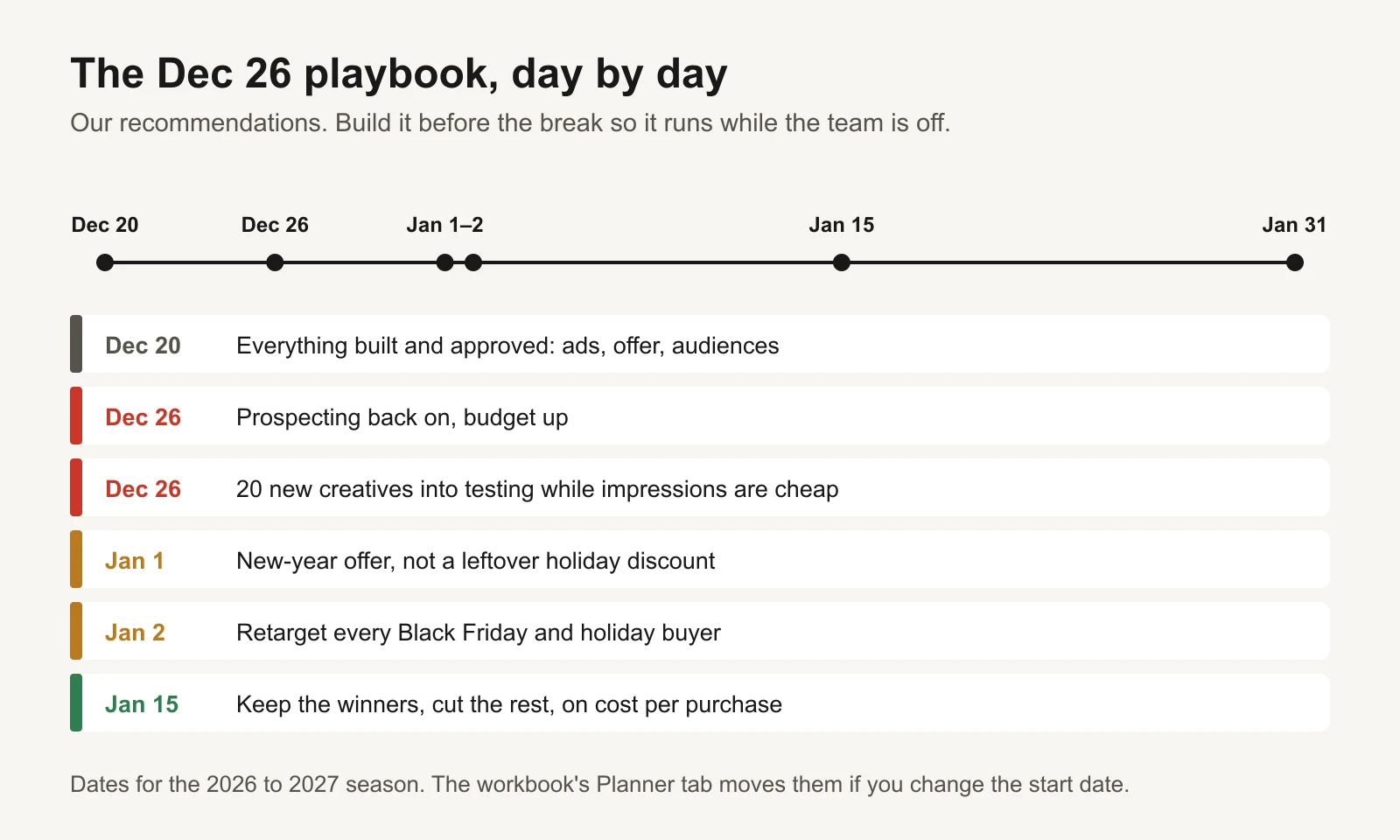
Our recommendations. The workbook's Planner tab holds the full list with dates that move with your restart date.
By Dec 20: build it before the break. Ads made, approved and scheduled to start on Dec 26. The offer page live but hidden. Audiences built. Anything that says Christmas, "gift" or "ships by" scheduled to stop on Dec 25. The point is that nothing waits on a person who is off for the holidays.
Dec 26: prospecting back on, budget up. Turn on campaigns aimed at new customers with a higher budget than usual. The workbook's default is 30% above your normal week; that's our starting point, not a rule. Pick a number you're willing to lose while you find out.
Dec 26: new creatives into testing. Our example launches 20. Make at least half of them new angles, not holiday ads with the date changed. Every test costs less when impressions are cheap, so this is the cheapest time of the season to find next quarter's winners. The creative testing budget calculator tells you how much each test needs.
Jan 1: a new-year offer. A reason to buy that fits January: a starter kit, a routine, a bundle, a subscription. Not the Black Friday discount still running because nobody switched it off.
Jan 2: retarget your holiday buyers. Everyone who bought for the first time between Black Friday and Christmas: second-product ads, how-to content, the new-year offer. Exclude them from prospecting. The Black Friday second-purchase flow has the full sequence.
Jan 15: keep the winners, cut the rest. Judge every new ad on cost per purchase against your target. Move budget to the ones that beat it. Don't judge on CPM or click-through rate alone.
Late January: brief the next batch from what won, and fill in the Judge tab.
Judge January on cost per purchase
The Judge tab compares Dec 1 to 24 with Dec 26 to Jan 15: spend, impressions, link clicks and purchases at account level, same attribution setting. It works out CPM, click-through rate, purchases per click and cost per purchase for both, and gives a verdict.
Fictional worked example: a store with a $45 target cost per purchase.
| Dec 1 to 24 | Dec 26 to Jan 15 | Change | |
|---|---|---|---|
| Amount spent | $34,000 | $30,000 | |
| CPM | $10.83 | $6.55 | −40% |
| Click-through rate | 1.00% | 0.90% | −10% |
| Purchases per click | 2.17% | 1.48% | −32% |
| Cost per purchase | $50.00 | $49.18 | −2% |
Impressions got 40% cheaper, but fewer people clicked and fewer clickers bought, so each sale cost almost the same. The verdict: cheaper than December per purchase, but still above the $45 target. This store should keep testing creative in January, but it shouldn't raise the budget until a winner beats target.
Or let GaaS keep the ads running over the holidays
GaaS is an AI agent that creates, launches and optimises Meta and Google ads from three inputs: your website, a spend limit and a one-line goal. It doesn't take a holiday, turns prospecting and new creative on when you've told it to, and asks before anything that changes spend. If you'd rather run it yourself, the workbook has the plan.
Limits
- Gupta's weekly figures are one tracker, of unknown size, for one season. Your own account's CPMs will differ. Use the shape, check your own numbers.
- Last season's drop isn't a promise for this one. The Dec 1 peak and Dec 29 low fall on different dates each year.
- CPM falls don't guarantee cheaper sales. Judge on cost per purchase, with the same attribution setting in both periods.
- The playbook dates, the 30% budget lift and the 20 new creatives are our recommendations, not Meta guidance.
Sources
- Gupta Media: What Is Q5 in Marketing? 2026 Dates, Ad Costs, and Whether It's Worth It (weekly Meta CPM tracker, 2025 to 2026)
- Bïrch: Meta ad costs analysis (US, 2021 to 2023, published April 16, 2024)
- GeistM: Meta rate trends Q1 2025
- SuperAds: US Facebook CPM (July 2025 to July 2026)