
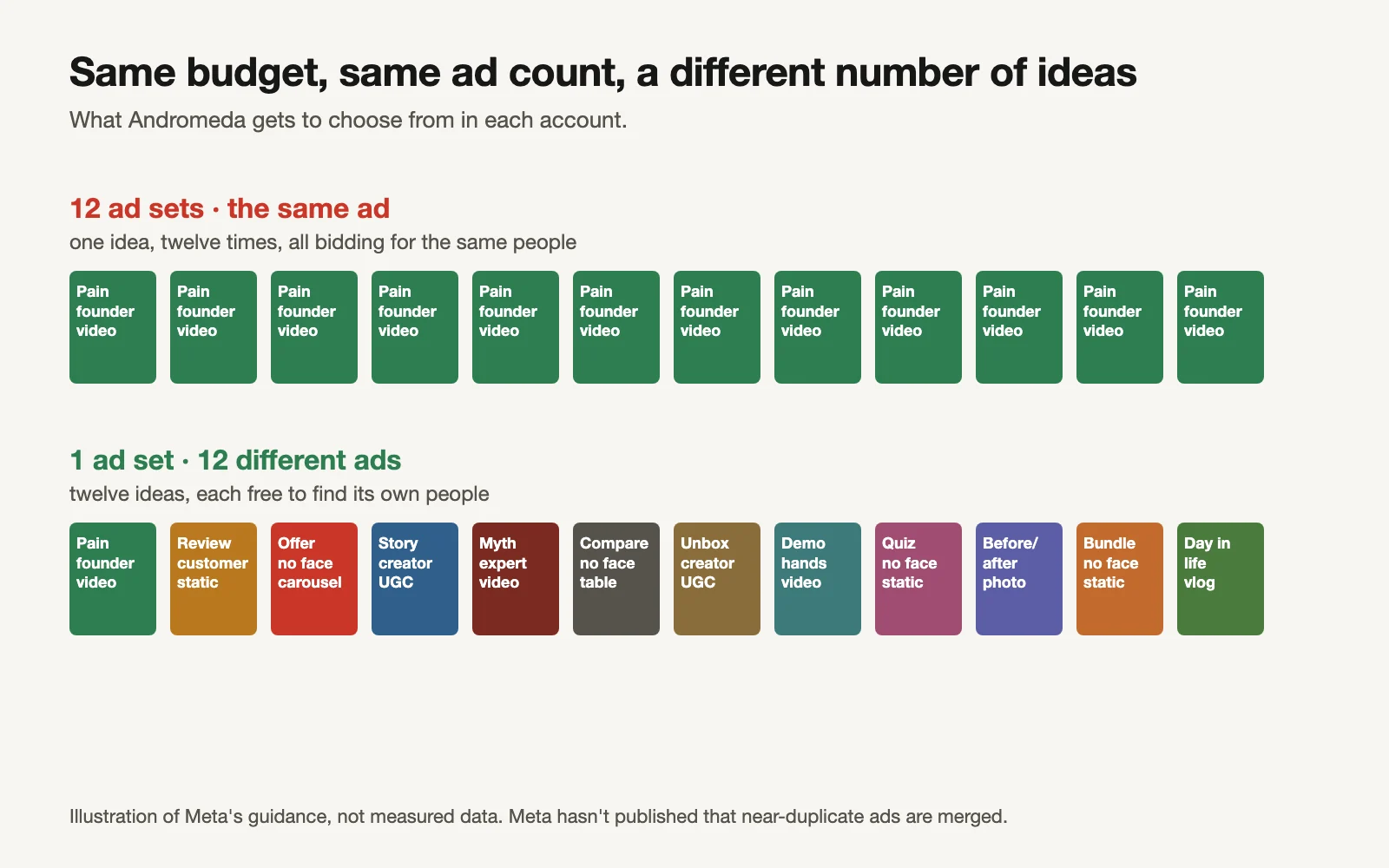
Meta's Andromeda sorts tens of millions of ads for every person who scrolls. Twelve ad sets running the same ad is one idea, twelve times.
For years the craft of Meta ads was targeting: interest stacks, lookalike percentages, an ad set for every audience. Meta's own messaging has turned that around. Its advice now is to let the system find the people, and to give it genuinely different ads to find them with. Andromeda is the reason.
This guide explains what Andromeda is in plain words, what Meta has and hasn't said about creative diversity, and gives you a six-line checklist and an audit workbook to apply it. It is written for business owners who run Meta ads, with enough detail for a performance marketer.
The workbook has an Ad audit tab (tag each live ad on five lines; it flags near-duplicates and names each one's closest twin), a Coverage tab (distinct angles, formats, people, hooks and looks, how many distinct ideas you really run, and checks against Meta's guidance, with a chart), and a New-ad checklist that gives each new ad GO, FIX or REWORK. Numbers in this article are a fictional worked example unless a source is linked.
What Andromeda is
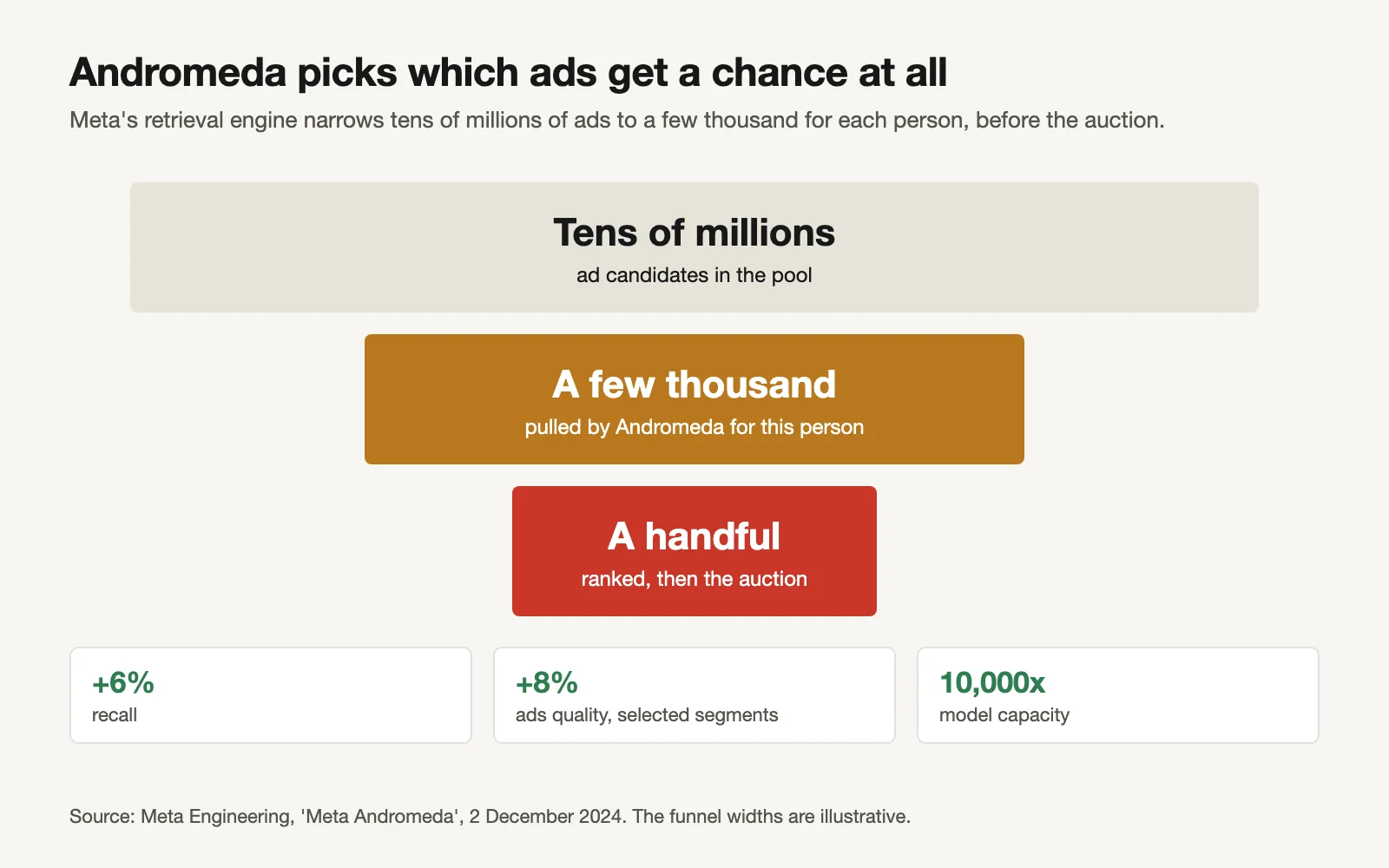
When someone opens Facebook or Instagram, Meta has to decide which ad to show them. It can't run a full auction across every ad in existence for every person, so it works in stages. The first stage, retrieval, picks a shortlist. Andromeda is the system that does that.
Source: Meta Engineering. The funnel widths are illustrative.
In December 2024 Meta's engineers described it as selecting "from tens of millions of ad candidates into a few thousand relevant ad candidates". They reported a +6% improvement in recall and +8% in ads quality on selected segments, from a model with 10,000 times more capacity than before. They also said why it was needed: ad creative volume is growing fast with generative AI, and more than a million advertisers had used Meta's AI tools to make more than 15 million ads in a month (Meta Engineering: Meta Andromeda).
Why it matters to you: if your ad isn't in the few thousand Andromeda pulls for a person, it never reaches the auction for them. Your bid and your targeting don't help an ad that wasn't shortlisted. What gets an ad shortlisted for a given person is, increasingly, what the ad itself is about.
What Meta has said about creative
Three Meta posts set the direction:
- April 2025: Meta wrote that the focus has shifted from niche targeting to "creative diversification as the best lever to find the most relevant audiences". It defines diversification as a wide range of ad creatives with "different themes, messages, and visuals", and says Andromeda has already led to an 8% improvement in ads quality (Meta: The Creative Advantage).
- November 2024: Meta recommended keeping at least 20 diversified ads in Advantage+ shopping campaigns, launching new ads weekly, and putting 20–30% of the budget into testing new ads (Meta: Three steps to optimize with creative diversification).
- Structure: Meta tells advertisers to "combine ad sets and minimize changes" during learning (Meta: Performance marketing).
Put together: fewer ad sets, more genuinely different ads, a steady flow of new ones.
What Meta hasn't said
You'll read that Meta "merges" near-identical ads, or gives each ad a "creative similarity score" and suppresses anything over 60%. We looked. Meta has not published either. No Meta page we could find describes merging or a similarity threshold, so we don't repeat those claims, and the 2-line rule below is our own working rule, not a Meta number.
What is true by definition: ten recolours of one ad are still one idea. If each ad Andromeda can shortlist says the same thing in the same way to the same kind of person, you've given it one option, however many ad IDs you have.
An illustration of Meta's guidance, not measured data.
The creative-diversity checklist
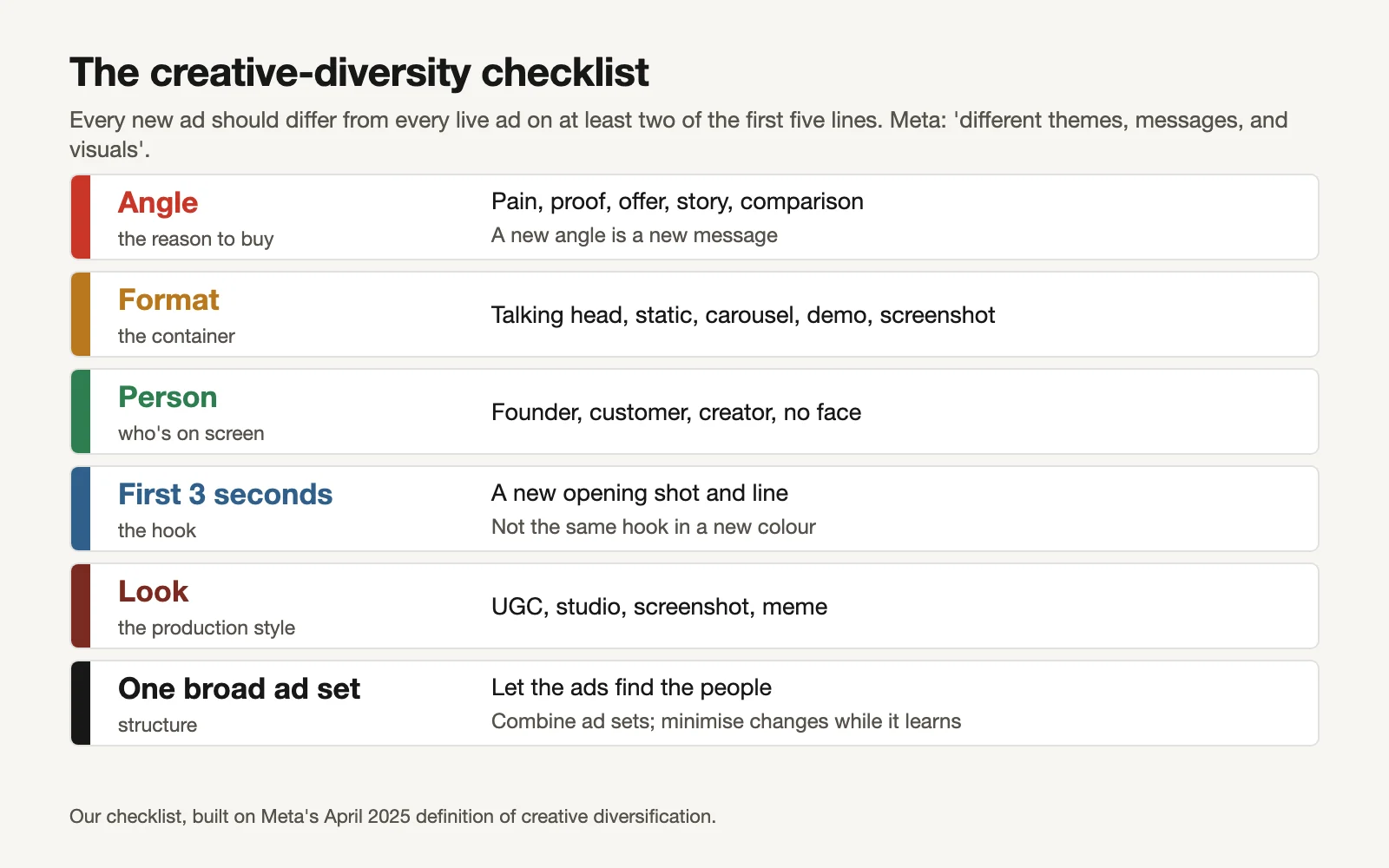
Meta's words are "themes, messages, and visuals". We turn that into five things you can tag on any ad, plus one structural rule:
Our checklist, built on Meta's April 2025 definition.
| Line | What it is | Examples |
|---|---|---|
| 1. Angle | The reason to buy: the message | Pain, proof, offer, story, comparison, myth, gift |
| 2. Format | The container | Talking head, static, carousel, demo, screenshot, meme |
| 3. Person | Who's on screen | Founder, customer, creator, expert, no face |
| 4. First 3 seconds | The opening shot and line | Not the same hook in a new colour |
| 5. Look | Production style | UGC, studio, lo-fi phone, screenshot, illustration |
| 6. One broad ad set | Structure | Added to the broad ad set, in this week's batch |
The rule: a new ad goes live only if it differs from every live ad on at least two of lines 1–5, and line 6 is Yes. A new hook alone (one line) is a variation, useful for refreshing a tired winner (see our creative fatigue system) but not a new idea. A new angle with a new person is.
Why two? One-line changes are where most "new" ads live: same founder, same script, new caption. Requiring two lines forces a genuinely different message or presentation without demanding a reshoot of everything. It's a default; the workbook lets you raise it.
For sources of new angles and formats, our 50 winning ad formats and 100 hook templates are built for this.
Audit your live ads
The workbook's Ad audit tab does this for up to 40 live ads. You tag each ad on the five lines with short, consistent words ("Pain", not "pain point" in one row and "problem" in another). It then compares every ad with every other ad and, for each one:
- counts how many lines it differs from its closest ad,
- names that closest twin,
- marks it NEAR-DUPLICATE (fewer than 2 lines different) or DISTINCT.
The Coverage tab counts distinct values on each line, counts distinct ideas (unique mixes of angle, format, person and look; hooks are left out because a new hook alone is a variation), and checks the account against Meta's guidance.
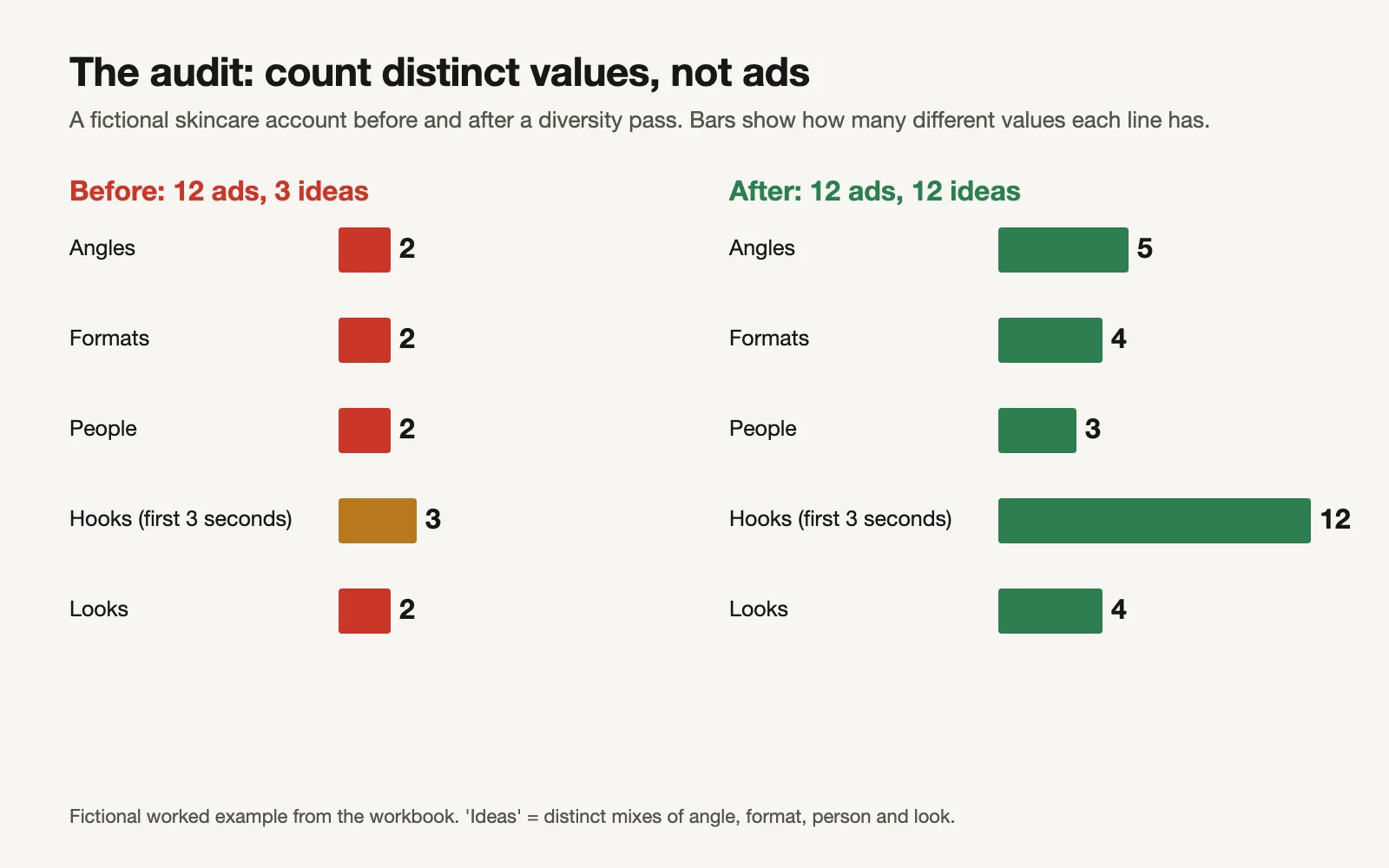
Worked example (fictional): a skincare brand runs 12 ads across 4 ad sets. It feels varied: 12 ads, 3 different hooks.
Fictional example from the workbook.
| Check | Before | Verdict |
|---|---|---|
| Live ads | 12 | – |
| Distinct ideas | 3 | Few: replace duplicates with new angles |
| Near-duplicates | 12 of 12 | Every ad has a twin one line away or closer |
| Ad sets | 4 | Consider combining |
| Different ads vs a 20-ad target | 3 | Short by 17 |
Eight of the twelve ads are the founder talking about acne, with one of three opening lines. Two more are the founder reading reviews. Two are static review cards. Every single ad has a twin that differs on one line or none.
The fix isn't 30 more ads. It's replacing the duplicates: keep the best of the founder videos, then brief new angles (an ingredient myth-buster, a dermatologist comparison, a customer's 8-week diary), new people (customers, a creator, no face) and new formats (a carousel, a demo). After the pass, the same 12 slots hold 12 ideas, and the 4 ad sets become 1.
How many new ads a week?
The Coverage tab turns Meta's numbers into a pace. With a $9,000 monthly budget, 20% for testing and 4 new ads a week, that's about $415 of test spend a week, roughly $104 per new ad, and about 5 weeks to go from 3 different ideas to Meta's suggested 20. If that is too slow, our winners calculator shows what a faster pace buys you.
Make it a routine
- Tag every live ad on the five lines, once.
- Pause or replace every NEAR-DUPLICATE except the best performer of each group.
- Combine ad sets that exist only for targeting ideas into one broad ad set (our account structure blueprint covers when not to).
- Run each new ad through the New-ad checklist. Ship only GO.
- Add new ads once a week, in one batch.
- Re-run the audit monthly.
Or let GaaS make the different ads
GaaS is an AI agent that creates, launches and optimises Meta and Google ads from three inputs: your website, a spend limit and a one-line goal. Making genuinely different ads every week, not ten colours of one, is the hard part of the Andromeda era; the agent writes and builds new angles, formats and hooks, launches them into a consolidated structure, and learns which ideas find buyers. We have made more than 60,000 ads for the Andromeda era. If you'd rather run it yourself, the workbook does the audit.
Limits of this checklist
- Meta has not published how Andromeda treats similar ads. The two-line rule is our working rule, built on Meta's "themes, messages, and visuals" wording, not a Meta threshold.
- The audit is only as good as your tags. Be consistent, and be honest: a new background colour is not a new look.
- Meta's 20-ad and 20–30% testing guidance was written for Advantage+ shopping campaigns in November 2024. It's a sensible target for any broad sales campaign, but it's Meta's suggestion, not a requirement.
- Diversity is necessary, not sufficient. Twelve different weak ideas still lose to one strong one; judge each ad on results.
Sources
- Meta Engineering: Meta Andromeda: Advantage+ automation's next-gen personalized ads retrieval engine (2 December 2024)
- Meta for Business: The Creative Advantage: Unlocking the Power of Diversification with Meta Andromeda (22 April 2025)
- Meta for Business: Three steps to optimize your performance with creative diversification (19 November 2024)
- Meta for Business: Performance marketing
- 60,000+ ads: GaaS figure. Checklist, rule and worked example: GaaS.