
Ridge is famous for one product: a slim metal wallet. So you would expect its Meta ads to be mostly about the wallet.
They aren't, quite. On 17 November 2026 Ridge had 954 ads live in the US. The opening line it repeats most often doesn't sell the wallet. It sells the Ridge Tracker Card, a card-shaped tracker that sits inside the wallet. And not one of those 954 ads had been running for more than 48 days.
This teardown shows what the library showed, the five parts Ridge builds its ads from, and a workbook to check whether your own ad budget is spread across your products the way your sales say it should be.
How we read the library, and what it can't tell you
We opened The Ridge's Page in the Meta Ad Library on 17 November 2026, signed in, with the United States, active ads and all media selected, and scrolled to the end. 954 ad cards loaded; the library's header said "~1,700 results", because it counts each version of an ad separately. For every card we logged the start date, format, advertiser line and the first line of text, then counted keywords in the copy.
Three limits matter:
- Live ads only. Outside the EU, the library shows ads that are running now. Ads about social issues, elections or politics are kept for seven years, and ads that delivered in the EU for a year after their last impression (Meta Transparency Center: Ad Library tools). Ordinary US product ads disappear when they stop. "Not older than 48 days" means nothing older is still running, not that Ridge never ran an ad for longer.
- No results. The library shows no spend, sales or ROAS for these ads. We can see what Ridge keeps paying to show, not what earns.
- One day. This is a snapshot 10 days before Black Friday, when most brands are busier than usual.
Finding 1: the most-run line sells a tracker card
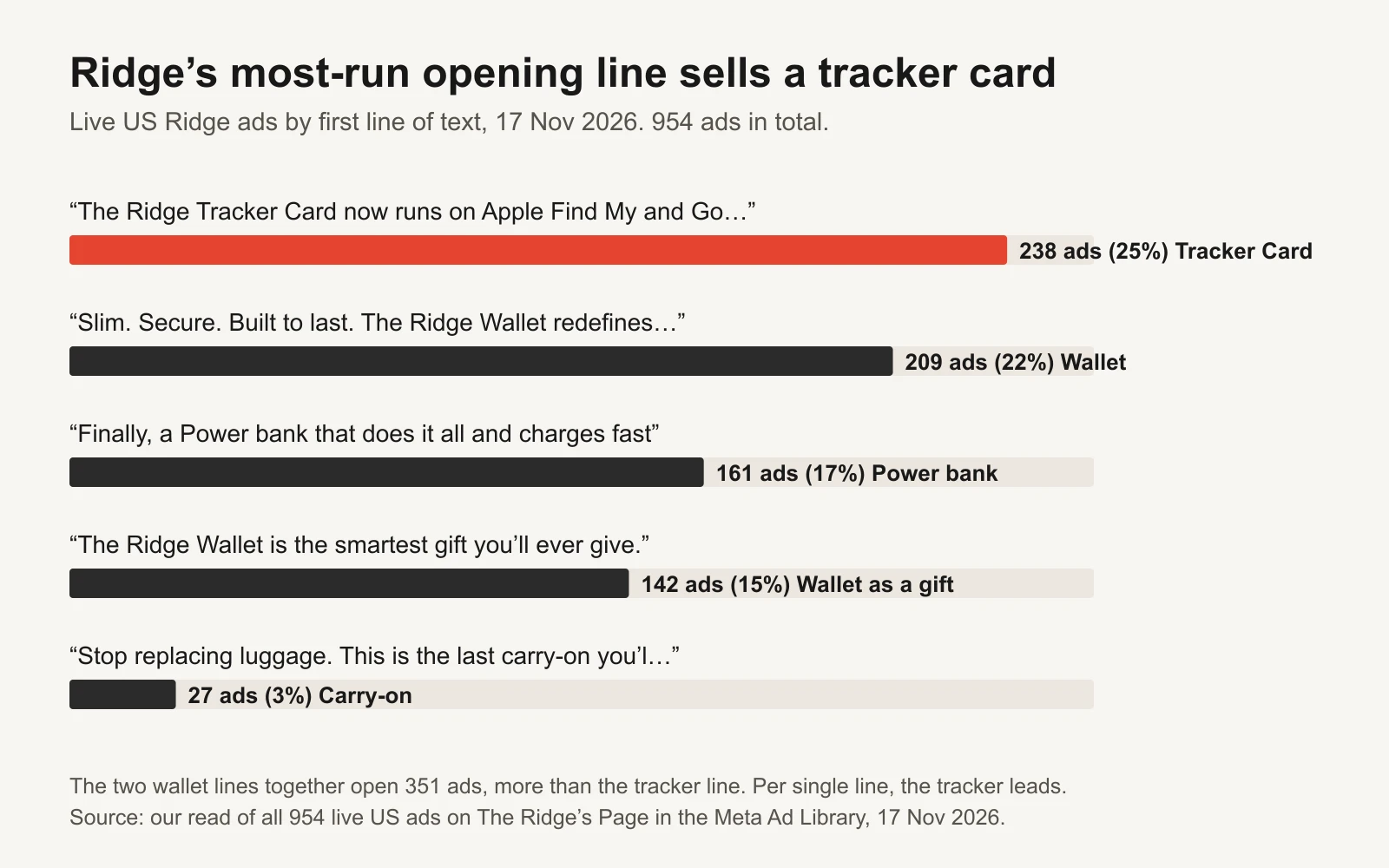
Per single line, the Tracker Card leads. Add the two wallet lines together and the wallet still has more ads (351).
To be precise about the claim: the Tracker Card line is Ridge's most-run opening line, not the product with the most ads. The wallet has two big lines, one about the product and one about gifting, and together they open 351 ads. The power bank has 161 and the carry-on 27.
What's interesting is the shape. Ridge doesn't write one ad and vary the picture. It runs a lane per product, each with its own opening line repeated across dozens or hundreds of ads, and the lanes are sized very differently. The newest product news ("now runs on Apple Find My and Go…") gets the single biggest lane.
| Opening line | Live ads | What it sells | What it does |
|---|---|---|---|
| "The Ridge Tracker Card now runs on Apple Find My and Go…" | 238 | Tracker Card | Leads with a product update: news is a reason to look |
| "Slim. Secure. Built to last. The Ridge Wallet redefines…" | 209 | Wallet | Three short benefits before the product name |
| "Finally, a Power bank that does it all and charges fast" | 161 | Power bank | "Finally" names a frustration the buyer already has |
| "The Ridge Wallet is the smartest gift you'll ever give." | 142 | Wallet as a gift | The hero product, re-angled for the season |
| "Stop replacing luggage. This is the last carry-on you'l…" | 27 | Carry-on | Names the repeat cost of the cheap option |
Finding 2: nothing older than 48 days
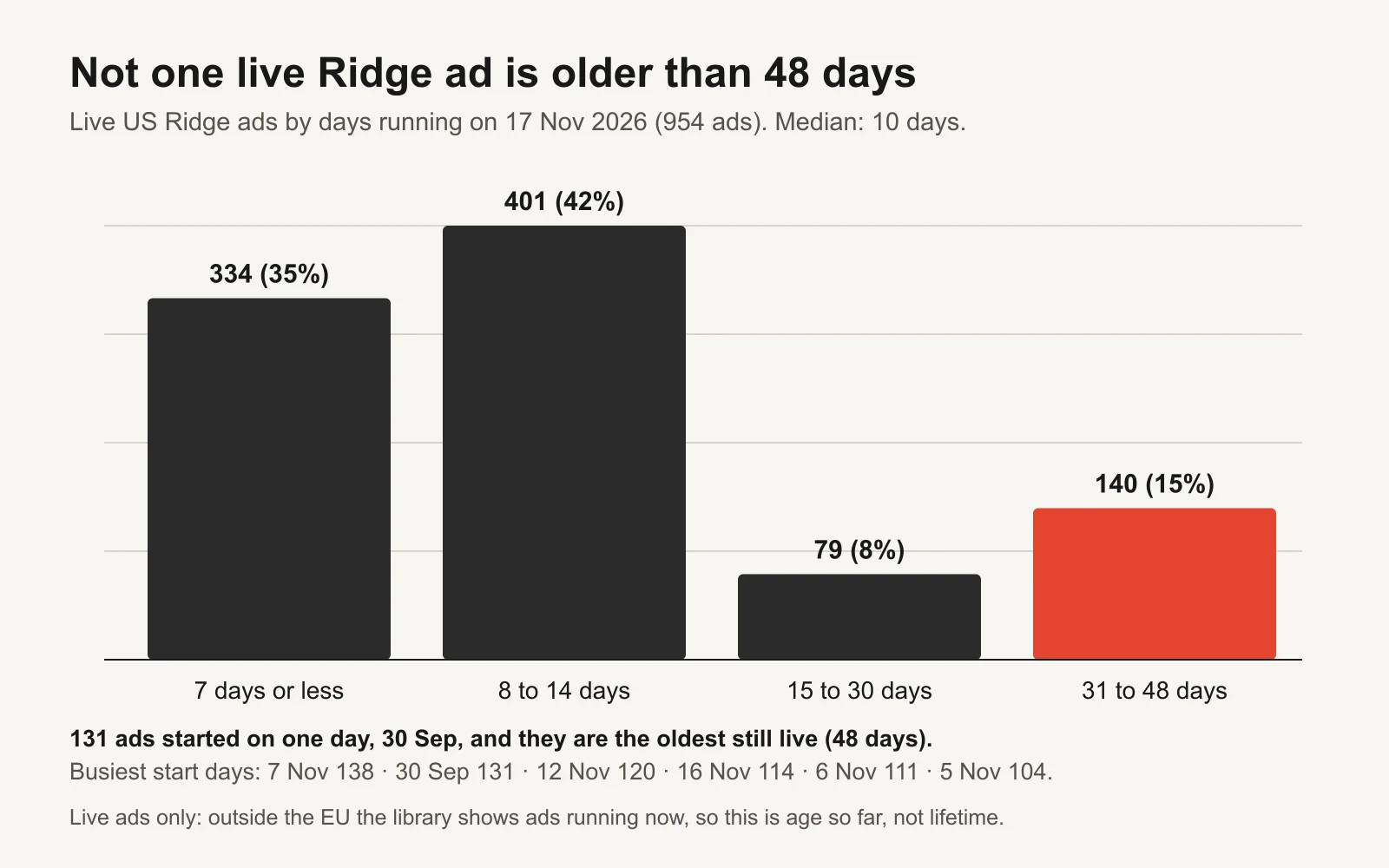
Median age: 10 days. Busiest start days: 7 Nov (138), 30 Sep (131), 12 Nov (120), 16 Nov (114).
The median live Ridge ad was 10 days old. 735 of 954 (77%) were two weeks old or younger. The oldest group is one batch of 131 ads that all started on 30 September, the power bank among them, which suggests Ridge launches in big drops and lets a batch run while it keeps working.
The oldest ads include a plain image ("Smarter essentials - power, protection, connection"), a power bank video and a partnership video with the tech reviewer Marques Brownlee ("mkbhd with The Ridge", library ID 4611430155798309) that opens "5 in 1 Power Bank - get 10,000mAh in the palm of your hand."
How fast is that? We read 19 other DTC brands the same day, the same way. Ridge sits in the middle: faster than Liquid Death (78 days) or Quince (57), slower than Jones Road (1 day) or Gymshark (2).
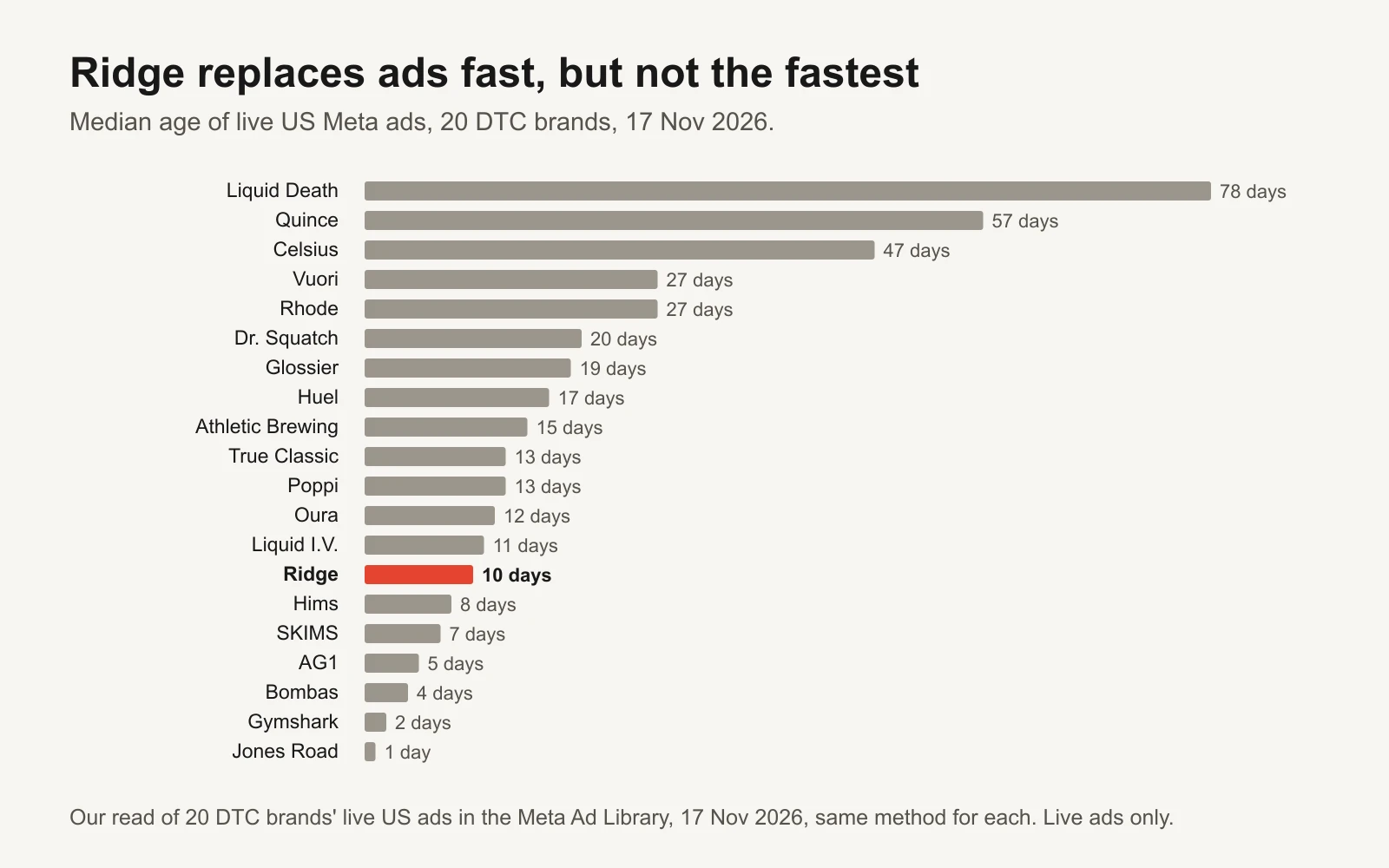
Same method for every brand: live US ads in the Meta Ad Library, read on 17 November 2026.
Finding 3: 57% run under someone else's name
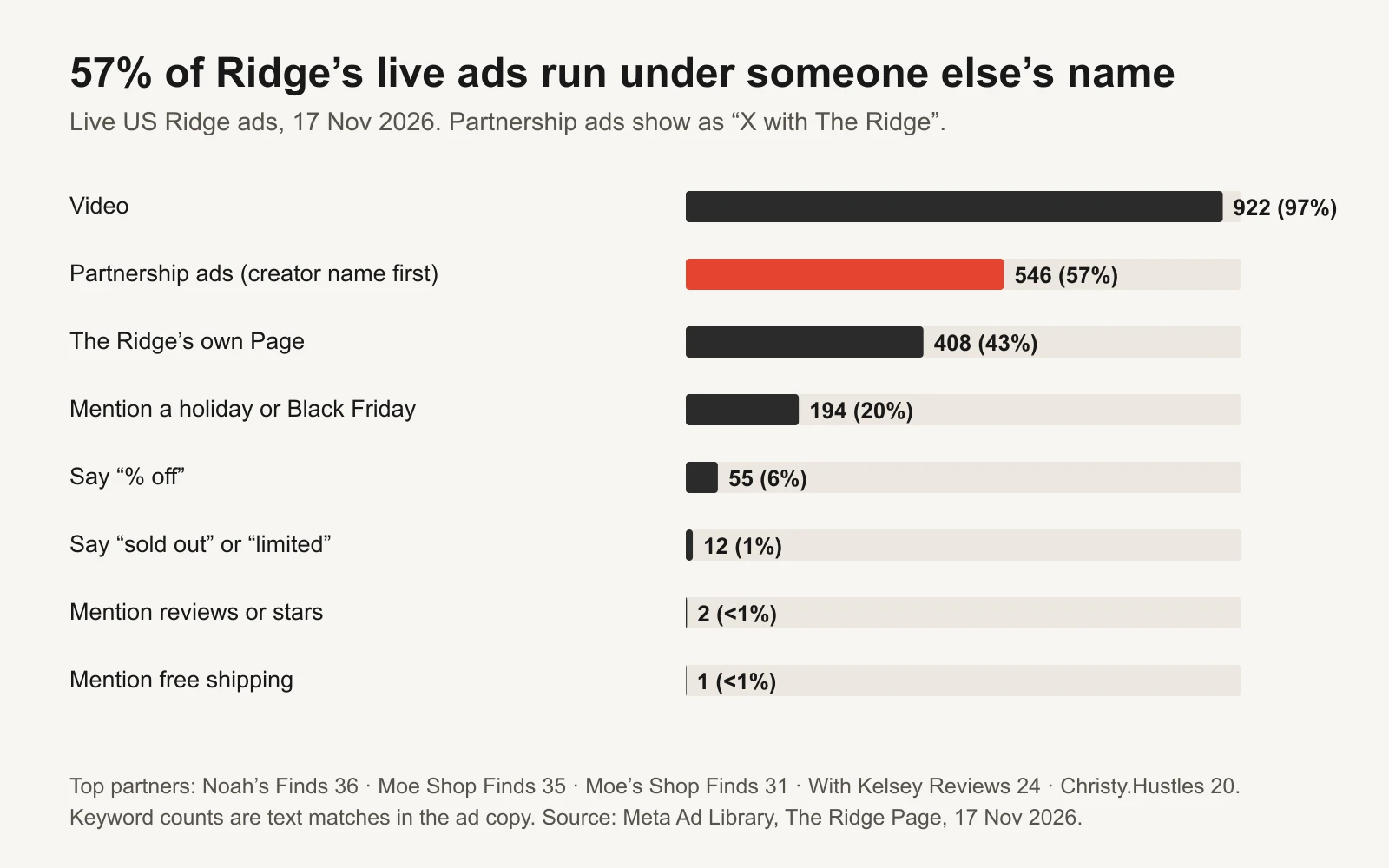
Top partners: Noah's Finds 36, Moe Shop Finds 35, Moe's Shop Finds 31, With Kelsey Reviews 24, Christy.Hustles 20.
546 of the 954 ads are partnership ads: they show as "[creator] with The Ridge", with the creator's name and photo on top. Ridge's own Page runs the other 408.
The partners aren't mostly celebrities. The biggest are deal and product-recommendation accounts, "finds" pages that post gadgets and gifts to followers who come to them for exactly that. Each runs 20 to 36 ads. It's a wide net of small, relevant faces rather than one big name.
Two other numbers stand out. 97% of the ads are video. And only 55 (6%) say "% off", even 10 days before Black Friday, while 194 (20%) mention the holidays or Black Friday. Ridge leans on the season and the product, not the discount.
Copy the system: five parts
The workbook's Copy the system tab has these five parts, with Ridge's live example next to an empty column for yours.
- One lane per product. Give each product its own opening line and run it across many versions. Size the lanes by what sells, not by which product you're known for.
- Open with news or a pain. "Now runs on Apple Find My" is news. "Finally, a power bank that does it all" and "Stop replacing luggage" are pains. Both give the scroller a reason to stop that isn't a price.
- Re-angle the hero for the season. Same wallet, new first line: "the smartest gift you'll ever give." In the run-up to the holidays that one angle is its own lane of 142 ads.
- Borrow many small faces. Partnership ads with creators whose followers already come to them for product picks. Get permission and use the right disclosure.
- Video, in batches. Ridge's busiest start days had 104 to 138 new ads each. Big launches let the algorithm pick the winners among many versions.
Check your own lanes
The question Ridge's library raises for any multi-product brand: is your ad budget going to the products that sell, or to the product you think of first?
The workbook's Product lanes tab answers it. List each product with its live ads, last-14-day spend and purchases, and your target CPA (cost per purchase). It works out each product's share of ads and share of purchases and gives a verdict:
- Good: add ads when a product earns a clearly bigger share of purchases than its share of ads (more than 1.2 times) at or under your target CPA.
- Bad: over-served when its share of purchases is well below its share of ads (under 0.8 times) or its CPA is over target.
- Watch when it's about right.
In the fictional example, a gift set with 10% of the ads brings 13% of purchases at a $30 CPA, so it gets more ads, while the power bank and carry-on lanes are over-served. These thresholds are starting points we chose, not rules; change them to suit your margins.
Small budgets: don't split $50 a day into five lanes. Run your best two, and use the sheet to decide which two.
Read any competitor the same way
The Ad log tab is prefilled with Ridge's five oldest live ads, with links. Add a competitor below them:
- Open their Page in the Meta Ad Library (United States, active ads), and scroll to the end.
- Log each ad's library ID, start date, format, face, angle, offer and first line. Set the check date.
- The Summary tab gives the share older than 14 days and the counts by age, format and face. Under 20% means they replace ads fast, so study their batches; over half means they keep winners, so study the long-runners.
For more on turning what you see into your own briefs, see the Ad Library competitor playbook. For a brand that runs the opposite way to Ridge's lanes, see the Grüns teardown.
Tools and repos that help
| Tool or repo | What it is for | Who should use it |
|---|---|---|
| Meta Ad Library | Every live ad for a Page, with start dates, formats and versions | Everyone; this teardown is built on it |
| Meta Transparency Center: Ad Library tools | What the library keeps, for how long | Anyone drawing conclusions from ad ages |
| facebookresearch/Ad-Library-API-Script-Repository | Meta's Python examples for the Ad Library API (ordinary product ads only if they reached the EU) | Developers tracking EU ads |
| anthropics/skills | Public agent skills, including one for reading and editing spreadsheets like this workbook | Anyone who wants an assistant to fill in the log |
Or let GaaS run it
GaaS is an AI agent that creates, launches and optimizes Meta and Google ads from three inputs: your website, a spend limit and a one-line goal. It builds lanes of ads per product, tests them in batches and moves budget toward what sells, and nothing spends without your approval. See how GaaS works. Either way, the workbook below is yours to keep.