
"Video wins" is close to a rule in Meta ads advice. True Classic, the men's basics brand, has 225 Meta ads live. 60 are video. And the ones that have lasted longest aren't videos at all.
On 17 November 2026, only 3 of True Classic's live ads had been running for more than 90 days. All 3 are still images that show several pieces of clothing together: "5 looks - zero guesswork", "Work trip fits, solved", "9 pieces to mix and match". They don't sell a T-shirt. They sell a wardrobe.
Everything else in the account looks like a brand gearing up for Black Friday: 127 ads with a "% off", most of them less than two weeks old. This teardown shows both lanes, why they work together, and a builder to make your own outfit grid.
How we read the library, and what it can't tell you
We opened True Classic's Page in the Meta Ad Library on 17 November 2026, signed in, with active ads, the United States and all media selected, and scrolled to the end. The header said "~230 results"; 225 distinct ad cards loaded. For each we logged the start date, format, advertiser line and opening text.
The limits:
- Live ads only. Outside the EU, the library shows only running ads; ordinary US ads disappear when they stop (Meta Transparency Center: Ad Library tools). "Longest-running" means the oldest ad still running today.
- No results. No spend, sales or return is shown. We see what True Classic keeps paying for, not what earns most.
- "Outfit grid" is our label. The library doesn't classify layouts. We call these ads outfit grids from their images and their copy ("5 looks", "9 pieces to mix and match").
True Classic's homepage on the same day led with "Black Friday Up to 50% OFF" and multi-packs of tees (trueclassictees.com, checked 17 November 2026).
Finding 1: most ads are new, three are very old
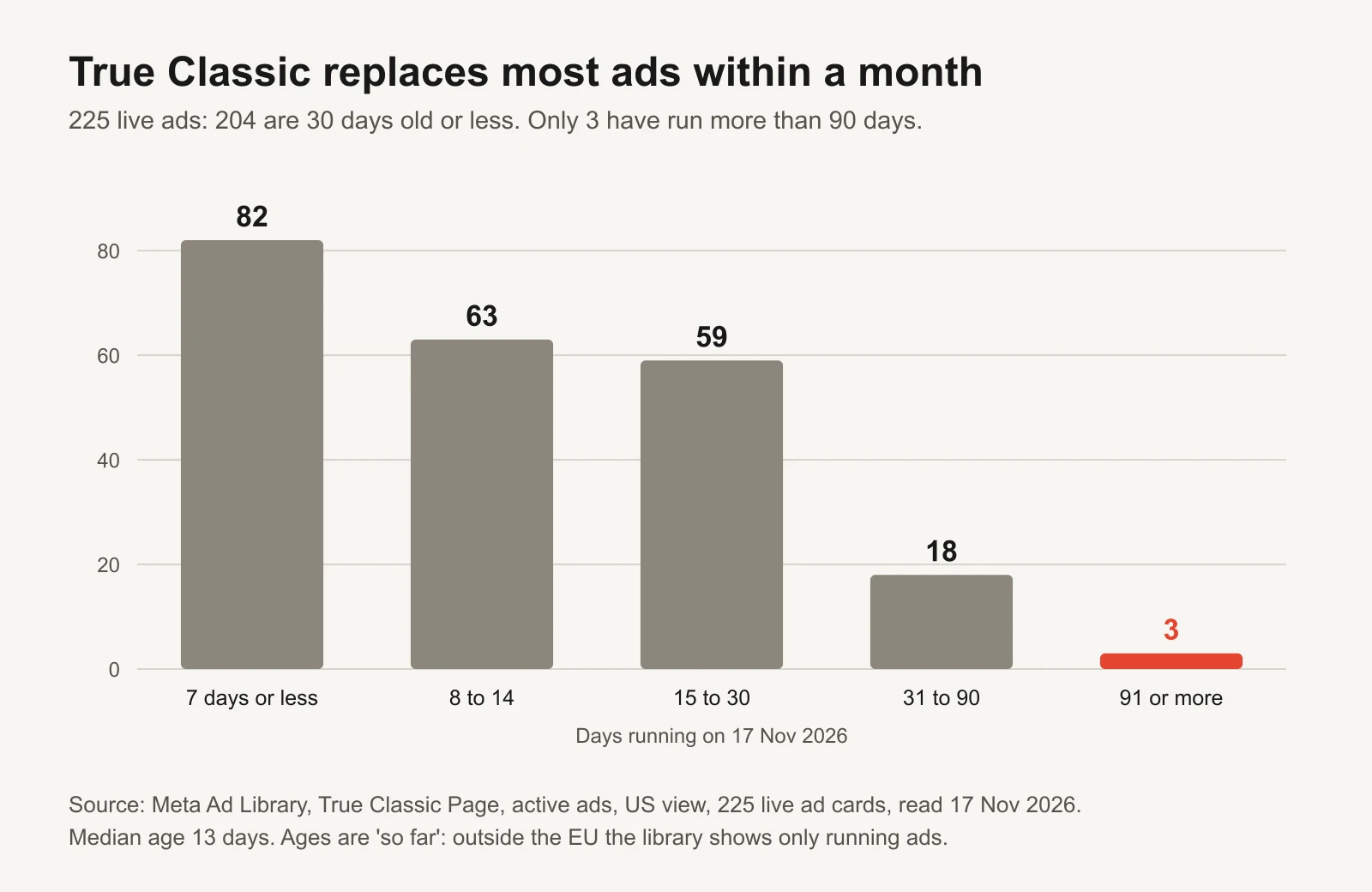
204 of 225 are 30 days old or less. Median age: 13 days.
True Classic ships ads in batches: 51 started on 13 November, 45 on 23 October, 29 on 4 November and 27 on 16 November. Most don't last a month. That makes the few that do stand out.
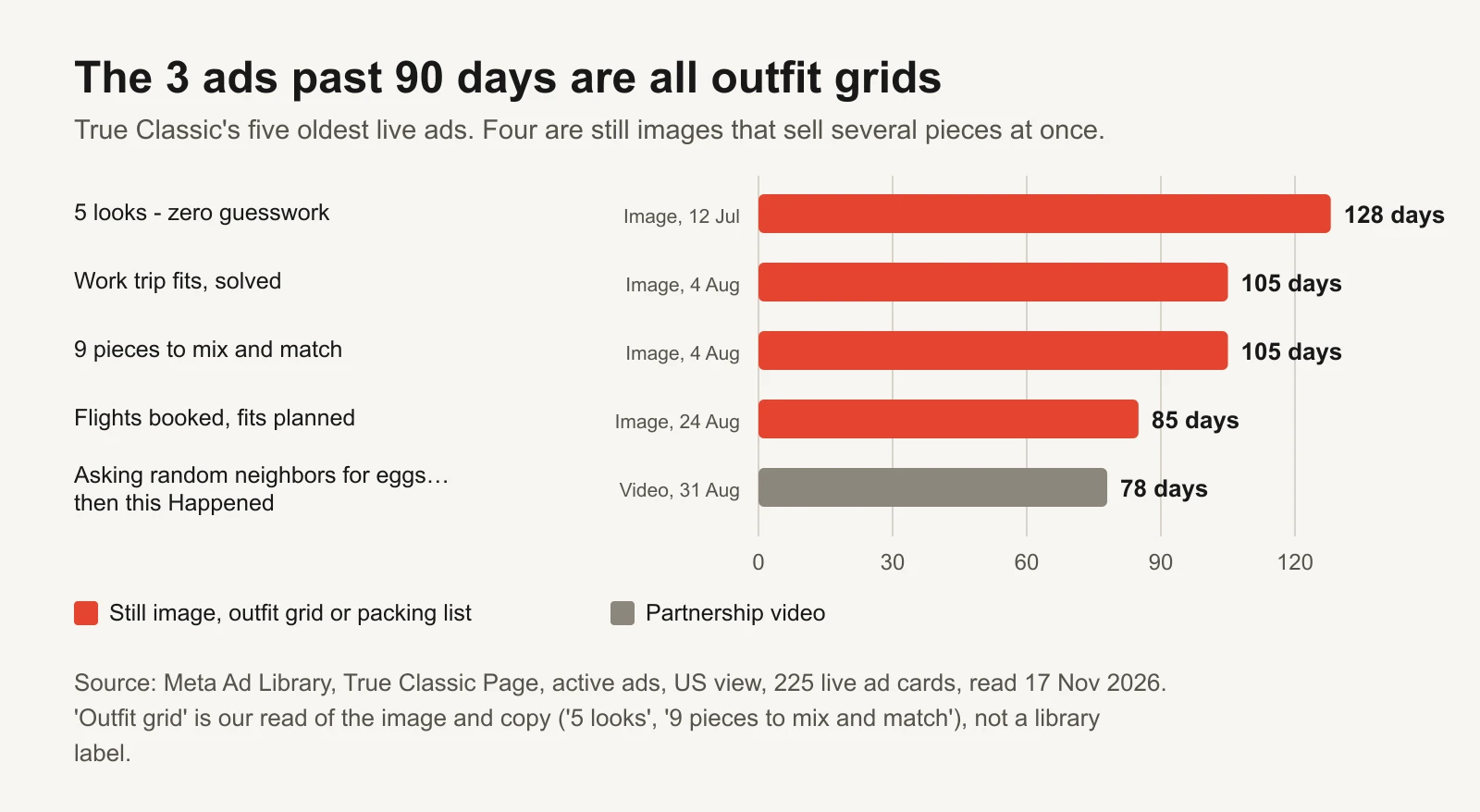
Four of the five oldest are still images that show many pieces at once.
| Started | Days running (to 17 Nov) | Format | Opening line | Library link |
|---|---|---|---|---|
| 12 Jul | 128 | Image | "5 looks - zero guesswork 👕👖" | Ad |
| 4 Aug | 105 | Image | "Work trip fits, solved ✅" | Ad |
| 4 Aug | 105 | Image | "9 pieces to mix and match 🔥🔥" | Ad |
| 24 Aug | 85 | Image | "Flights booked, fits planned ✈️" | Ad |
| 31 Aug | 78 | Video (partnership) | "Asking random neighbors for eggs… then this Happened" | Ad |
Finding 2: the rest of the account shouts the sale
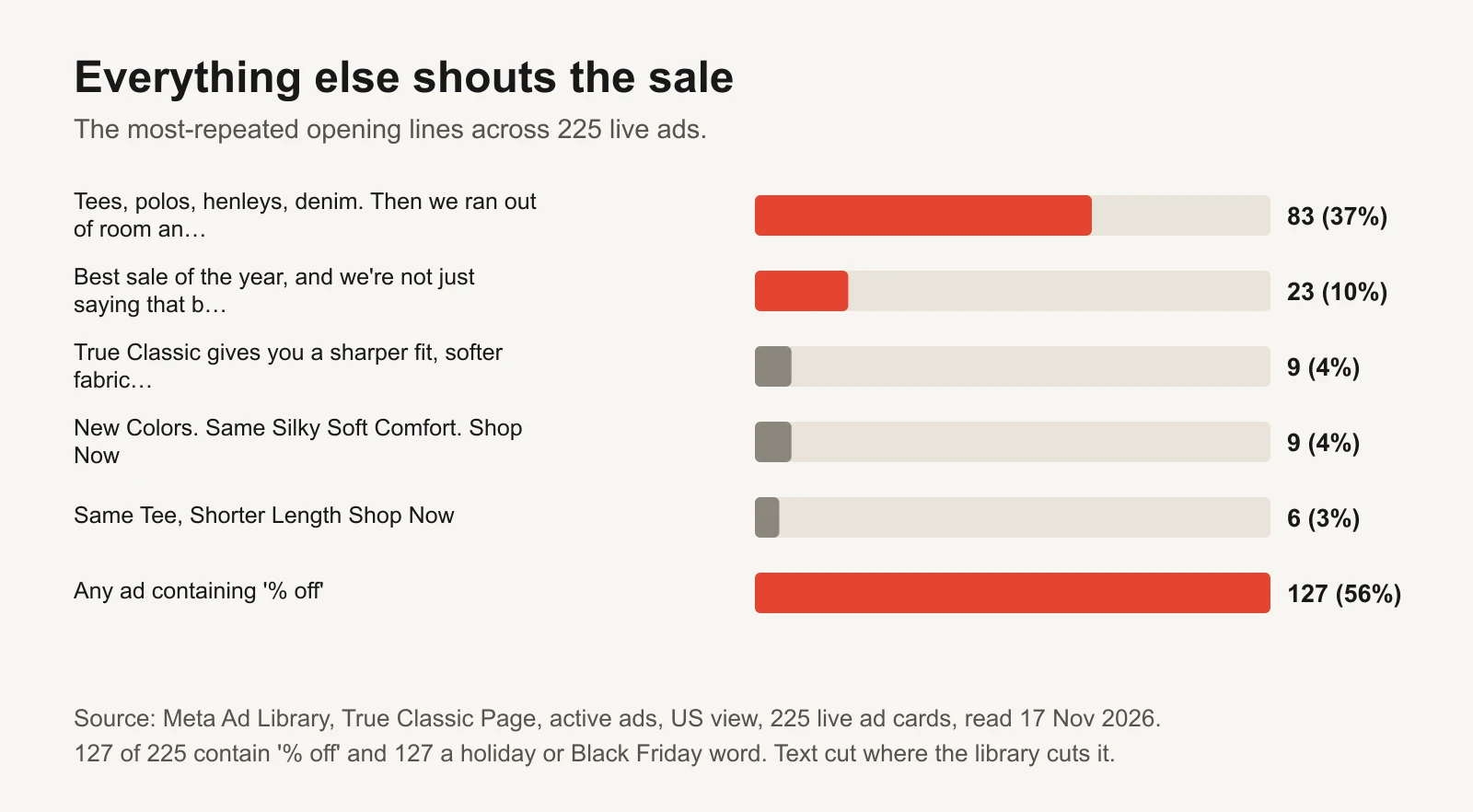
127 of 225 ads contain "% off", and 127 a holiday or Black Friday word.
One opening line runs on 83 ads: "Tees, polos, henleys, denim. Then we ran out of room an[d]…", a product-range list that reads like the outfit grids in words. "Best sale of the year…" runs on 23 more. Only 5 ads are partnerships; True Classic runs 220 from its own Page. Only 1 ad mentions reviews or stars.
| What we counted | Ads | Share of 225 |
|---|---|---|
| Still images | 165 | 73% |
| Video | 60 | 27% |
| Contain "% off" | 127 | 56% |
| Holiday or Black Friday word | 127 | 56% |
| Partnership ads | 5 | 2% |
Why the outfit grid lasts
Again, we can't see results, so this is reasoning from what keeps running.
It sells a bigger order. A single tee is a small decision. "9 pieces to mix and match" frames the purchase as a wardrobe, which suits a brand whose site sells 3-, 6- and 10-packs. A bigger first order pays for a more expensive click.
It answers the real worry. Men buying basics online mostly worry about looking put together without effort. "5 looks - zero guesswork" says exactly that. "Work trip fits, solved" and "Flights booked, fits planned" name a moment when the worry is sharpest.
A number makes the headline. "5 looks", "9 pieces". A count is concrete, fast to read and easy to test (5 vs 9, 3 vs 6).
A still can be read at a glance. A grid shows every piece in one frame. A video has to play to show the same thing, and most people scroll before it does.
It isn't tied to a date. The sale ads expire with the sale. A grid built around a job (travel, work, weekends) works in July and in November, so there's no reason to turn it off.
The template: sell the wardrobe
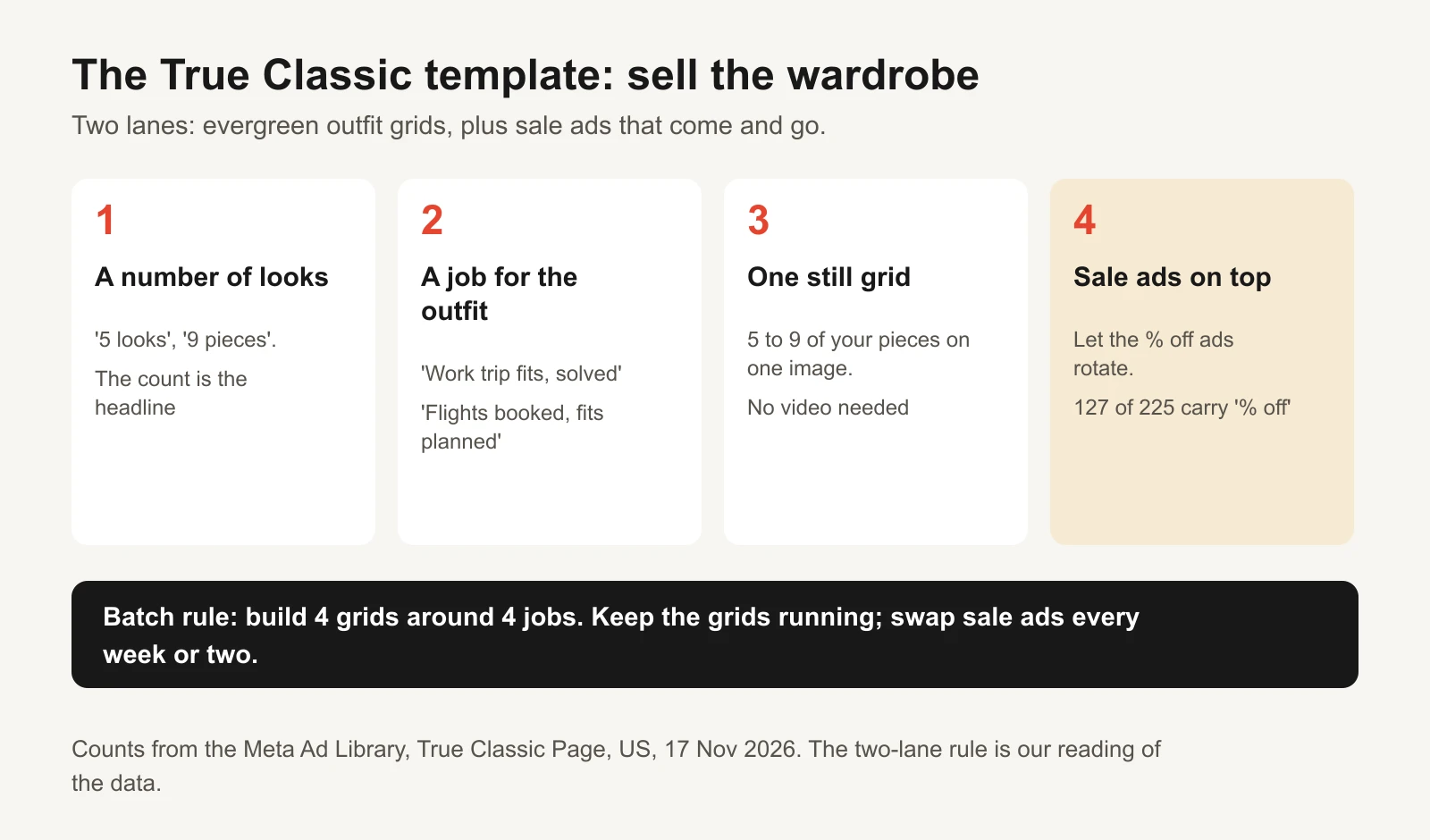
The two-lane rule is our reading of the data, not a stated True Classic policy.
- A number of looks. Put the count in the first line: "5 looks", "6 outfits from 4 pieces", "a week of fits".
- A job for the outfit. The work trip, the wedding guest, the first week back at the office, the weekend away.
- One still grid. Five to nine of your pieces on a clean background, arranged as outfits. No video needed.
- Sale ads on top. Run your discounts as a separate lane that comes and goes. Keep the grids running underneath.
It transfers well beyond men's basics: any brand where buyers combine products (skincare routines, kitchen sets, pet supplies, stationery) can show the set, name the job and put a number on it.
Build your grid in the workbook
The Outfit grid builder prices the wardrobe before you design it:
- List your pieces and prices, and mark which go in the grid with a 1.
- Type the bundle price you'd offer.
- The sheet totals the pieces bought one by one, the saving at your bundle price, how many 3-piece outfits the pieces make, and a headline number to use.
In the fictional example, 8 pieces cost $434 one by one. A $329 bundle saves 24%, and the 8 pieces make 56 possible 3-piece outfits, so the headline could be "8 pieces, 56 outfits". The sheet flags grids with fewer than 4 pieces (reads as a product ad) or more than 9 (hard to see on a phone). That range is our starting point, taken from True Classic's long-runners, and "possible outfits" counts every combination, so treat it as a ceiling.
Then test the grid like any other ad: give it enough spend, judge it on cost per purchase, and if it earns, leave it on. The kill, hold, scale rulebook covers the judging.
Read any competitor the same way
The workbook's Ad log is prefilled with True Classic's five oldest live ads, each with a link. Add a competitor below:
- Open their Page in the Meta Ad Library with active ads, your country and all media selected, and scroll to the end.
- Log each ad's library ID, start date, format, face, angle, offer and first line.
- The Summary tab gives counts by age and format and the share older than 30 days, with a one-line reading. Sort by days running and look at the top five: what a brand keeps running tells you more than what it launched yesterday.
The Ad Library competitor playbook and the winning ad formats teardown go further on reading layouts.
Tools and repos that help
| Tool or repo | What it is for | Who should use it |
|---|---|---|
| Meta Ad Library | Every live ad for a Page, with start dates, formats and versions | Everyone; this teardown is built on it |
| Meta Transparency Center: Ad Library tools | What the library keeps and for how long | Anyone reading "days running" |
| facebookresearch/Ad-Library-API-Script-Repository | Meta's Python examples for the Ad Library API; ordinary product ads only if they reached the EU | Developers |
| anthropics/skills | Public agent skills, including an xlsx skill for spreadsheets like this one | Anyone who wants an assistant to fill in the log |
Or let GaaS run it
GaaS is an AI agent that creates, launches and optimizes Meta and Google ads from three inputs: your website, a spend limit and a one-line goal. It can build outfit-grid statics from your product photos, run them next to your sale ads, judge both on cost per purchase and keep what earns, and nothing spends without your approval. See how GaaS works. Either way, the builder below is yours to keep.