
AG1 sells one product: a daily greens powder, now sold as AG1 Next Gen. It is one of the most advertised supplements in the US. So what does a brand like that actually run on Meta?
Mostly, other people's faces. On 17 November 2026, 10 days before Black Friday, AG1 had 572 Meta ads live in the US. 467 of them ran under a creator's name, not AG1's. And most of those creators were saying the same thing: one line, "Sold out after launch. It's back (for now).", opened 382 of the 572 ads.
That is the lesson worth copying. AG1 doesn't write 572 ideas. It writes one message and has hundreds of people say it. This teardown shows what we found, how the parts fit, and a template and creator roster to run the same system on a smaller budget.
How we read the library, and what it can't tell you
We opened AG1's Page in the Meta Ad Library on 17 November 2026, signed in, with the US, active ads and all media selected, and scrolled to the end. 572 ad cards loaded. The library's header said "~1,000 results", because it counts every version of an ad; 90 of the 572 cards held several versions. We counted cards. For each card we logged the start date, format, advertiser line, opening line and keywords in the copy.
Three limits before any conclusion:
- Live ads only. Outside the EU, Meta's library shows ads that are running now. Ads about social issues, elections or politics stay for seven years, and ads that delivered in the EU stay for a year after their last impression, but ordinary US product ads disappear when they stop (Meta Transparency Center: Ad Library tools). "118 days" means "still running after 118 days", not AG1's longest-ever ad.
- No results. The library shows no spend, sales or ROAS for these ads. We can see what AG1 keeps paying to run, not what earns.
- Keyword counts are text searches. "21 ads say '% off'" means the string "% off" appears in the copy. An offer worded another way isn't counted.
Finding 1: 82% of the ads run under a creator's name
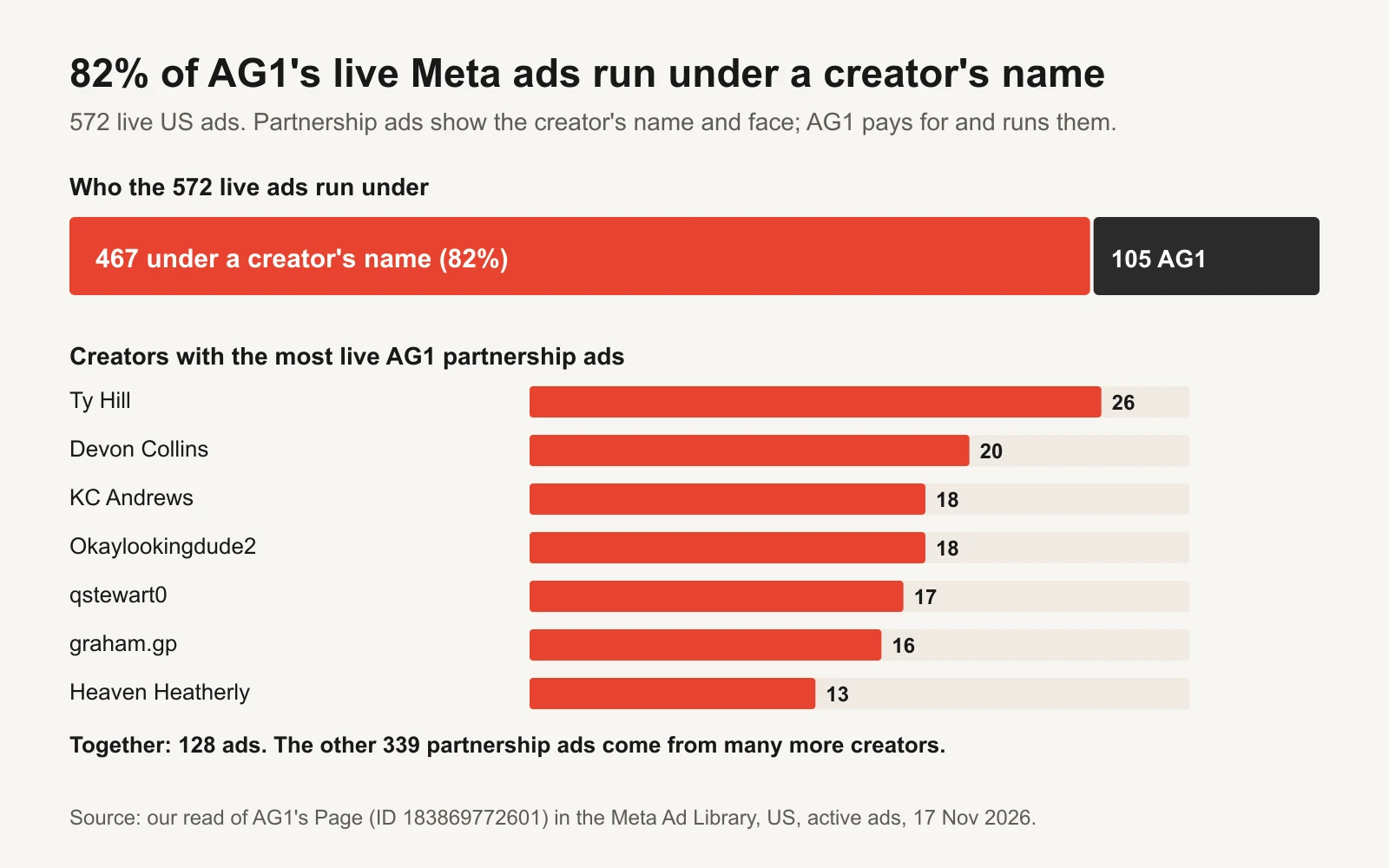
Seven creators carry 128 ads. The long tail carries 339.
467 of the 572 live ads are partnership ads: the advertiser line reads "Ty Hill with AG1", "Devon Collins with AG1" and so on. These are not ads the creators run on their own. AG1 pays for them and runs them, but the ad shows the creator's name and face at the top, the way a post from someone you follow would. AG1's own page runs the other 105.
| Creator (advertiser line "X with AG1") | Live ads |
|---|---|
| Ty Hill | 26 |
| Devon Collins | 20 |
| KC Andrews | 18 |
| Okaylookingdude2 | 18 |
| qstewart0 | 17 |
| graham.gp | 16 |
| Heaven Heatherly | 13 |
| All other creators | 339 |
Two things stand out. First, nobody dominates: the top creator runs 26 of 467, under 6%. AG1 spreads the message across a long list of faces rather than one celebrity. Second, almost all of it is video: 535 of the 572 ads. Creator ads are mostly someone talking to a phone camera.
Finding 2: one line, 382 times
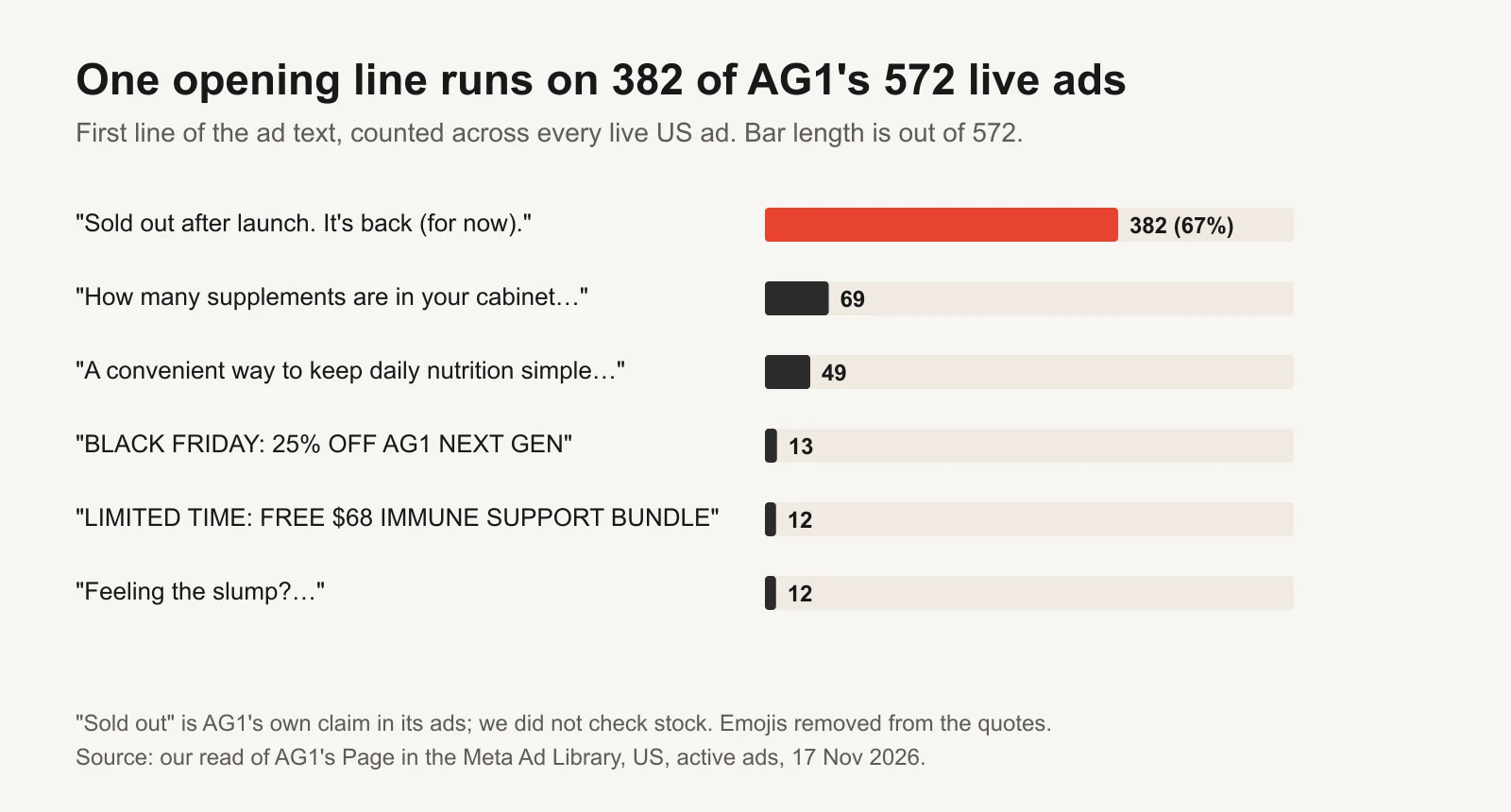
The faces change; the first line mostly doesn't.
The full line reads: "Sold out after launch. It's back (for now). Built on the clinically backed AG1 Next Gen fo[rmula]…". It opens 382 ads, 67% of everything live. "Sold out" is AG1's claim in its own ads; we did not check its stock.
| Opening line | Ads | What it does |
|---|---|---|
| "Sold out after launch. It's back (for now)…" | 382 | Proof of demand plus a reason to act now |
| "How many supplements are in your cabinet right now?…" | 69 | A problem the buyer can see at home |
| "A convenient way to keep daily nutrition simple…" | 49 | The plain benefit |
| "BLACK FRIDAY: 25% OFF AG1 NEXT GEN. The best offer we've had all year." | 13 | The seasonal offer |
| "LIMITED TIME: FREE $68 IMMUNE SUPPORT BUNDLE" | 12 | A gift instead of a discount |
| "Feeling the slump?…" | 12 | A named moment in the day |
The keyword counts tell the same story. 408 ads use "sold out" or "limited" wording, 134 mention the subscription and 80 mention stars or reviews. Only 21 say "% off" and 34 mention Black Friday or the holidays. Ten days out, AG1's main message was scarcity, not a sale.
Finding 3: almost everything is less than a week old
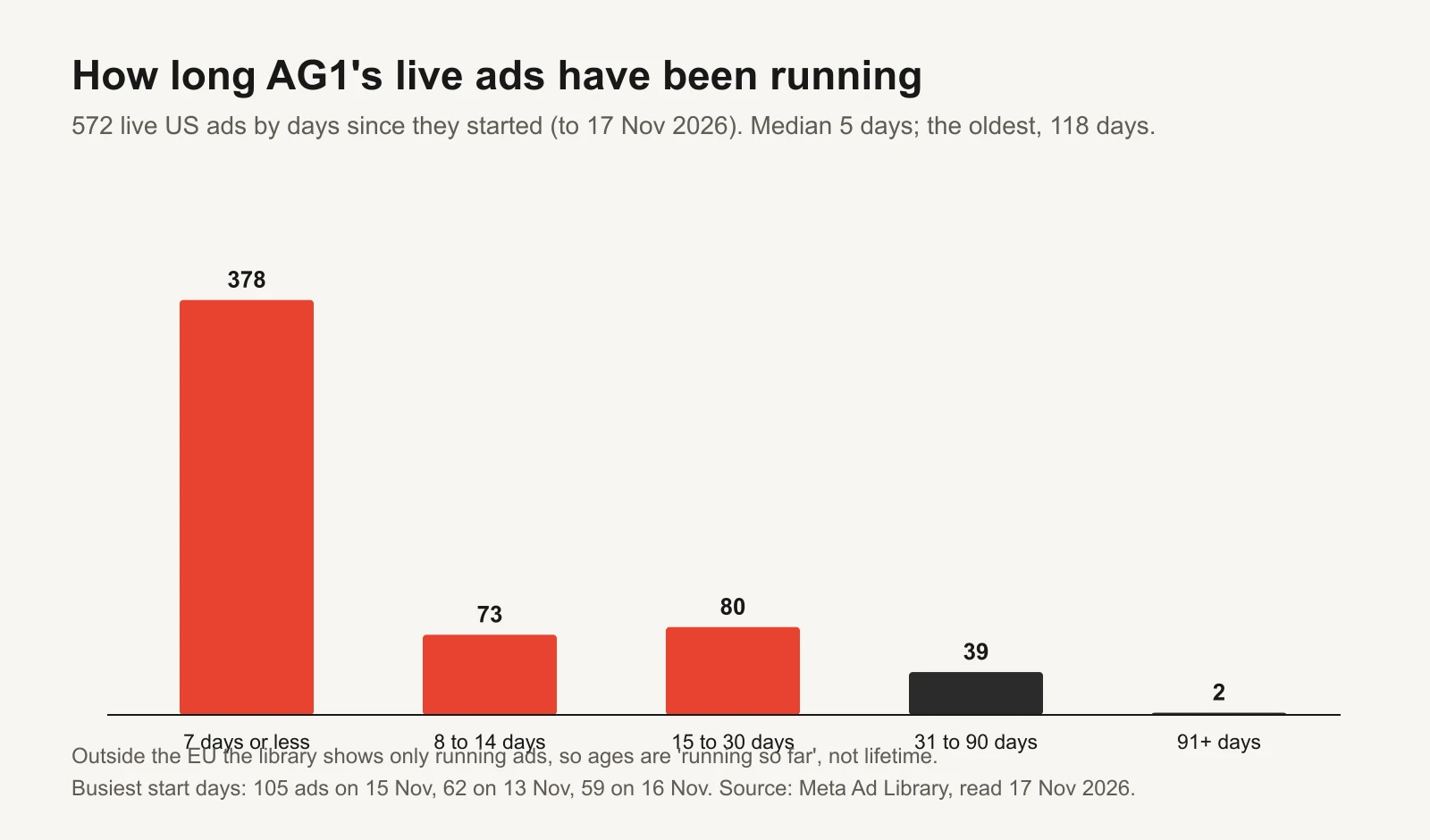
378 of 572 ads started in the last seven days.
The median live ad was 5 days old, and nine in ten were 27 days old or younger. The busiest start days were 15 November (105 ads), 13 November (62), 16 November (59), 14 November (53) and 12 November (43). Like Grüns, AG1 ships in batches and keeps few ads for long.
The few long-runners are telling. The oldest, live 118 days since 22 July, is an audience offer: "Military and First Responders get 25% off AG1". Then a gummies ad for parents ("Your kids have theirs. Here's yours.", 97 days), a 90-day habit image ("90 Days of AG1. Lock In. Level Up.", 83 days) and the "Feeling the slump?" image (83 days). Each speaks to one specific person or moment.
Where AG1 sits among five brands
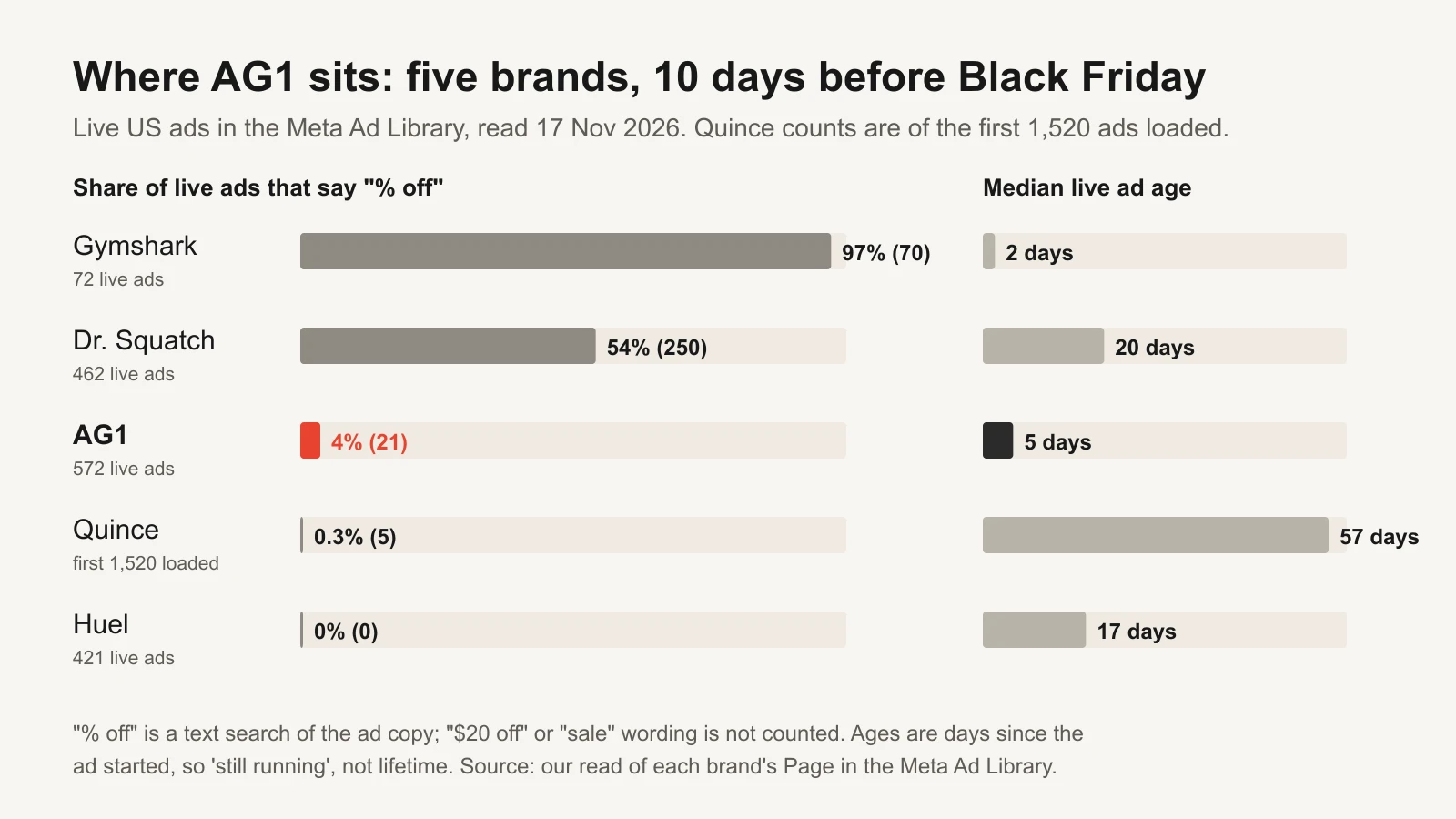
Same day, five different answers to "what do we run before Black Friday?"
We read four other brands the same day. AG1 is among the freshest (median 5 days, behind only Gymshark's 2) and among the least discount-led (4% say "% off"). It is also the only one where creators carry most of the ads: Dr. Squatch runs zero partnership ads and Huel runs 98, 57 of them with one celebrity.
How AG1 runs Meta: five moves
1. Write one message, not 572. The "sold out, it's back" line works as both proof (people bought it all) and urgency (it may go again). Everything else is a version of it.
2. Have many people say it. A message heard from 100 different faces doesn't tire the way one ad does. Each creator brings a slightly different viewer, voice and setting, so each partnership ad is effectively a new creative for the algorithm.
3. Run creator videos as partnership ads. The creator's name in the header makes the ad look like a post, not a brand ad. AG1 still controls the budget, targeting and landing page.
4. Refresh constantly. 378 ads in a week means AG1 is not waiting for ads to tire. It adds new creators and new cuts every few days. See creative fatigue vs saturation for why the refresh pays.
5. Keep the brand page for offers and specific people. The military and first-responder offer, the parents' gummies, the Black Friday 25% and the free bundle run in a brand voice. The creators carry the main message.
Copy the system: the AG1 template
| Part | AG1 example | Write yours |
|---|---|---|
| 1. One message everyone repeats | "Sold out after launch. It's back (for now)." on 382 ads | Your strongest true claim: demand, a result, a number |
| 2. Many faces saying it | 467 partnership ads; Ty Hill 26, Devon Collins 20, KC Andrews 18 | 5 to 20 creators or customers who agree to it |
| 3. A reason to act now | Back "for now"; a limited free bundle; 25% off for Black Friday | Only what is true on the day the ad runs |
| 4. The proof behind it | "Built on the clinically backed AG1 Next Gen fo[rmula]…" | A study, a spec, a guarantee you can show |
Two cautions. Partnership ads need the creator's permission and run with a paid-partnership label; never put someone's face on an ad they didn't agree to. And scarcity must be true: "sold out" and "back for now" only while they are. The FTC's 2022 staff report on manipulative design lists false scarcity and fake countdowns among the patterns it calls deceptive (FTC, Bringing Dark Patterns to Light).
Run it on your budget: the creator roster
You don't need 467 ads. The workbook's Creator roster tab runs the same idea at small scale:
- Set three numbers: your target CPA (cost per purchase), the minimum spend before judging a video (as a multiple of target CPA) and the flat fee you pay per creator video.
- List your creators and how many videos each makes. The sheet totals the fees and the test spend you need to judge every video.
- At day 14, type spend and purchases per creator. Each row is marked: re-brief for more videos, too early to judge, or stop (no sales, or CPA over target). It also shows cost per sale including the creator's fee, which Ads Manager doesn't see.
In the fictional example, 8 creators make 16 videos at $150 each ($2,400 in fees) and need $1,080 of test spend to judge them at a $45 target CPA. At day 14, 2 creators earn a re-brief, 4 are stopped and 2 need more spend. Creator A, at $37 CPA ($78 a sale including fees), gets the next three briefs.
Brief every creator with the same message and let them say it their way. That is the AG1 move: the variable is the face, not the claim. The kill, hold, scale rulebook covers judging small numbers, and testimonial ads that don't feel cringe covers the briefs.
Read any competitor the same way
The workbook's Ad log is prefilled with AG1's five oldest live ads, each with a library link. Add your competitor below:
- Open their Page in the Meta Ad Library with US, active ads and all media selected, and scroll to the end.
- For each live ad, log the library ID, start date, advertiser line, format, face, angle, offer and first line. Set the check date at the top.
- The Summary tab counts ads by age, format and face, and the share older than 14 days. Log at least 20 ads before you read it. Under 20% older than two weeks means the brand replaces ads fast; over half means it keeps winners.
One extra column for AG1-style brands: count the advertiser lines that say "X with [brand]". That share tells you how much of their reach rides on other people's faces. The Ad Library competitor playbook turns what you find into briefs that are yours.
Tools and repos that help
| Tool or repo | What it is for | Who should use it |
|---|---|---|
| Meta Ad Library | Every live ad for a Page, with start dates, versions and advertiser lines | Everyone; this teardown is built on it |
| Meta Transparency Center: Ad Library tools | What the library keeps, for how long, and the research tools around it | Anyone reading "days running" |
| facebookresearch/Ad-Library-API-Script-Repository | Meta's Python examples for the Ad Library API. Ordinary product ads come back only if they reached the EU | Developers tracking EU ads |
| anthropics/skills | Public agent skills, including an xlsx skill so Claude can read and fill a tracker like this one | Anyone who wants an assistant to log ads or draft briefs |
Or let GaaS run it
GaaS is an AI agent that creates, launches and optimizes Meta ads from three inputs: your website, a spend limit and a one-line goal. It writes ads in batches around one message, tests them, keeps what earns and replaces the rest, and nothing spends without your approval. If you would rather review batches than brief them, see how GaaS works. Either way, the workbook below is yours to keep.