
Huel sells complete-nutrition shakes, powders and meals. Ten days before Black Friday, most brands' ads are counting down to a sale. So what is Huel running?
We searched all 421 of Huel's live US Meta ads for "% off". Zero results. "Black Friday": zero. "Free shipping": zero. On 17 November 2026, not one Huel ad mentioned a discount.
What Huel runs instead is evidence. The line it uses most, on 86 ads, opens with a study: "We asked people to add Huel to their routine for 6 weeks…". That is the lesson worth copying: when your product needs belief more than a deal, put the proof first. This teardown shows what we found, the parts, and a workbook with a template and the maths on what a discount would have to win back.
How we read the library, and what it can't tell you
We opened Huel's US Page in the Meta Ad Library on 17 November 2026, signed in, with the US, active ads and all media selected, and scrolled to the end. 421 ad cards loaded; the header said "~450 results", because it counts versions (209 of the 421 cards held several). For each card we logged the start date, format, advertiser line, opening line and keywords.
Three limits:
- Live ads only. Outside the EU, Meta's library shows ads that are running now; ordinary US product ads disappear when they stop (Meta Transparency Center: Ad Library tools). "248 days" means "still running after 248 days".
- No results. The library shows no spend, sales or ROAS. We see what Huel keeps paying to run, not what earns.
- Ads, not the store. "Not one ad mentions a discount" is a text search of the ad copy. A sale could still run on huel.com, or start later, without being in these ads. We also quote the study line as the ads say it; we did not check the study.
Finding 1: zero discounts, 10 days out
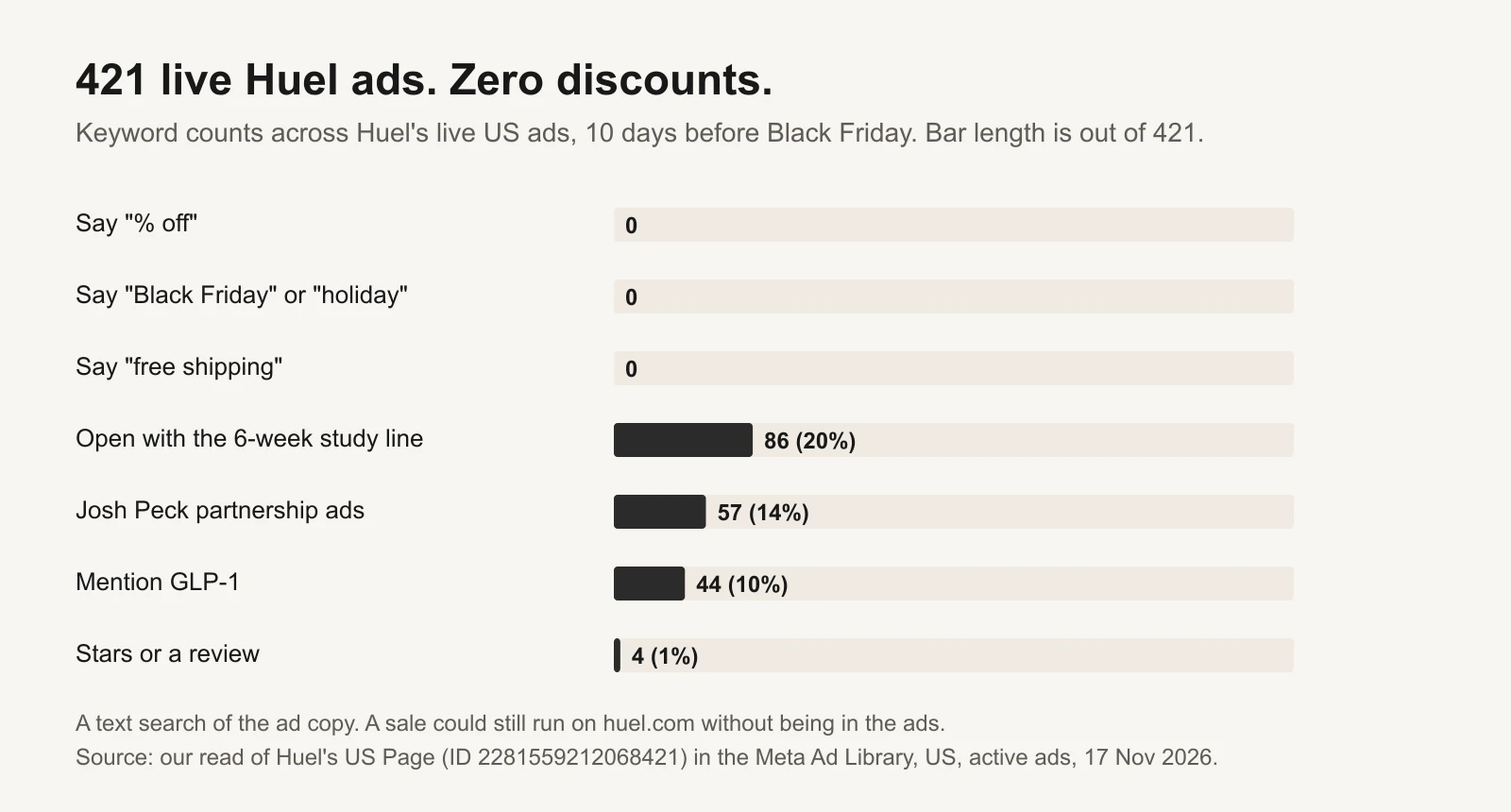
Three searches, three zeros. The study line alone is on one ad in five.
Huel is not quiet: 421 live ads, 248 of them video. It just doesn't use them for price. Even reviews and star ratings, the usual stand-in for proof, appear on only 4 ads. Huel's proof is a study, a number and a face.
Finding 2: a study, a problem, an objection
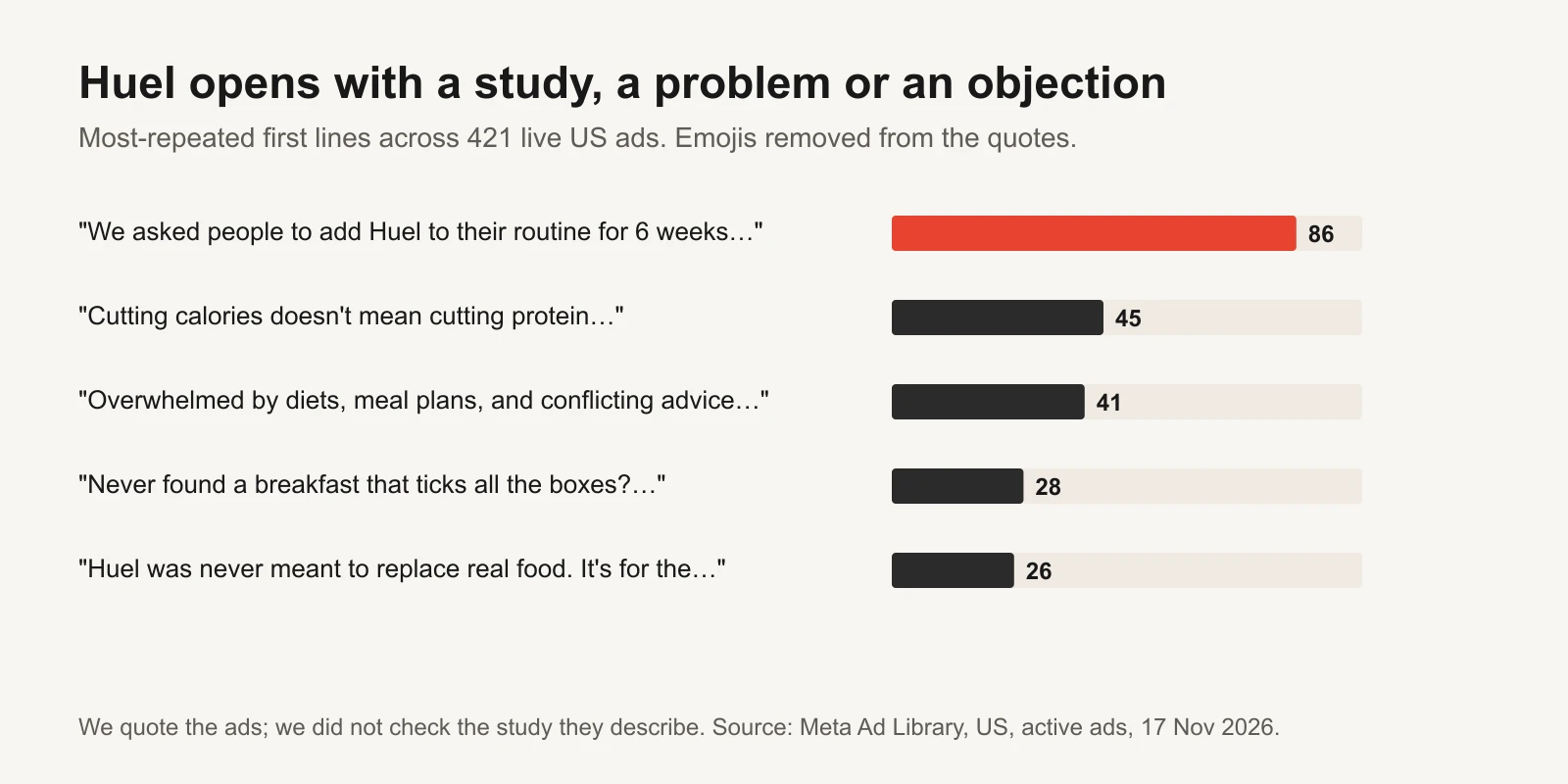
Each top line does a different job: prove, name the problem, answer the doubt.
| Opening line | Ads | Job |
|---|---|---|
| "📊 We asked people to add Huel to their routine for 6 weeks…" | 86 | Evidence |
| "📉 Cutting calories doesn't mean cutting protein…" | 45 | A problem the buyer has (dieting) |
| "😩 Overwhelmed by diets, meal plans, and conflicting advice…" | 41 | A feeling the buyer has |
| "Never found a breakfast that ticks all the boxes?…" | 28 | A moment in the day |
| "Huel was never meant to replace real food. It's for the…" | 26 | The biggest objection, answered |
The last one is worth noticing. "Isn't this just a meal replacement?" is the doubt that stops people buying a shake. Huel states it in the first line and answers it, instead of hoping the buyer doesn't think of it.
Two specific audiences run through the copy too: 44 ads mention GLP-1, the same named situation Grüns targets, and the oldest ads speak to weight loss.
Finding 3: Huel keeps its winners
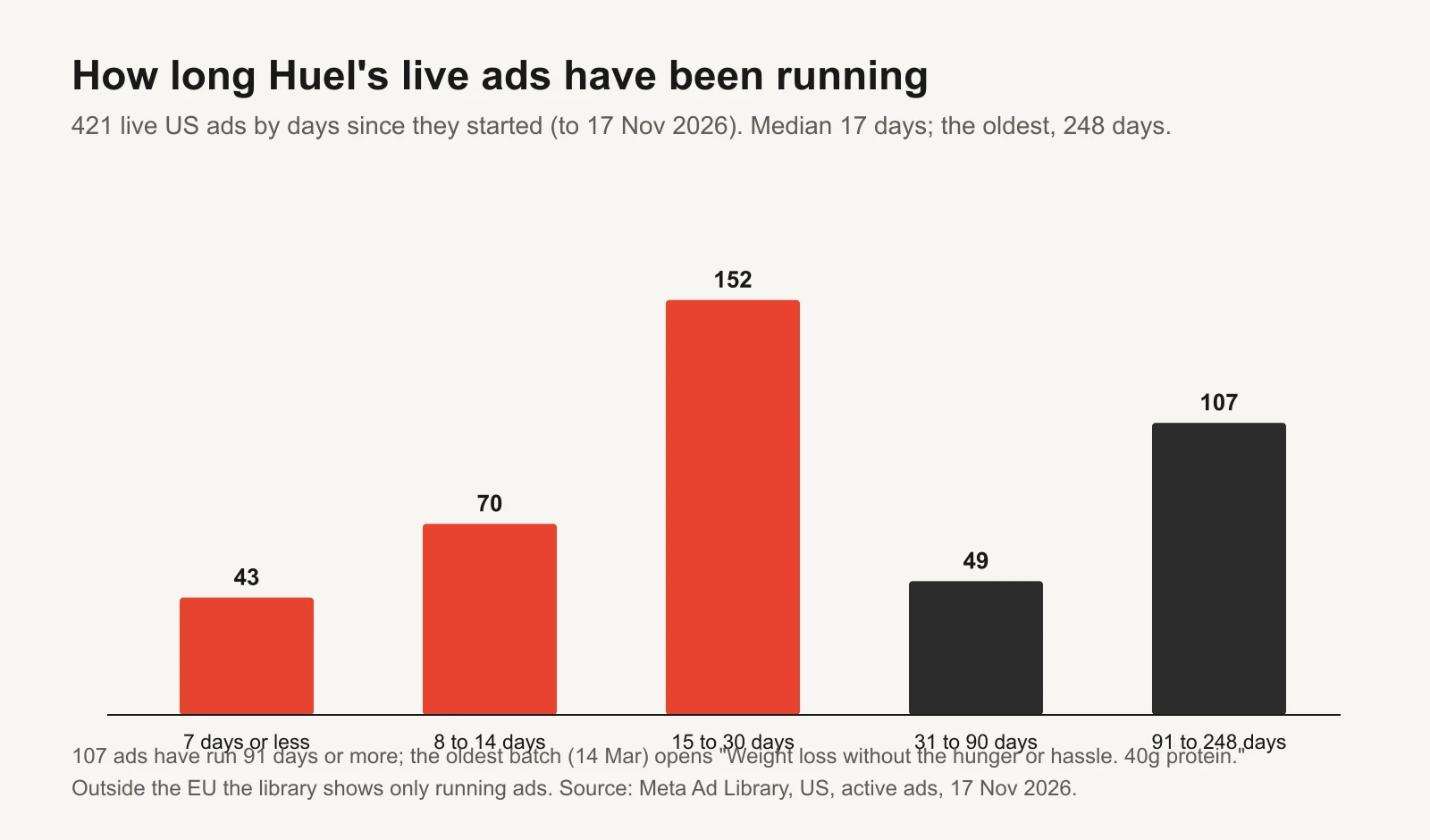
One ad in four has run more than three months.
The median live ad is 17 days old, but the tail is long: 107 ads have run 91 to 248 days. The oldest batch, at least five ads started 14 March, opens "Weight loss without the hunger or hassle. 40g protein." One benefit, one number.
| Started | Days running (to 17 Nov) | First line | Library link |
|---|---|---|---|
| 14 Mar | 248 | "Weight loss without the hunger or hassle. 40g protein." | Ad |
| 14 Mar | 248 | Same line | Ad |
| 14 Mar | 248 | Same line | Ad |
| 14 Mar | 248 | Same line | Ad |
| 14 Mar | 248 | Same line | Ad |
New batches keep coming on top (96 ads started on 2 November, 41 on 9 November, 41 on 13 November), but Huel doesn't throw out what still works.
The face is consistent too. 98 ads are partnership ads, and 57 of those are with one person: actor Josh Peck. Where AG1 spreads 467 partnership ads across hundreds of creators, Huel puts most of its partnership weight on one recognisable face.
Where Huel sits among five brands
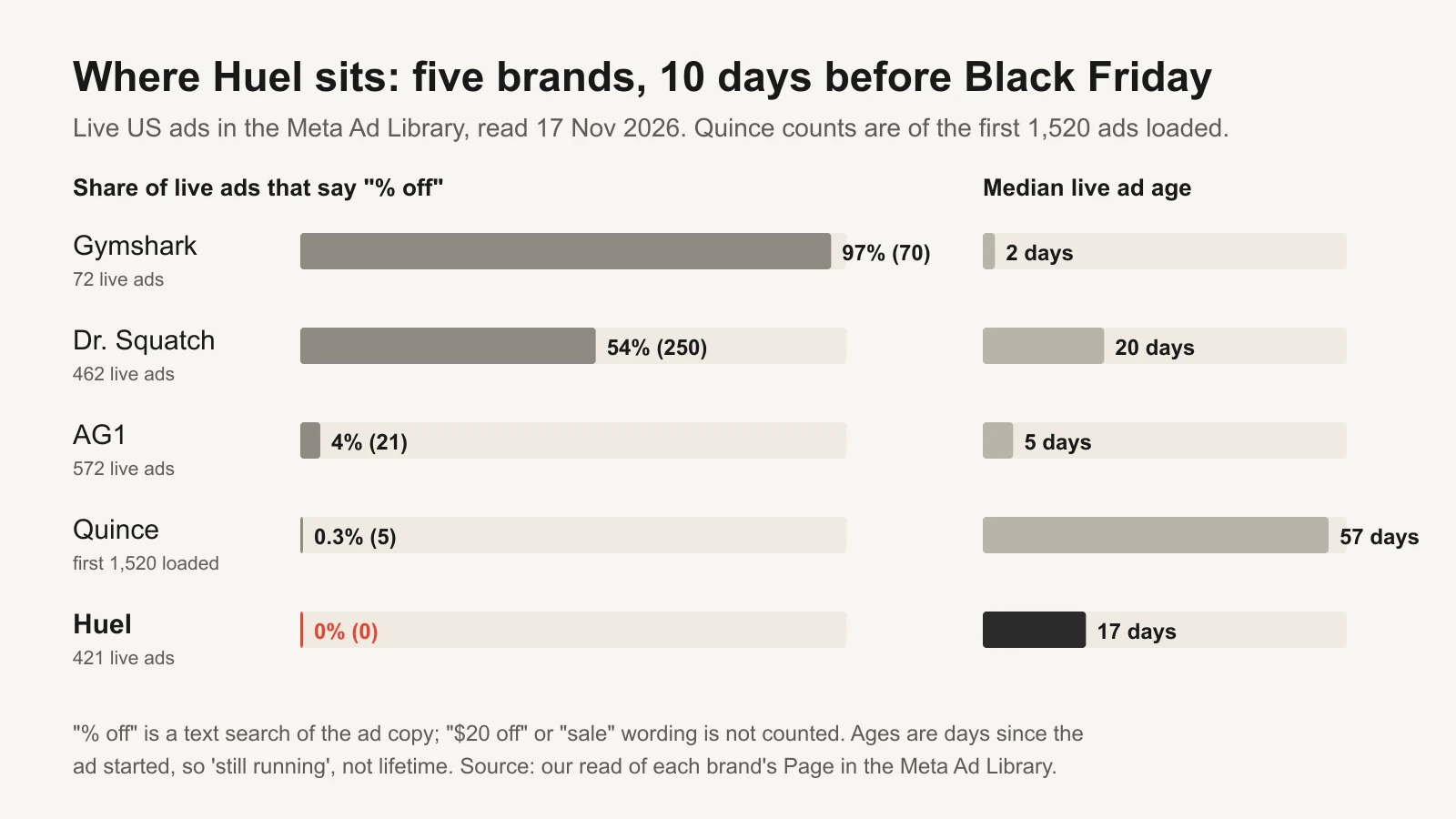
Huel is the only one of the five with no "% off" at all.
On the same day, Gymshark had "% off" on 70 of 72 ads and Dr. Squatch on 250 of 462. Quince had 5 in 1,520. Huel had none.
How Huel sells without a sale: five moves
1. Lead with evidence. A study, described in the first line, does what a discount does for other brands: it gives a reason to try now.
2. Name the problem in the buyer's words. "Cutting calories doesn't mean cutting protein" and "Overwhelmed by diets" are things buyers say, not product features.
3. Answer the biggest objection out loud. "Huel was never meant to replace real food" removes the doubt before it stops the sale.
4. One number per ad. "40g protein" on the longest-running ads. Not a nutrition label; one figure that sticks.
5. One face, used a lot, and winners kept. Josh Peck on 57 ads, and 107 ads past three months.
Copy the system: the Huel template
| Part | Huel example | Write yours |
|---|---|---|
| 1. Evidence first | "We asked people to add Huel to their routine for 6 weeks…" (86 ads) | A study, trial or customer survey you can describe honestly |
| 2. A problem in the buyer's words | "Cutting calories doesn't mean cutting protein…" | What your buyer says before they find you |
| 3. The objection, answered | "Huel was never meant to replace real food. It's for the…" | The doubt that stops people buying |
| 4. One number | "40g protein" | The one figure that matters |
| Face | Josh Peck, 57 ads | One recurring face, with their agreement |
Evidence brings its own rules. If an ad describes a study or a health result, you need to be able to substantiate it, and health claims about weight need particular care. Use your own studies and survey numbers, describe them as they were run, and never borrow another brand's.
Should you discount at all? The discount maths
The workbook's Discount maths tab shows what a discount has to win back before it pays:
- Type your price, your gross margin and your weekly orders without a discount.
- Read each discount row. It shows profit per order after the discount, the orders you'd need for the same weekly profit, and the extra orders that means.
- Read the verdict: reachable, needs 50% more orders, needs more than double, or every order loses money.
In the fictional example, a $60 product at 55% margin makes $33 an order and $6,600 a week on 200 orders. A 10% discount needs 22% more orders to make the same profit. 20% off needs 57% more. 30% off needs 120% more: more than double. At 50% off the brand keeps $3 an order and needs 11 times the orders.
That is the maths Huel's ads suggest it has already done. If your extra-orders number looks out of reach, put the effort into proof instead: a study, a number, a face. The economics of promotional discounts goes deeper, and testimonial ads that don't feel cringe covers making proof watchable.
Read any competitor the same way
The workbook's Ad log is prefilled with Huel's five oldest live ads, each with a library link. Add your competitor below:
- Open their Page in the Meta Ad Library with US, active ads and all media selected, and scroll to the end.
- For each live ad, log the library ID, start date, format, face, angle, offer and first line. Set the check date at the top.
- The Summary tab counts ads by age, format and face, and gives the share older than 14 days. Log at least 20 ads before reading it.
Then use the library's search box on their Page: "% off", "Black Friday", "free shipping". Three zeros, like Huel's, tell you a competitor sells on something other than price, and the opening lines tell you what. The Ad Library competitor playbook covers turning that into briefs that are yours.
Tools and repos that help
| Tool or repo | What it is for | Who should use it |
|---|---|---|
| Meta Ad Library | Every live ad for a Page, with start dates, versions and a search box | Everyone; this teardown is built on it |
| Meta Transparency Center: Ad Library tools | What the library keeps and for how long | Anyone reading "days running" |
| facebookresearch/Ad-Library-API-Script-Repository | Meta's Python examples for the Ad Library API. Ordinary product ads come back only if they reached the EU | Developers tracking EU ads |
| anthropics/skills | Public agent skills, including an xlsx skill so Claude can fill the tracker | Anyone who wants an assistant to do the logging |
Or let GaaS run it
GaaS is an AI agent that creates, launches and optimizes Meta ads from three inputs: your website, a spend limit and a one-line goal. It writes ads from your real proof, tests them, keeps what earns and replaces the rest, and nothing spends without your approval. If you would rather review ads than write them, see how GaaS works. Either way, the workbook below is yours to keep.