
Quince sells cashmere, silk, linen and leather at prices well below the luxury brands it compares itself to. Ten days before Black Friday, nearly every store is shouting a percentage. So how loud is Quince?
Barely. On 17 November 2026 we loaded 1,520 of Quince's live US Meta ads, and the library still had more. Of those 1,520, only 5 said "% off". Quince's own line instead: "Competitors marked it down. We never marked it up."
That is the lesson. When your everyday price is the offer, a discount weakens it. Quince runs ads about why things cost what they cost, compares itself to other brands' sale prices, gives free shipping and keeps its winners running for months. This teardown shows what we found, the parts, and a template and checker to make the same kind of price claim honestly.
How we read the library, and what it can't tell you
We opened Quince's Page in the Meta Ad Library on 17 November 2026, signed in, with the US, active ads and all media selected, and scrolled. Quince is the biggest account we have read. Our scan stopped at its 1,500-card cap after 1,520 ad cards; the library's header showed "~5,700 results", a count that includes every version of each ad (1,497 of our 1,520 cards held several). Every count below is "of the first 1,520", which loaded in the library's impressions order.
Three more limits:
- Live ads only. Outside the EU, Meta's library shows ads that are running now; ordinary US product ads disappear when they stop (Meta Transparency Center: Ad Library tools). "269 days" means "still running after 269 days".
- No results. The library shows no spend, sales or ROAS. We see what Quince keeps paying for, not what earns.
- Keyword counts are text searches. "5 say '% off'" means 5 contain that string. "$20 off" or "sale" wording isn't counted. So this is not "5 ads have a discount"; it is "5 ads lead with a percentage".
Finding 1: price is the message, a discount isn't
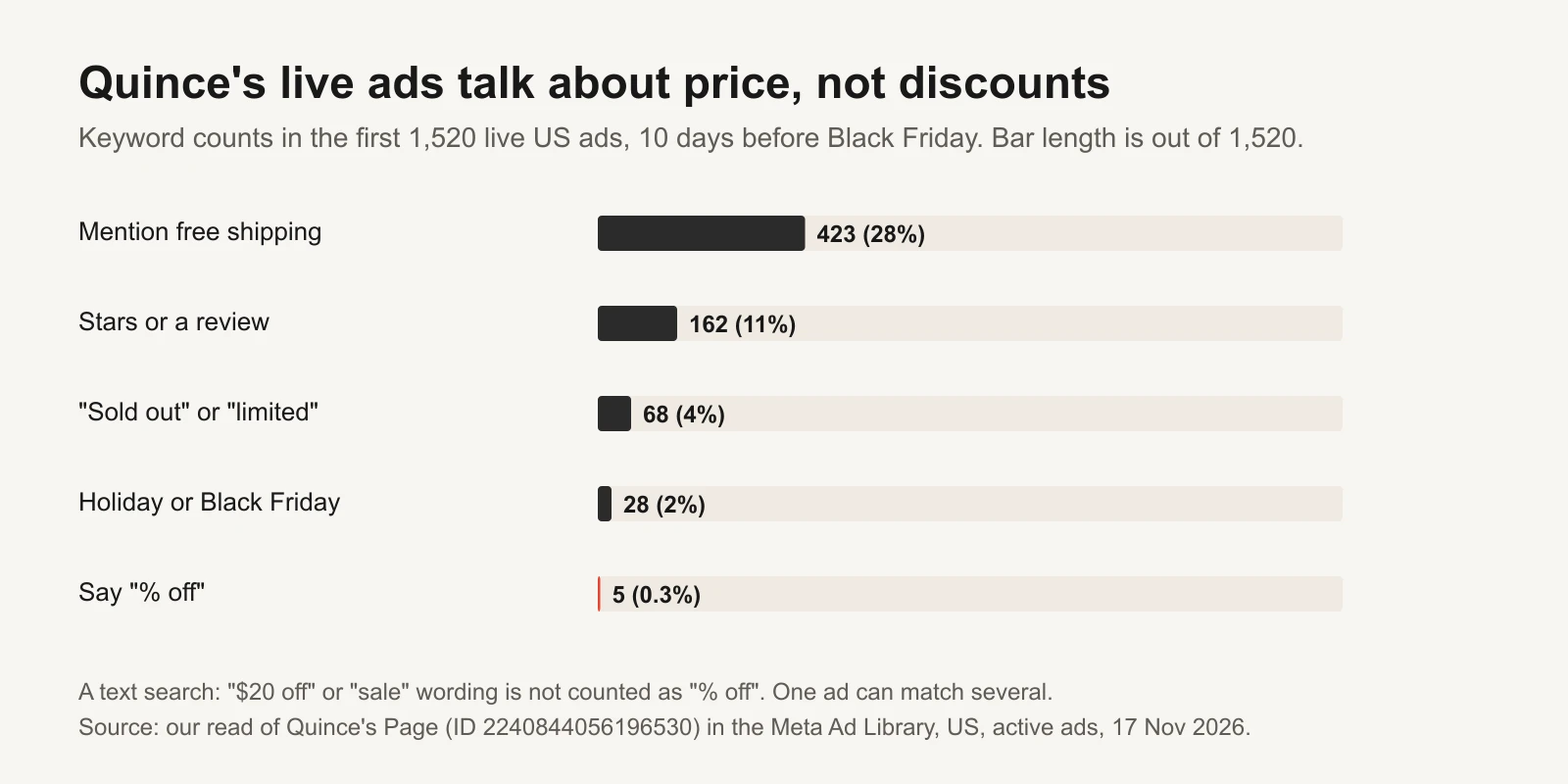
Free shipping appears 85 times as often as "% off".
Five "% off" ads in 1,520, and 28 that mention the holidays or Black Friday. What Quince says instead is that its price is already low, and why. Two image ads from 9 July, both still live:
| Started | Days running (to 17 Nov) | Format | Line | Library link |
|---|---|---|---|---|
| 9 Jul | 131 | Image | "Competitors marked it down. We never marked it up." | Ad |
| 9 Jul | 131 | Image | "Their best sale price is still more than ours." | Ad |
| 9 Jul | 131 | Image | "Everyday luxury for everyone." | Ad |
The first two turn everyone else's Black Friday into Quince's ad. Every competitor discount makes the line more relevant, and Quince doesn't have to change a word.
Finding 2: the top opening is a question about price
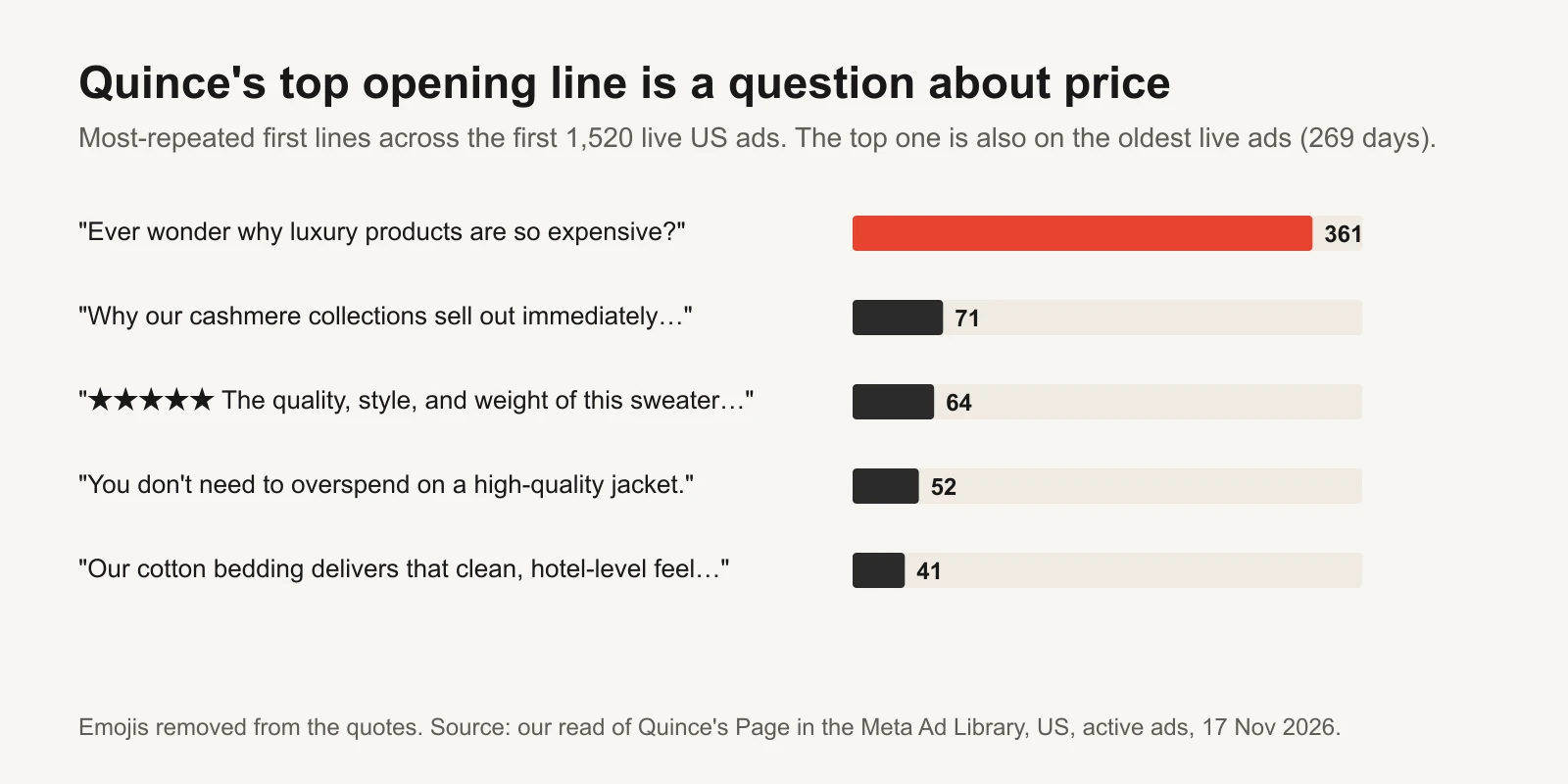
The most-run line asks the buyer to think about price before they see one.
"Ever wonder why luxury products are so expensive?" opens 361 ads, and it is also on the oldest live ads: two videos started 21 February (Ad, Ad), 269 days before we looked. The answer the ads go on to give is Quince's whole pitch: the same quality without the markup.
The other top openings each do one job: scarcity and demand ("Why our cashmere collections sell out immediately", 71), proof ("★★★★★ The quality, style, and weight of this sweater…", 64), permission not to overspend ("You don't need to overspend on a high-quality jacket.", 52) and a sensory benefit ("hotel-level feel", 41).
Finding 3: Quince keeps its ads
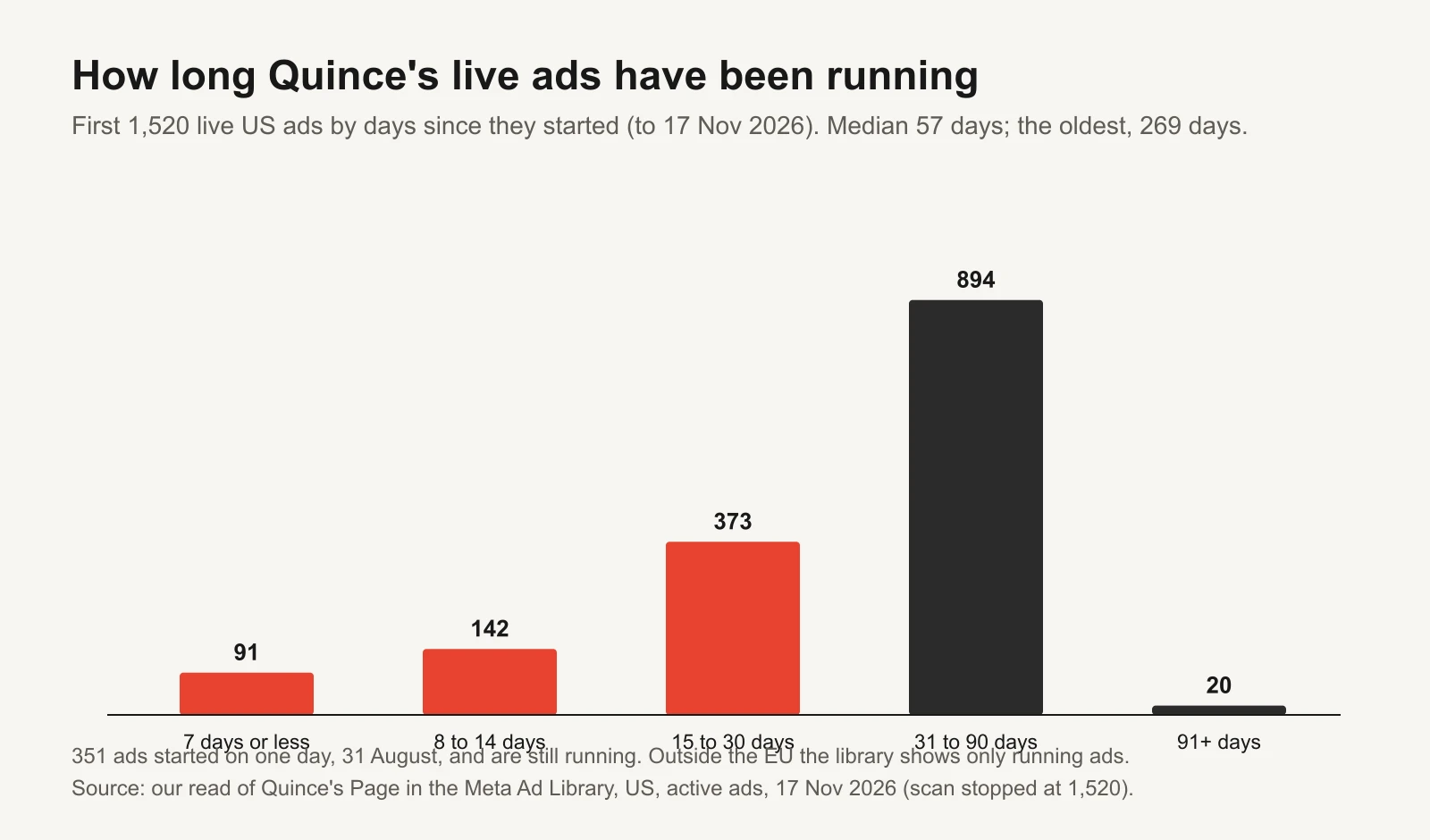
894 of 1,520 have run one to three months.
The median live ad was 57 days old. That is the opposite of Grüns or AG1, whose median ads were days old. Quince still launches big batches (351 live ads started on one day, 31 August; 108 on 1 September; 104 on 28 October) but then lets them run. An evergreen price story doesn't expire on 1 December, so neither do the ads.
Where Quince sits among five brands
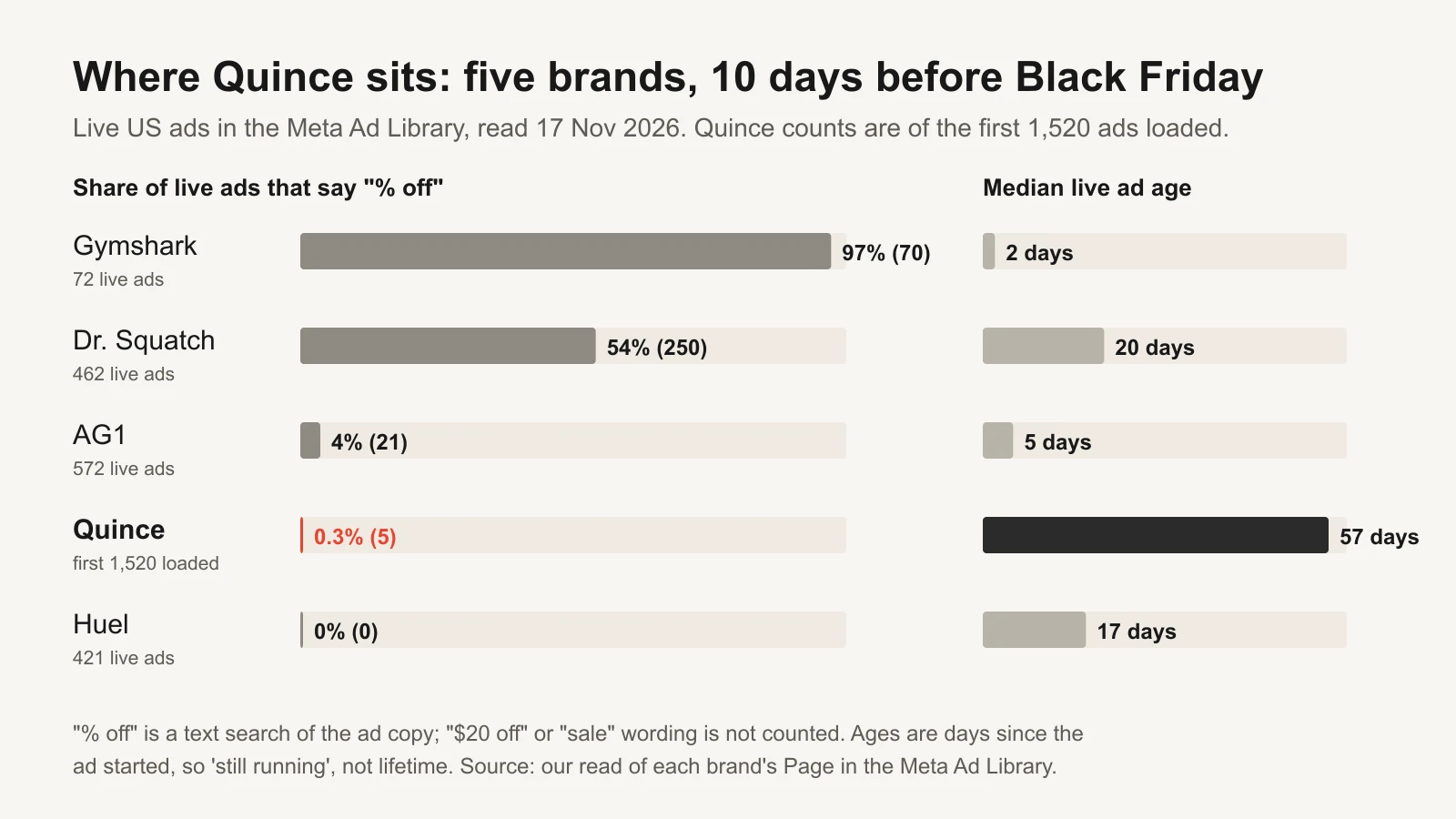
Quince has the oldest ads of the five and almost no percentages.
On the same day Gymshark had "% off" on 70 of 72 ads and Dr. Squatch on 250 of 462. Quince and Huel went the other way. Neither leads with a deadline: Quince sells an everyday price, Huel sells proof.
How Quince sells without a sale: five moves
1. Make the price the story. "Ever wonder why luxury products are so expensive?" invites the buyer to do the maths before Quince shows a number.
2. Compare against their sale, not their full price. "Their best sale price is still more than ours." is a stronger claim than "50% less than retail", and it gets stronger every time a competitor discounts.
3. Remove the last cost instead of cutting the price. Free shipping appears on 423 ads. It answers the "what will this really cost me" question without touching the price.
4. Prove quality with buyers' words. 162 ads mention stars or reviews, and 64 open with a five-star review about a sweater's quality and weight.
5. Keep what works. A price story is evergreen, so the ads are too: median 57 days, oldest 269.
Copy the system: the Quince template
| Part | Quince example | Write yours |
|---|---|---|
| 1. A question about price | "Ever wonder why luxury products are so expensive?" (361 ads) | Why does your category cost what it costs? |
| 2. The comparison | "Competitors marked it down. We never marked it up." / "Their best sale price is still more than ours." | Only with prices you can show |
| 3. Proof of quality | Five-star review on a sweater's "quality, style, and weight" (64 ads) | A real review with a first name |
| 4. Remove the last cost | Free shipping (423 ads) | Free shipping, free returns, a guarantee |
The caution matters here more than anywhere: a price comparison is a factual claim. The FTC's Guides Against Deceptive Pricing include a section on retail price and comparable value comparisons. Compare against real prices for the same kind of product, offered in your market. Keep the evidence.
Check your own claim: the price-comparison tab
The workbook's Price comparison tab tells you whether you can run a Quince-style line:
- Set a minimum gap (10% in the example). A claim that rests on a $2 difference won't survive a buyer checking.
- List your products with your price, a competitor's full price and their best sale price for a comparable product.
- Read the verdict per row: cheaper than their best sale price (make the claim), cheaper but the gap is thin (soften it), or their sale beats you (drop the claim).
In the fictional example, three of five products clear the bar: a $50 sweater against a competitor's $112 sale price (55% less), a $120 duvet set against $240 (50% less) and a $40 tee against $60 (33% less). The $200 jacket is only 5% under a $210 sale price, so it gets a softer line. The $45 pillowcase is beaten by a $42 sale, so it gets none.
If you discount instead, run the numbers first: the economics of promotional discounts and the Black Friday ad playbook show what a percentage costs in margin.
Read any competitor the same way
The workbook's Ad log is prefilled with Quince's five oldest live ads, each with a library link. Add your competitor below:
- Open their Page in the Meta Ad Library with US, active ads and all media selected, and scroll to the end. For a very large account, note how many cards you loaded and say "of the first N".
- For each live ad, log the library ID, start date, format, face, angle, offer and first line. Set the check date at the top.
- The Summary tab counts ads by age, format and face, and gives the share older than 14 days. Log at least 20 ads before reading it. Over half older than two weeks means the brand keeps winners, so study its long-runners.
Then search their copy for "% off", "sale" and "free shipping" in the library's search box. The ratio tells you whether they compete on discounts or on price. The Ad Library competitor playbook covers turning that into your own briefs.
Tools and repos that help
| Tool or repo | What it is for | Who should use it |
|---|---|---|
| Meta Ad Library | Every live ad for a Page, with start dates and versions | Everyone; this teardown is built on it |
| Meta Transparency Center: Ad Library tools | What the library keeps and for how long | Anyone reading "days running" |
| FTC Guides Against Deceptive Pricing (16 CFR 233) | The US rules on former-price and competitor-price comparisons | Anyone writing a price comparison |
| anthropics/skills | Public agent skills, including an xlsx skill so Claude can fill the tracker or checker | Anyone who wants an assistant to do the logging |
Or let GaaS run it
GaaS is an AI agent that creates, launches and optimizes Meta ads from three inputs: your website, a spend limit and a one-line goal. It writes ads from your real prices and proof, tests them, keeps what earns and replaces the rest, and nothing spends without your approval. If you would rather review ads than write them, see how GaaS works. Either way, the workbook below is yours to keep.